
YouTube Algorithm: 7 Powerful Ways to Grow Your Channel in 2026
If you are creating videos but wondering why some receive hundreds or thousands of views while others barely move, the YouTube algorithm is an important concept to understand. But there is one common misconception: YouTube does not simply “push” videos because an algorithm likes them.
Instead, YouTube systems try to match each viewer with videos they are most likely to watch and enjoy. Viewer behavior, content performance, personalization, search relevance, satisfaction, competition, and topic interest all influence discovery.
Think of the YouTube algorithm as the backbone connecting your content to the right audience. Your topic, keyword research, title, thumbnail, video quality, retention, engagement, and analytics all work together.

What Is the YouTube Algorithm?
The YouTube algorithm is a collection of ranking and recommendation systems that help viewers discover relevant videos across YouTube.
There is not one universal formula that gives every video a fixed ranking score. Different YouTube surfaces use different signals.
For example:
| YouTube surface | What matters |
|---|---|
| YouTube Search | Relevance, engagement, quality |
| Home | Viewer history, interests, performance |
| Suggested / Up Next | Current video and viewer interests |
| Shorts Feed | Personalized viewer behavior |
| Subscriptions | Recent content from subscribed channels |
YouTube states that Search primarily considers relevance, engagement, and quality, while recommendations use personalization and performance signals.
How Does the YouTube Algorithm Work?
At a simple level, the process looks like this:
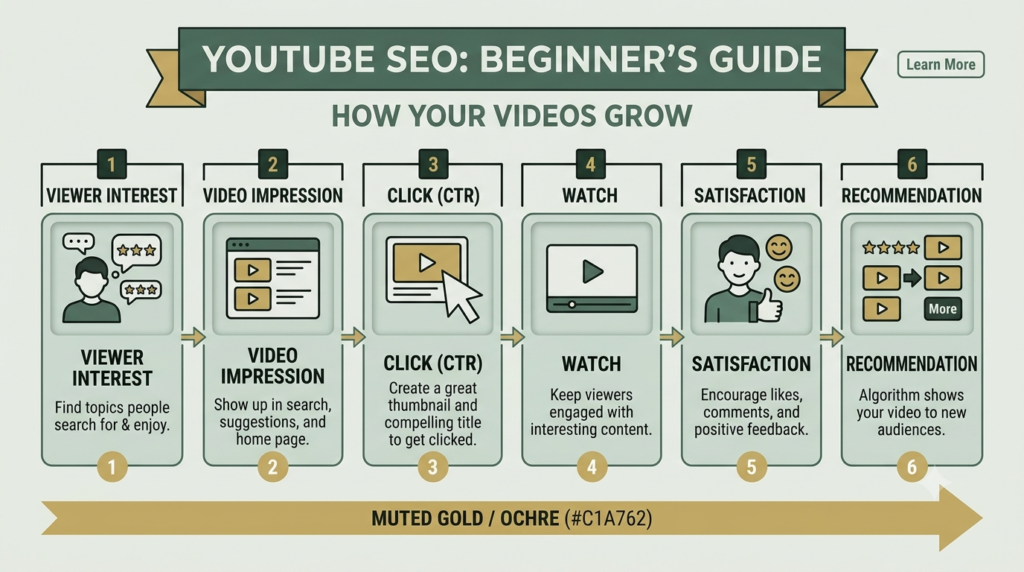
Viewer interest → Video is shown → Viewer chooses → Viewer watches → Viewer responds → YouTube learns → Similar opportunities increase or decrease
The system observes signals such as watch history, search history, subscriptions, likes, dislikes, “Not interested” feedback, and satisfaction surveys.
This is why creators should stop thinking, “How do I trick the algorithm?”
A better question is:
“How can I make the right viewer want to watch and feel satisfied afterward?”
1. Viewer Personalization
YouTube recommendations are personalized for individual viewers.
The system can consider what someone has watched, searched for, liked, ignored, or previously enjoyed. It also considers similarities between viewers and the topics or formats they prefer.
This means the same video can appear prominently to one person and not appear at all to another.

2. Appeal
Appeal means whether people choose your video when it is presented to them.
Your title and thumbnail are therefore extremely important.
A strong package should:
- Clearly communicate the topic.
- Create curiosity without misleading the viewer.
- Match the actual video.
- Make the benefit easy to understand.
- Stand out among competing videos.
Do not use clickbait that promises something the video does not deliver. A click followed by immediate abandonment creates a poor viewer experience.

3. Engagement
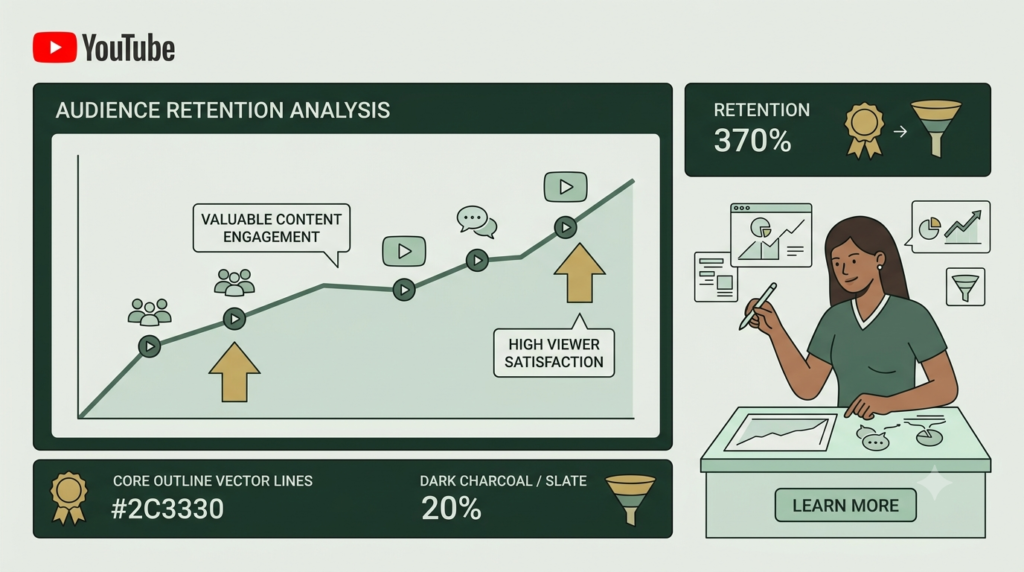
After someone clicks, YouTube wants to understand whether they actually watch.
Important indicators include average view duration and average percentage viewed.
This is where your introduction matters.
Avoid spending the first 30 seconds talking about yourself. Tell viewers what they will learn and move quickly into the promised value.
4. Satisfaction
Watch time alone does not tell the entire story.
YouTube also uses satisfaction signals, including viewer feedback and surveys, to understand whether people actually enjoyed the content.
A useful video should solve a problem, answer a question, teach a skill, entertain, or otherwise deliver the experience promised by its packaging.
5. Search Relevance
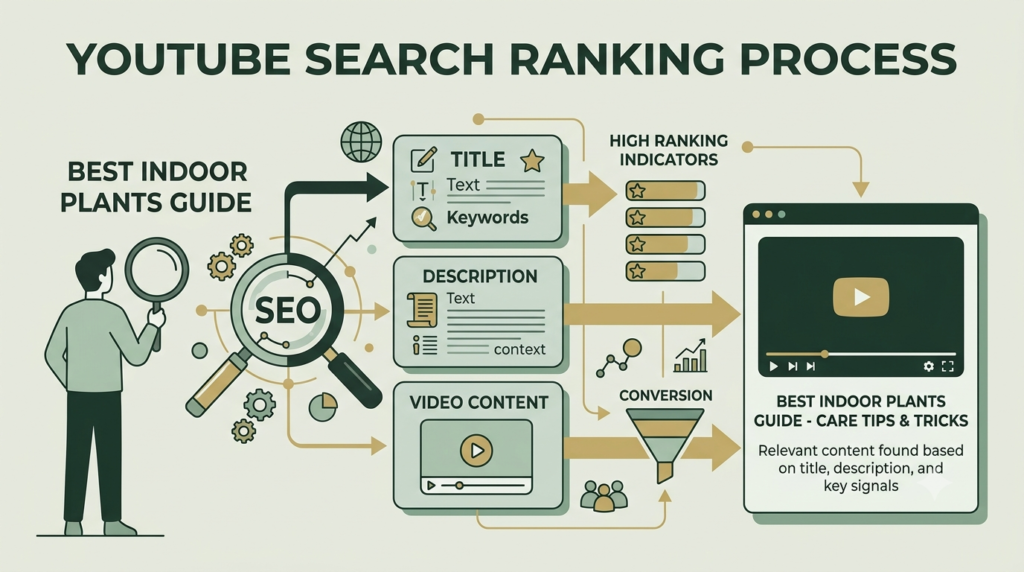
For Search, YouTube examines how well the title, description, tags, and video content relate to the viewer’s query. Engagement and quality also contribute to ranking.
This is where YouTube video SEO becomes useful.
Use your primary keyword naturally in:
- Title
- Opening description
- Spoken/video topic
- Relevant tags where appropriate
- Chapters when useful
- Supporting content around the video
Do not repeat keywords unnaturally.
6. Competition
Your video is not evaluated only against your own previous videos.
YouTube can rank your content against other videos a viewer might want to watch. Therefore, even good performance does not guarantee a large number of impressions if competing videos are performing better for that audience.
7. Topic Interest and Seasonality
Some subjects naturally have larger audiences than others.
Interest can also change during holidays, events, trends, seasons, or major shifts in viewer behavior.
Therefore, a sudden decrease in views does not automatically mean your channel is “penalized.”
Why the YouTube Algorithm Is the Backbone of Channel Growth
The algorithm connects nearly every major YouTube growth activity.
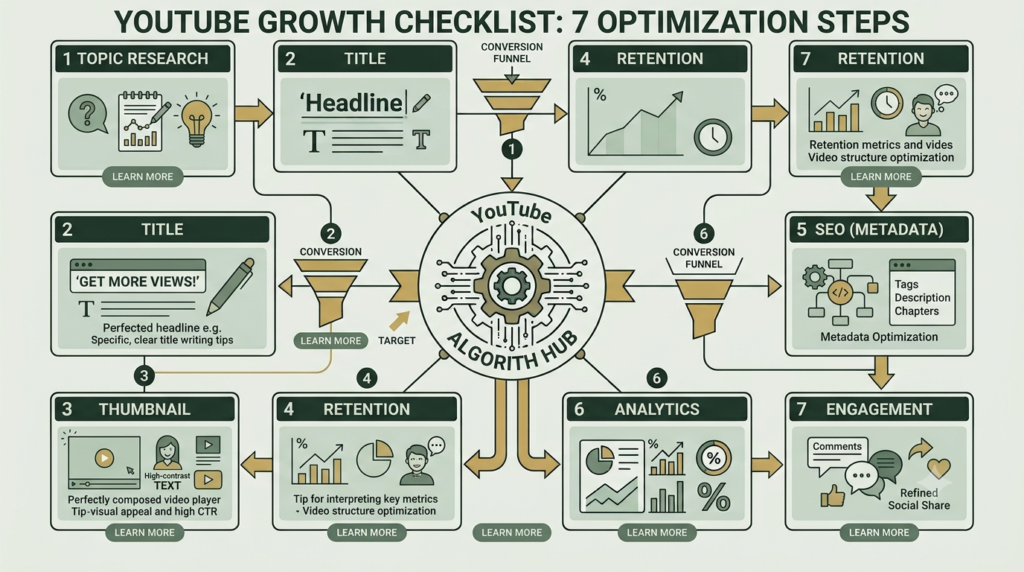
Keyword research helps you understand what viewers search for.
YouTube search ranking determines how relevant your video may be for search queries.
Titles and thumbnails influence appeal.
YouTube audience retention helps reveal whether viewers continue watching.
Engagement and satisfaction help YouTube understand viewer response.
Analytics tells you what happened so you can improve your next video.
This makes the algorithm a backbone rather than a separate SEO task.

How to Optimize Your Videos for the YouTube Algorithm
You cannot manually set the algorithm to “100% optimized.” There is no official YouTube optimization score that guarantees ranking.
Instead, optimize the elements you control.
Before publishing
- Choose a clear audience.
- Research the viewer’s problem or search intent.
- Select one primary topic.
- Create a useful video outline.
- Write a clear title.
- Design a relevant thumbnail.
- Plan the first 30 seconds carefully.
During publishing
- Use the main keyword naturally.
- Write a useful description.
- Add relevant chapters where appropriate.
- Select an accurate category.
- Use relevant supporting keywords.
- Make the promise of the title match the actual video.
After publishing
Check YouTube Analytics.
Look at:
- Impressions
- Click-through rate
- Average view duration
- Average percentage viewed
- Audience retention
- Traffic sources
- Search terms
- Returning viewers
Then identify the weakest stage.
For example:
Many impressions + few clicks = improve title/thumbnail.
Good clicks + poor retention = improve the video opening and structure.
Good retention + low impressions = investigate topic interest, competition, audience fit, and discoverability.
This is a much more useful approach than blaming “the algorithm.”
How to Fix Poor YouTube Algorithm Performance
If a video is underperforming, use this simple correction process.
Step 1: Check whether the topic matches your target audience.
Step 2: Check the title and thumbnail. Are they clear and compelling?
Step 3: Study the retention graph. Identify where viewers leave.
Step 4: Compare your video with competing videos.
Step 5: Check your traffic sources.
Step 6: Improve future videos based on evidence rather than guessing.
Remember that one underperforming video does not automatically damage your entire channel. YouTube says recommendations rely heavily on how viewers respond to individual videos and audience-level signals.
7 Practical Ways to Work With the YouTube Algorithm
- Know your audience before choosing topics.
- Solve a specific problem rather than making a vague video.
- Create strong titles and thumbnails that accurately represent the video.
- Improve audience retention by removing unnecessary introductions and filler.
- Use YouTube video SEO to clarify the video’s subject.
- Study Analytics instead of relying on assumptions.
- Create consistently useful content so viewers have more reasons to return.
YouTube itself recommends focusing on what your audience likes because recommendations follow viewer response.
Common YouTube Algorithm Myths
Myth 1: YouTube promotes only big channels.
Not necessarily. Videos are evaluated according to viewer and content signals.
Myth 2: Every video must be long.
There is no universal ideal video length. YouTube recommends making videos as long as necessary to deliver the value effectively.
Myth 3: Uploading Shorts automatically hurts long-form videos.
YouTube says experimenting with different formats does not inherently confuse or penalize the algorithm. Viewer response matters.
Myth 4: Monetization makes YouTube recommend a video more.
YouTube says recommendation systems do not prioritize videos based on whether they are monetized.
Frequently Asked Questions
What is the YouTube algorithm?
The YouTube algorithm refers to the collection of systems YouTube uses to rank and recommend content to individual viewers across Search, Home, Suggested, Shorts, and other surfaces.
What is the most important YouTube algorithm factor?
There is no single universal factor. YouTube considers viewer personalization, content appeal, engagement, satisfaction, relevance, and external factors such as competition and topic interest.
Does YouTube SEO still matter in 2026?
Yes. Search remains an important discovery method, and YouTube Search considers relevance, engagement, and quality when ranking results.
Does watch time matter?
Watch time and retention-related signals help YouTube understand whether viewers continue watching. However, satisfaction and other signals also matter, so watch time should not be treated as the only ranking factor.
How can I improve my YouTube algorithm performance?
Start by improving audience fit, topic selection, title and thumbnail appeal, viewer retention, satisfaction, and your use of Analytics. Do not try to manipulate the system.
Can one bad video hurt my whole channel?
One underperforming video does not automatically penalize your entire channel. YouTube explains that recommendations rely substantially on how viewers respond to individual videos and relevant audience signals.
How long should a YouTube video be?
There is no universal ideal length. Make the video long enough to deliver the promised value without unnecessary filler.
Final Takeaway
The YouTube algorithm is not something you need to defeat. It is a system designed to connect viewers with content they are likely to watch and enjoy.
Your job is to make that connection easier.
Choose the right topic, understand search intent, create compelling packaging, deliver value quickly, monitor YouTube audience retention, improve your YouTube search ranking strategy, and use Analytics to learn from real viewer behavior.
If you consistently create useful content for a clearly defined audience, you give YouTube better evidence about who should see your videos and why they may enjoy them.
Ready to improve your YouTube growth strategy? Start with one video, one audience, and one problem—and optimize from the data.