
7 Powerful YouTube Competitor Research Tips for Growth Today
What Is YouTube Competitor Research?
YouTube competitor research is the process of studying other channels in your niche to understand what they create, who watches their content, which topics perform well, and where opportunities exist for your own channel.
It is not about copying another creator.
Instead, you study successful patterns and use those insights to make better decisions about your content, keywords, titles, thumbnails, video formats, and channel strategy.
For a beginner, competitor research can remove much of the guesswork from YouTube growth.
You can discover:
- Topics people already care about
- Questions competitors are answering
- Videos receiving strong engagement
- Content gaps you can improve
- Common title and thumbnail patterns
- Different formats used by successful channels
- Opportunities to create a better or more specific version
YouTube itself recommends using Analytics and audience information to understand what viewers watch and use those patterns to inform content strategy. Its Trends feature can also reveal searches, breakout videos, and content gaps.

Why Is YouTube Competitor Research Important?
Imagine choosing video topics without knowing what your audience wants. You may spend hours creating a video that receives very little attention.
Competitor research gives you market intelligence before you invest your time.
It helps answer five important questions:
- What are people watching?
- What topics are repeatedly successful?
- What problems are competitors solving?
- What are competitors missing?
- How can I create something more useful or different?
This is why competitor research can become the backbone of your YouTube SEO strategy.
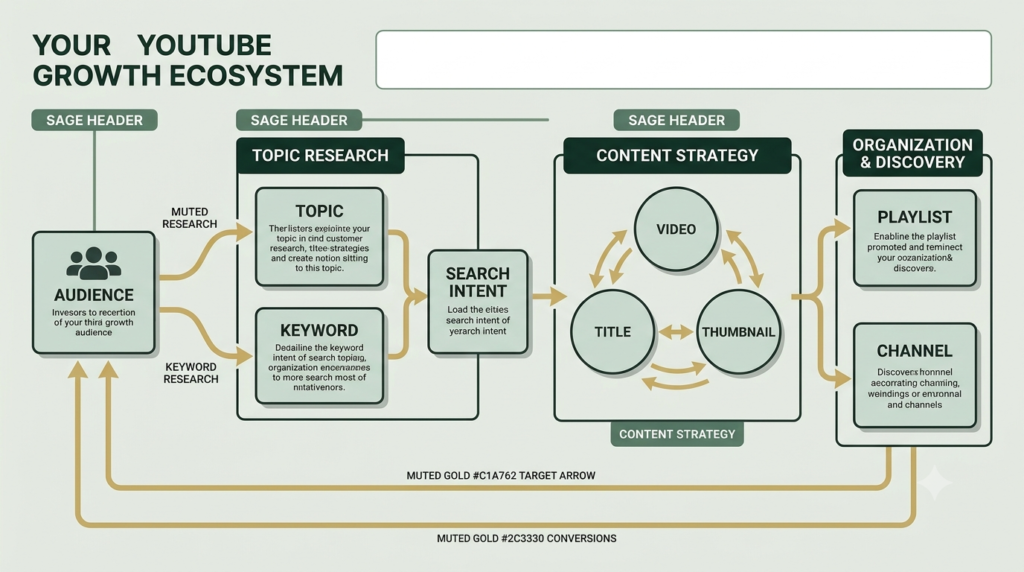
It connects several important entities in your content ecosystem:
Audience → Topic → Keyword → Search Intent → Video → Title → Thumbnail → Content → Playlist → Channel → Engagement
Instead of treating each element separately, you can see how they work together.
YouTube explains that search ranking considers relevance between the viewer’s search and the video’s title, description and content, together with engagement signals.
What Elements Should You Analyze?
A useful YouTube channel analysis should look beyond subscriber counts.
| Element | What to Study | Why It Matters |
|---|---|---|
| Channel niche | Main topics and audience | Identifies positioning |
| Video topics | Repeated successful subjects | Reveals demand |
| Titles | Keywords, benefits and hooks | Helps improve discoverability |
| Thumbnails | Visual style and promise | Helps understand click appeal |
| Video format | Tutorials, reviews, Shorts, lists | Shows successful formats |
| Length | Approximate video duration | Helps identify format patterns |
| Engagement | Views, comments and interaction | Shows audience response |
| Upload pattern | Frequency and consistency | Reveals publishing strategy |
| Playlists | Topic grouping | Shows content organization |
| Content gaps | Missing or weak coverage | Creates opportunities |
Do not judge a competitor from one viral video.
Look for patterns across multiple videos.
How to Do YouTube Competitor Research Step by Step
1. Find Your Real Competitors
Start with your main topic or keyword.
Search YouTube for phrases your target audience might use.
For example, if your niche is YouTube SEO, search:
- YouTube SEO for beginners
- YouTube keyword research
- YouTube channel growth
- YouTube video SEO
- YouTube content strategy
Identify around 5–10 relevant channels.
Your best competitors are not necessarily the biggest creators. A smaller channel producing highly relevant videos for the same audience can provide more useful insights.
2. Create a Competitor Research Sheet
Record the important information in a simple spreadsheet.
Track:
- Channel name
- Niche
- Subscriber range
- Main topics
- Top videos
- Video titles
- Approximate views
- Upload frequency
- Video format
- Thumbnail style
- Common keywords
- Content gaps
This transforms random browsing into structured competitor research for YouTube.
3. Identify Their Top-Performing Topics
Look at each competitor’s videos and identify recurring subjects.
If several competitors repeatedly receive strong views around the same topic, it may indicate audience interest.
However, do not automatically assume views guarantee success.
You should also consider:
- How old the video is
- Whether the topic is seasonal
- Search intent
- Audience relevance
- Competition
- Your ability to provide a better solution
YouTube recommends looking for patterns rather than relying on one metric alone when analyzing content performance.
4. Analyze Titles and Thumbnails
Study how competitors package their ideas.
Look for patterns such as:
- Numbers
- Questions
- How-to formats
- Beginner language
- Benefits
- Curiosity
- Specific outcomes
- Strong visual contrast
Do not copy their title.
Instead, ask:
“What promise is this title making, and can I make my version clearer?”
The same principle applies to thumbnails.
Study the communication strategy, not the artwork.
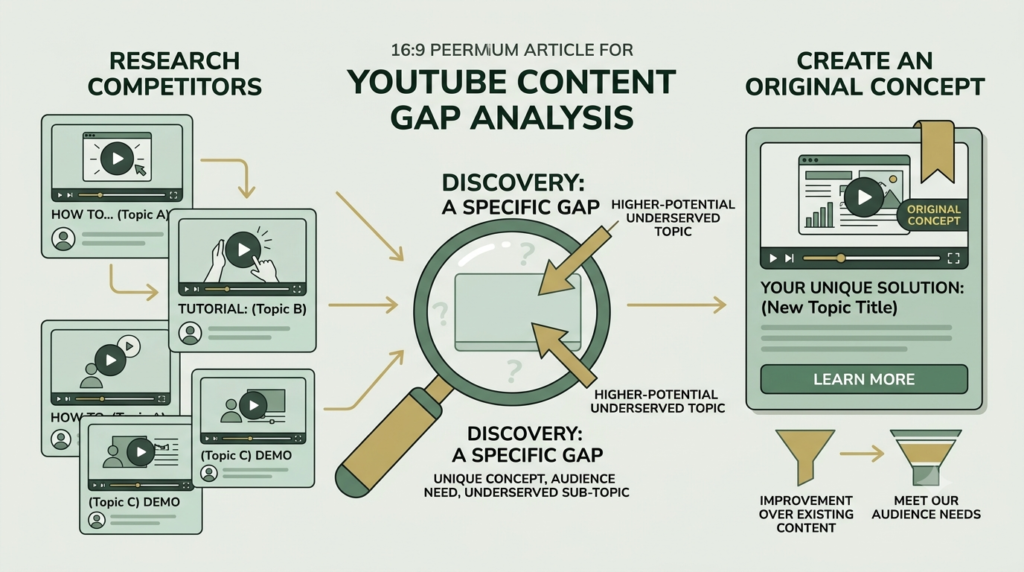
5. Find Content Gaps
This is one of the most valuable parts of YouTube content gap analysis.
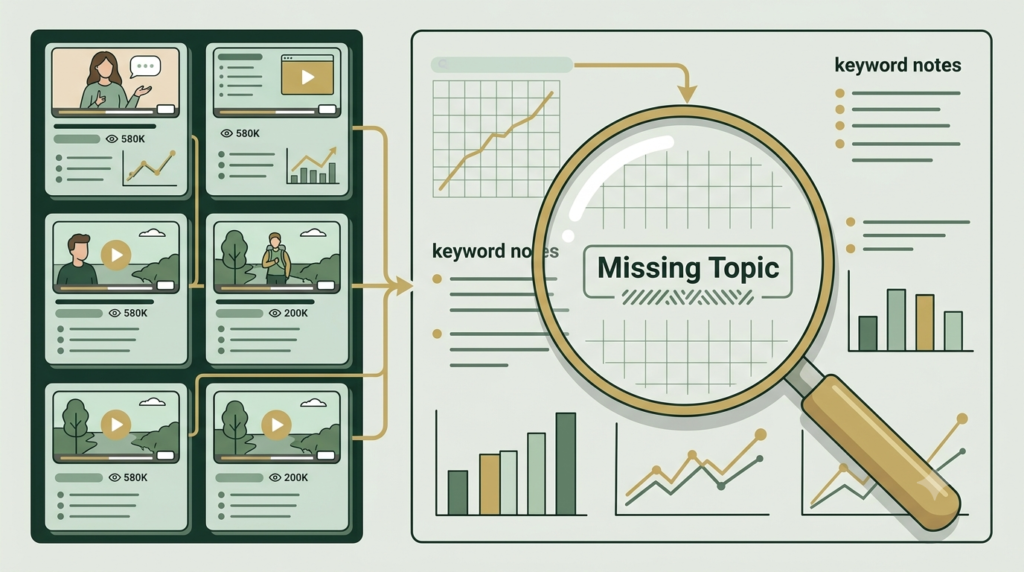
A content gap exists when viewers have a need that existing videos do not adequately satisfy.
For example, competitors may have:
“How to Start a YouTube Channel”
but very few videos explaining:
“How to Start a YouTube Channel Without Showing Your Face in 2026.”
The second topic creates a more specific opportunity.
YouTube’s Trends feature specifically provides information about content gaps where viewers may not be finding enough relevant or high-quality results.
How to Turn Competitor Research Into Better Videos
Once you collect the information, use this simple framework:
Observe → Analyze → Improve → Differentiate
Observe
Find successful topics and patterns.
Analyze
Understand why those topics may be working.
Improve
Create a clearer, more complete or more current solution.
Differentiate
Add your own experience, examples, perspective, framework or presentation.
For example:
Competitor topic: YouTube keyword research
Your improved angle: YouTube Keyword Research for Beginners: A Simple 2026 Process
You are not copying the competitor. You are responding to the same audience need with your own useful approach.
YouTube Competitor Research Mistakes to Avoid
Avoid these common mistakes:
- Copying competitor titles word-for-word
- Recreating thumbnails
- Assuming subscribers equal success
- Studying only one competitor
- Looking only at views
- Ignoring older successful videos
- Ignoring small channels
- Copying content without adding value
- Choosing topics unrelated to your audience
- Obsessing over competitors instead of serving viewers
Your goal is competitive intelligence, not imitation.
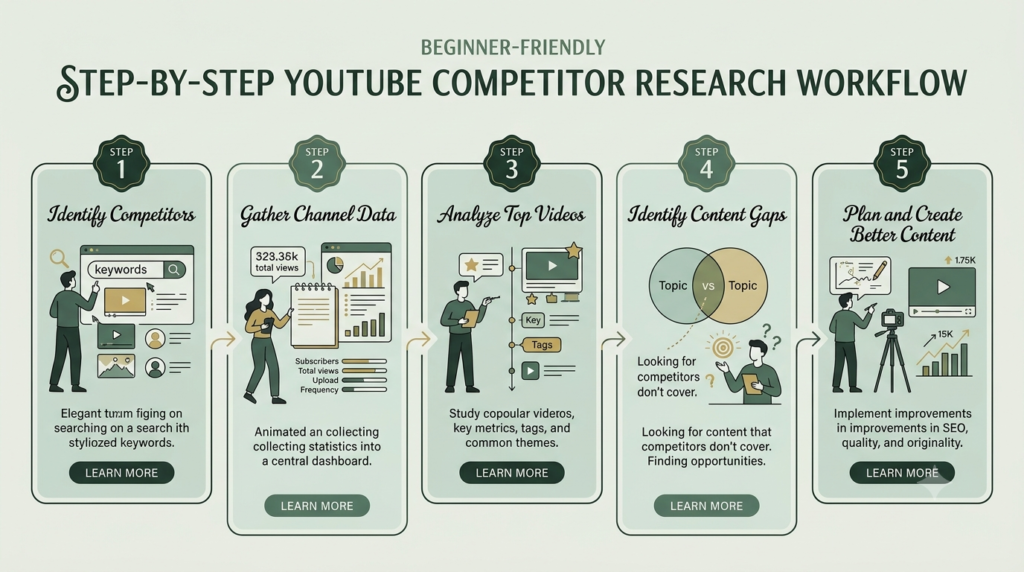
A Simple Beginner Competitor Research Workflow
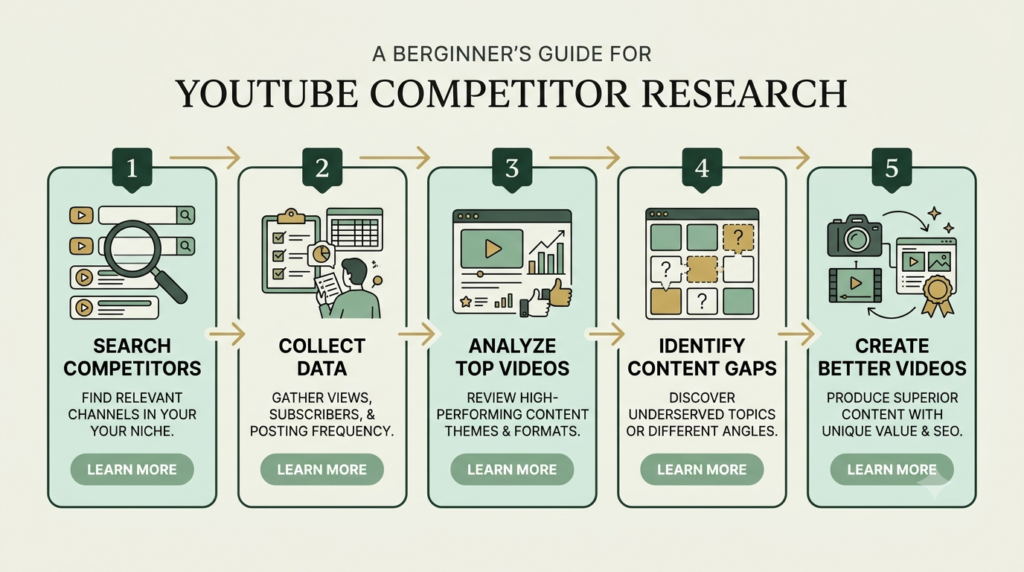
Use this five-step process every time you plan a new topic:
Step 1: Search your main keyword on YouTube.
Step 2: Select 5–10 relevant competing channels.
Step 3: Record their top videos, topics, titles and formats.
Step 4: Identify a content gap or improvement opportunity.
Step 5: Create a more useful, specific and audience-focused video.
You can then compare your results with your own YouTube Analytics.
YouTube Studio provides Content, Reach, Engagement and Audience reports, while Advanced Mode allows deeper comparisons and data analysis.
Frequently Asked Questions
What is YouTube competitor research?
YouTube competitor research is the process of studying relevant YouTube channels, videos, topics, titles, thumbnails, formats and audience patterns to discover opportunities for your own channel.
Why is competitor research important for YouTube SEO?
It helps you understand what topics and search intents are already being served and where you can create more useful, specific or differentiated content.
How many YouTube competitors should I analyze?
For beginners, start with 5–10 relevant channels. Quality and relevance are more important than collecting a huge list.
Can I copy my competitors’ successful videos?
No. Use competitors for research and inspiration, but create original content with your own explanation, examples, structure and perspective.
What is a YouTube content gap?
A content gap is an opportunity where viewers may not be finding enough relevant, current or useful content for a particular need. YouTube’s Trends feature can help identify such gaps.
Is YouTube competitor research useful for small channels?
Yes. In fact, it can be especially useful for small channels because it helps creators choose focused topics instead of competing broadly with established channels.
Conclusion
YouTube competitor research gives beginners a smarter way to plan content.
Instead of guessing what to create, you can study existing demand, understand successful patterns, identify content gaps and develop a clearer content strategy.
Remember the objective:
Do not copy what competitors are doing. Understand why it works, find what is missing, and create something better for your audience.
Start with five competitors, analyze their strongest topics, find one meaningful gap and turn that gap into your next video.
That simple habit can gradually make your YouTube strategy more focused, consistent and data-driven.
Ready to improve your YouTube SEO?
Explore Aahraa’s beginner-friendly YouTube SEO resources and build your channel one strategic step at a time.