
What Is YouTube Brand Positioning? Complete Beginner’s Guide in 2026
What Is YouTube Brand Positioning?
YouTube brand positioning is the process of deciding how you want your channel to be understood and remembered by your target audience.
Think about it this way: when someone discovers your channel, they should quickly understand who you help, what you help them with, why your content is different, and why they should subscribe.
A strong position gives your channel direction. It influences your topics, thumbnails, titles, visual style, tone, audience, and even the products or services you may eventually offer.
For beginners, this can sound complicated. It isn’t.
Your positioning can start with one simple statement: “I help [specific audience] achieve [specific result] through [your content approach].”
For example:
“I help beginner YouTubers grow their channels through practical YouTube SEO and content strategies.”
That single sentence can guide many decisions across your channel.
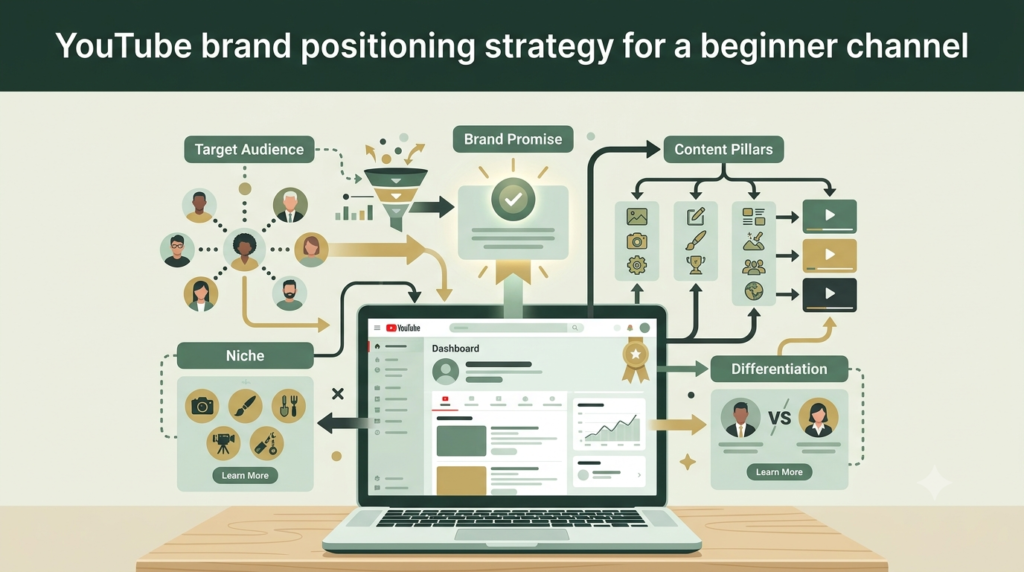
Why Is YouTube Brand Positioning Important?
Your channel may contain excellent videos, but viewers still need a reason to recognize and remember you.
This is where positioning becomes important.
A clear position helps you:
- Attract a more relevant audience
- Create consistent content
- Develop recognizable branding
- Choose better video topics
- Improve audience expectations
- Build authority in a specific subject
- Make your channel easier to understand
- Connect content with future products or services
More importantly, positioning is the backbone that connects the other elements of your YouTube brand.
Your colors, typography, thumbnails, channel description, featured sections, content pillars, tone, and calls to action should support the same underlying position.
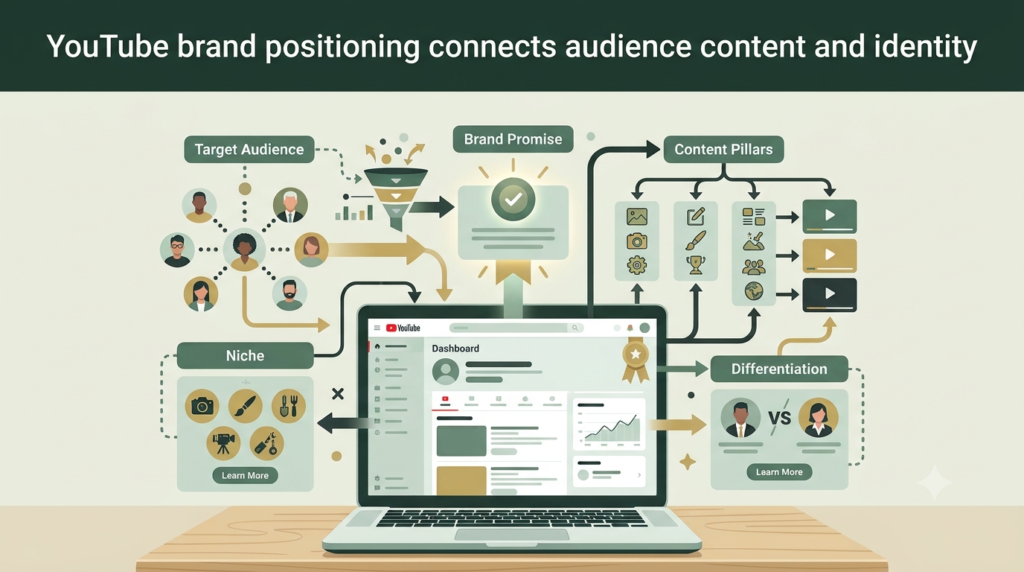
YouTube Brand Positioning: The 7 Essential Elements
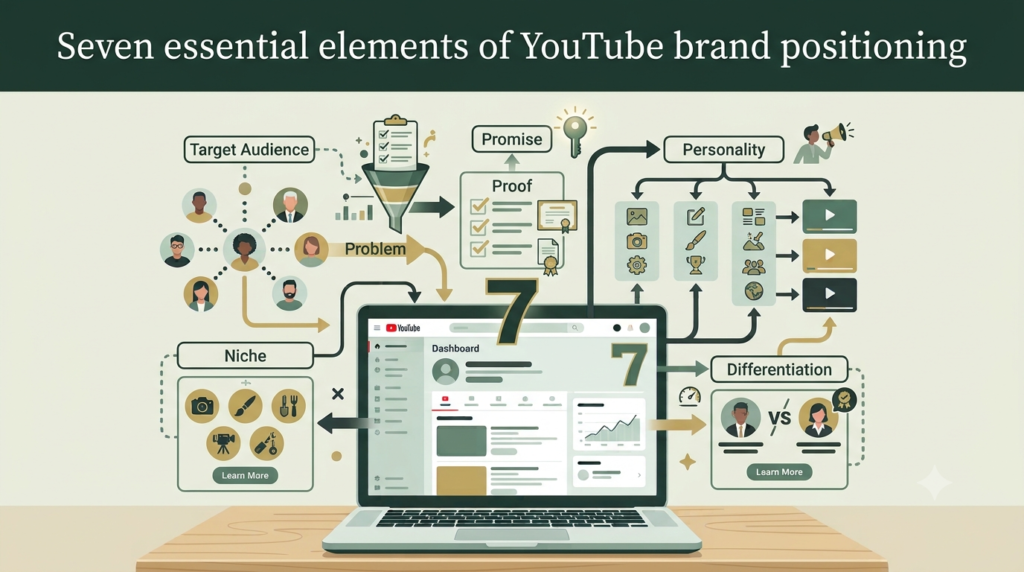
| Element | What it means | Beginner action |
|---|---|---|
| Target audience | People you want to reach | Define one primary audience |
| Problem | What your audience struggles with | List 3–5 major problems |
| Promise | Result you aim to provide | Create one clear value statement |
| Niche | Subject your channel covers | Narrow your main topic |
| Differentiation | What makes you recognizable | Identify your unique approach |
| Personality | How your brand communicates | Choose a consistent tone |
| Proof | Why viewers should trust you | Demonstrate knowledge/results |
Let’s look at each one.
1. Target Audience
Your audience is the foundation.
Instead of saying, “My channel is for everyone interested in business,” become more specific.
For example:
“My channel helps beginner entrepreneurs learn YouTube SEO without complicated technical terminology.”
Specificity makes your content easier to plan.
This is also where YouTube audience targeting becomes important. You need to understand what your viewers search for, what problems they have, and what outcomes they want.
2. Audience Problem
A strong brand usually solves a recognizable problem.
Ask:
- What is frustrating my audience?
- What are they trying to achieve?
- What information are they missing?
- What mistakes are they making?
Your answers can become your content pillars.
3. Brand Promise
Your promise explains what viewers can expect from you.
For example:
“Simple YouTube SEO lessons for beginners.”
Keep it realistic. Don’t promise overnight success or guaranteed views.
A trustworthy promise is more sustainable than exaggerated claims.
4. Niche
Your niche determines the territory your channel wants to own.
For example:
Broad: Digital marketing
More focused: YouTube growth
More focused: YouTube SEO for beginners
The narrower version makes positioning easier because viewers immediately understand the channel’s purpose.
5. Differentiation
Ask yourself:
“Why should someone choose my channel instead of another channel covering the same subject?”
Your differentiation could come from:
- Simpler explanations
- A specific audience
- A particular teaching method
- Practical templates
- Case studies
- Personal experience
- A distinctive perspective
You don’t need to invent something nobody has ever done. You need a recognizable way of delivering useful information.
6. Brand Personality
Your personality determines how your message feels.
You might choose:
- Friendly and conversational
- Educational and professional
- Calm and practical
- Energetic and motivational
- Analytical and data-driven
Consistency matters more than choosing the “perfect” personality.
7. Proof
Positioning becomes stronger when you provide evidence.
Proof can include:
- Demonstrations
- Examples
- Experiments
- Case studies
- Screenshots
- Results
- Tutorials
- Transparent lessons from mistakes
You don’t need to pretend to be an expert. Show people what you know and what you are learning.
How to Create YouTube Brand Positioning
Use this simple five-step process.
Step 1: Define Your Audience
Complete:
I create content for __________.
Avoid “everyone.”
Step 2: Identify Their Main Problem
Write three problems your audience repeatedly faces.
For example:
- They don’t know what videos to create.
- Their videos aren’t getting discovered.
- They don’t understand YouTube SEO.
Step 3: Define Your Content Promise
Complete:
“My channel helps [audience] achieve [result] by [method].”
Step 4: Choose Your Difference
Ask:
“What will I consistently do differently?”
Your answer becomes an important part of your YouTube branding strategy.
Step 5: Connect Everything
Your positioning should influence:
Positioning → niche → content pillars → titles → thumbnails → visual identity → channel About section → playlists → audience experience
This is why positioning acts as the backbone of your entire YouTube brand ecosystem.
How YouTube Brand Positioning Connects to Brand Identity
Positioning and identity are related but different.
Positioning = how you want people to perceive your brand.
Identity = the visual and verbal elements you use to communicate that perception.
For example:
If your positioning is “simple YouTube SEO education for beginners,” your identity might use:
- Clear typography
- Simple graphics
- Consistent thumbnail structure
- Educational language
- Repeatable visual elements
- Practical calls to action
This creates stronger YouTube brand identity because the visual presentation supports the strategic message.
How to Correct Weak Brand Positioning
If your channel feels confusing, don’t immediately redesign everything.
First diagnose the positioning.
Problem: Your channel covers too many subjects
Correction: Choose one primary audience and one central transformation.
Problem: Viewers don’t understand your channel
Correction: Rewrite your channel description and About section around your audience, problem, and promise.
Problem: Your thumbnails look unrelated
Correction: Establish a repeatable visual system for fonts, layout, imagery, and key design elements.
Problem: Your videos attract unrelated viewers
Correction: Review your topics and keywords. Make sure they match your intended audience.
Problem: Your content feels random
Correction: Build 3–5 content pillars based on the problems your audience wants solved.
YouTube Brand Positioning Optimization Checklist
Before publishing, check:
- One clearly defined primary audience
- One central niche
- One clear audience problem
- One realistic brand promise
- A recognizable point of difference
- Consistent channel voice
- Consistent visual identity
- Related content pillars
- Clear About section
- Consistent thumbnails
- Relevant playlists
- Strong internal content connections
- Honest proof and examples
- Clear subscriber CTA
If these elements support the same message, your positioning is much stronger.
YouTube Brand Positioning and SEO
Positioning doesn’t replace SEO. Instead, it gives your SEO strategy direction.
Your YouTube channel branding, topics, keywords, titles, descriptions, playlists, and content should all serve the same audience.
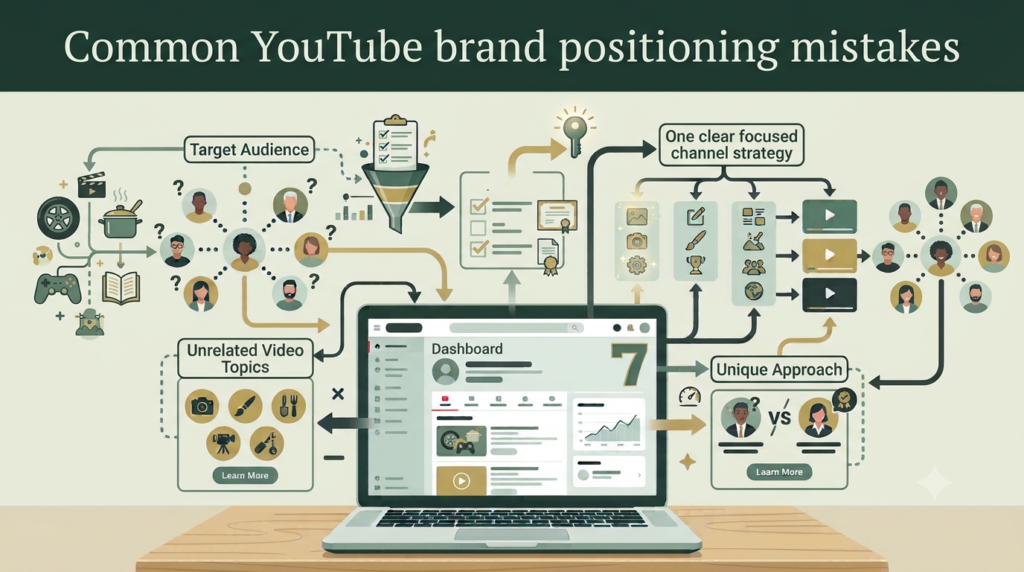
For example, a channel positioned around beginner YouTube SEO shouldn’t repeatedly publish unrelated cooking, travel, finance, and gaming videos simply because those keywords have search volume.
SEO can help people discover your content.
Positioning helps them understand why your channel is worth following.
For official guidance, refer to YouTube’s Creator Academy and YouTube Help.
Common YouTube Brand Positioning Mistakes
Avoid these beginner mistakes:
- Trying to appeal to everybody
- Changing your niche every few weeks
- Copying another creator’s identity
- Using vague promises
- Creating unrelated videos
- Changing your visual style constantly
- Making exaggerated growth claims
- Confusing branding with only colors and logos
- Ignoring audience problems
- Optimizing only for keywords
Remember: a logo cannot fix unclear positioning.
Your strategy needs to come first.
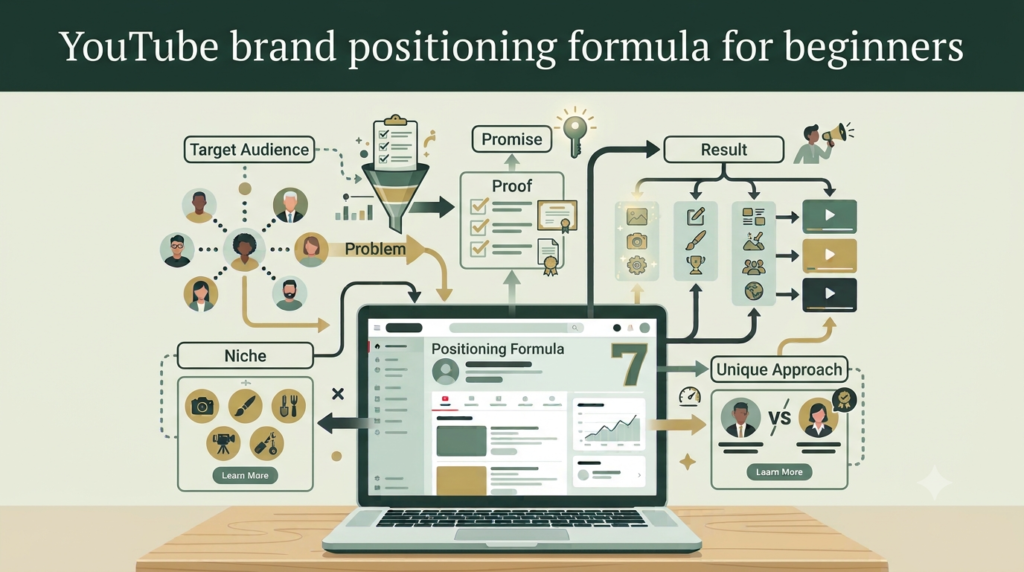
A Simple YouTube Brand Positioning Formula
Use this formula to create your first positioning statement:
I help [specific audience] solve [specific problem] and achieve [desired result] through [your unique approach].
Example:
“I help beginner YouTubers solve content and discoverability problems through simple YouTube SEO strategies.”
You can then use this statement to guide your channel description, content pillars, video ideas, playlists, and future digital products.
Final Takeaway
YouTube brand positioning is the strategic foundation of your channel.
It tells viewers what your channel is about, who it is for, what problem you solve, and why your approach deserves attention.
Don’t start by changing your logo.
Start by answering four questions:
- Who am I helping?
- What problem am I solving?
- What result am I helping them achieve?
- Why should they choose my approach?
Once these answers are clear, your YouTube branding strategy, channel visuals, content, SEO, and audience targeting become much easier to align.
Ready to strengthen your YouTube channel?
Start by writing your one-sentence positioning statement today, then use it to review your channel name, About section, content pillars, thumbnails, and playlists.
FAQ
What is YouTube brand positioning?
YouTube brand positioning is the strategy for defining how you want your channel to be understood by a specific audience and what makes your channel different.
Why is brand positioning important on YouTube?
It helps create consistency between your audience, niche, content, visual identity, messaging, and overall channel experience.
Is YouTube brand positioning the same as YouTube branding?
No. Positioning defines the strategic place you want your channel to occupy in the audience’s mind, while branding communicates that position through visual and verbal elements.
How do I find my YouTube brand position?
Define your target audience, identify their primary problem, determine the result you want to provide, select your niche, and identify your unique approach.
Can YouTube brand positioning improve SEO?
Indirectly, yes. Clear positioning helps you consistently create relevant content for a defined audience, which makes keyword, topic, content-pillar, and channel optimization more focused.