7 Powerful YouTube Content Pillars for Better Growth in 2026
If you sometimes struggle to decide what video to make next, YouTube content pillars can give your channel a clear direction. Instead of creating unrelated videos whenever an idea appears, you organize your content around a few important topics that consistently serve the same audience.
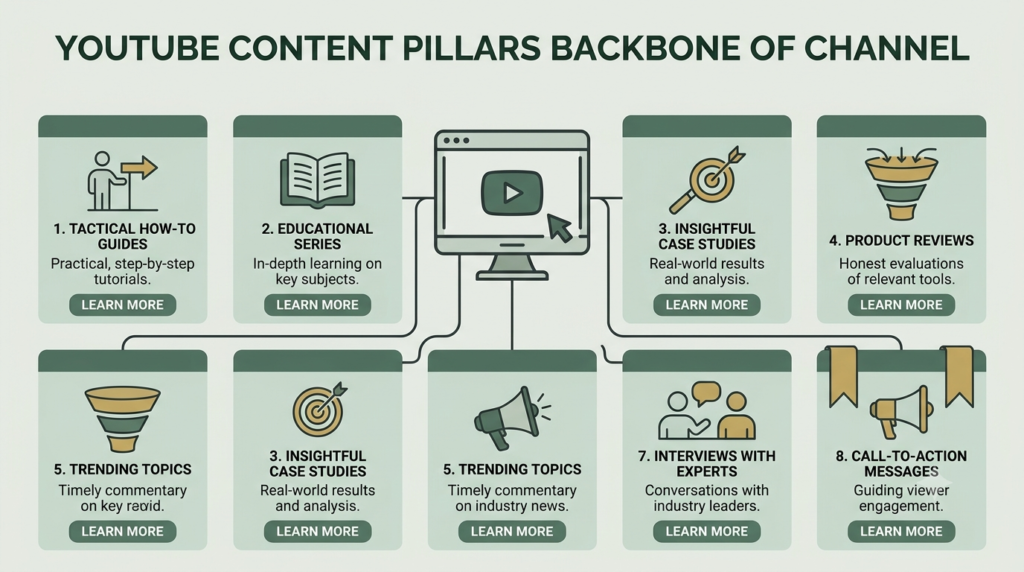
Think of content pillars as the backbone of your YouTube channel. They connect your audience, video topics, playlists, keywords, internal content relationships, and overall brand positioning.
A strong pillar system can make your YouTube content strategy easier to manage while helping viewers understand exactly what your channel is about.
What Are YouTube Content Pillars?
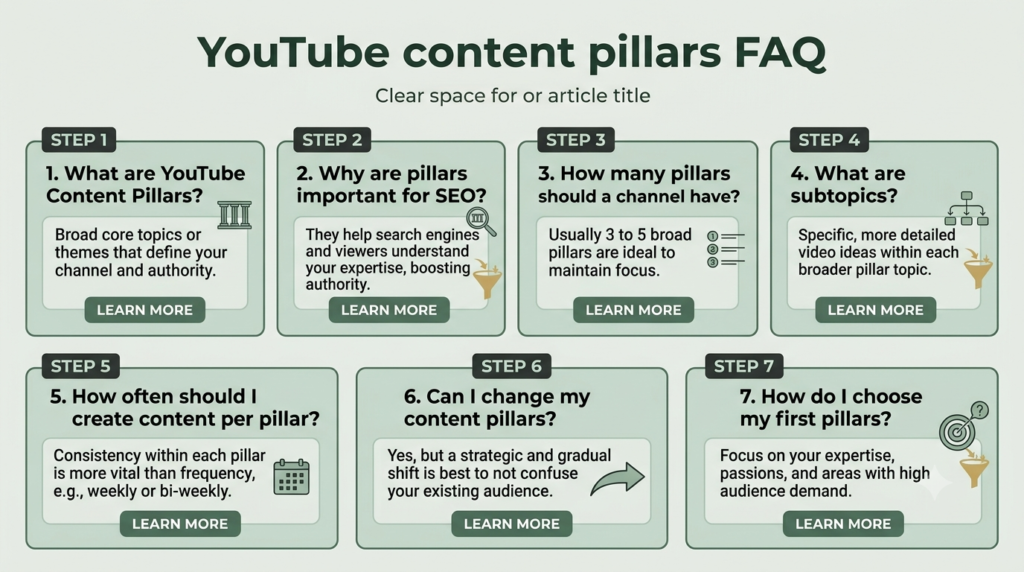
YouTube content pillars are the main recurring topics or themes around which a creator builds videos.
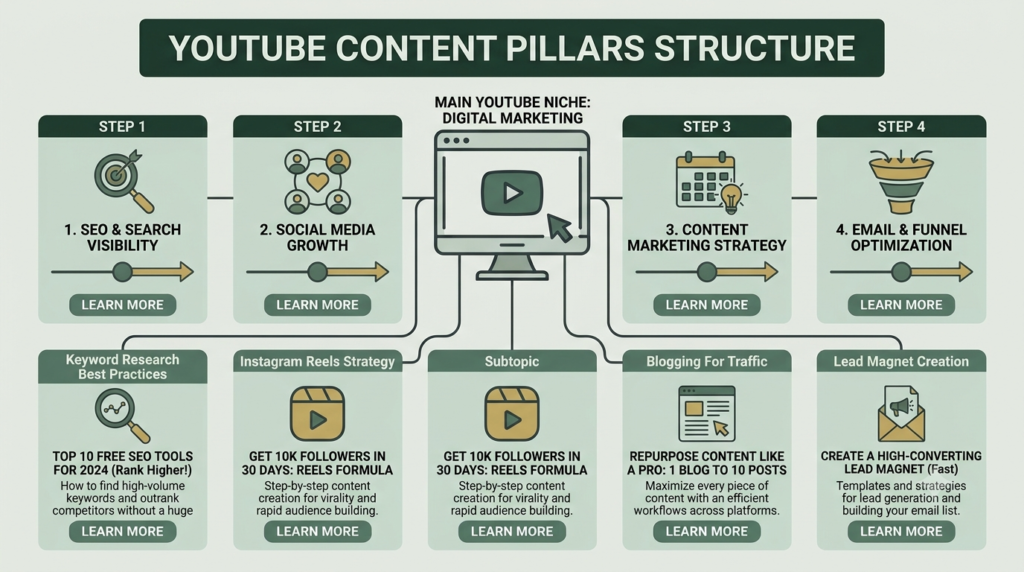
For example, a channel about YouTube growth might have these pillars:
- YouTube SEO
- YouTube Content Strategy
- YouTube Channel Branding
- YouTube Analytics
- YouTube Monetization
- YouTube Shorts
- YouTube Growth Problems
Each pillar can then produce many smaller video topics.
For example:
Pillar: YouTube SEO
Subtopics: Keyword research, titles, descriptions, thumbnails, tags, playlists and video optimization.
This creates a logical relationship between individual videos instead of leaving every upload as an isolated piece of content.
Why Are YouTube Content Pillars Important?
Without a structure, creators can quickly move from one topic to another. One video may be about SEO, the next about cooking, and the next about personal finance.
That makes it harder to build a recognizable audience.
YouTube itself recommends grouping content into useful “buckets,” such as format, series, intended audience, topic longevity and production cost. Analytics can then help creators identify patterns across those groups.
The biggest benefits of YouTube content pillars include:
- Clearer channel positioning
- Easier video planning
- More relevant YouTube video ideas
- Stronger topical relationships
- Better playlist organization
- More consistent publishing
- Easier audience targeting
- A stronger foundation for YouTube channel growth.
Understanding content pillars for YouTube helps beginners organize their channel around topics that matter to their audience. Instead of publishing unrelated videos, creators can build a clear structure that connects their niche, subtopics, keywords, and playlists. This approach makes planning easier and helps viewers discover more relevant content.
Your pillars should not exist only as an SEO exercise. They should help you consistently solve problems for a specific audience.
The 7 Essential Elements of YouTube Content Pillars
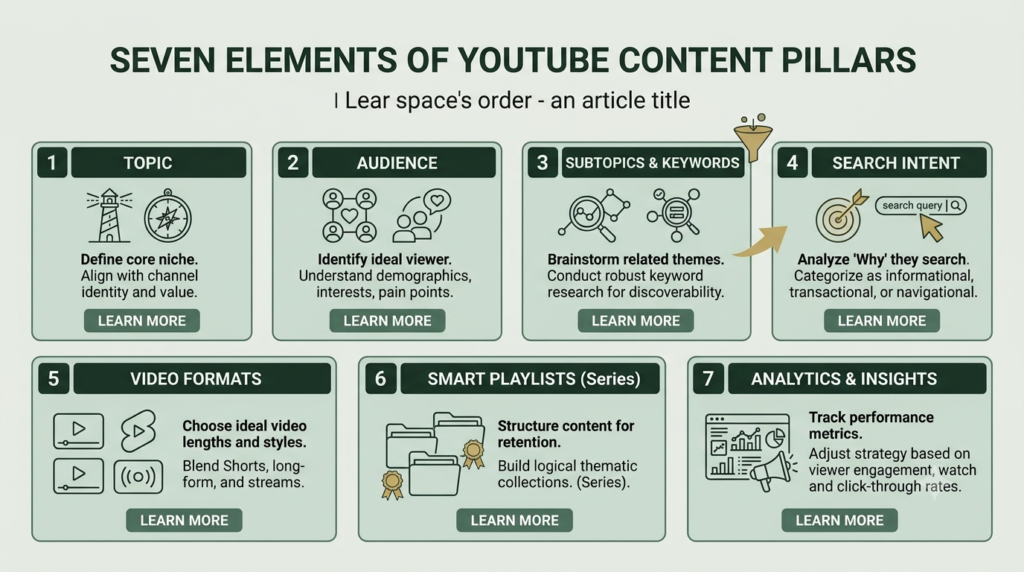
| Element | Purpose | Example |
|---|---|---|
| Main topic | Defines your broad subject | YouTube SEO |
| Audience | Identifies who you help | Beginner creators |
| Subtopics | Expands the pillar | Keyword research |
| Search intent | Defines the viewer’s need | Informational |
| Video formats | Adds variety | Tutorial, list, case study |
| Playlists | Groups related videos | YouTube SEO Guide |
| Analytics | Measures performance | Views, retention, engagement |
1. Main Topic
Your main topic is the foundation of a pillar.
Choose subjects directly connected to your channel’s niche and audience. A good main topic should have enough depth to generate multiple useful videos.
2. Target Audience
Every pillar should serve a recognizable audience.
Ask:
Who is this content for?
For example, “YouTube SEO for beginners” is more focused than simply “SEO.”
Understanding your audience also helps you develop content for new, casual and regular viewers. YouTube provides these audience segments inside Analytics to help creators understand viewing behavior.
3. Subtopics
Subtopics turn one broad pillar into multiple YouTube video ideas.
For a YouTube SEO pillar, subtopics could include:
- Keyword research
- Video titles
- Descriptions
- Thumbnails
- Playlists
- Search intent
- Analytics
- Video optimization
This creates a repeatable system instead of forcing you to brainstorm from zero every time.
4. Search Intent
Search intent is the reason someone searches for a topic.
A viewer might want to:
- Learn something
- Solve a problem
- Compare options
- Find a tool
- Follow a tutorial
- Make a decision
Matching your video to the viewer’s intent makes your YouTube content strategy more useful.
5. Video Formats
A pillar does not mean every video needs to look identical.
You can use:
- Beginner guides
- Tutorials
- Checklists
- Mistake videos
- Case studies
- Comparisons
- Step-by-step videos
- Shorts
YouTube also recommends examining the formats your audience watches when deciding how to develop your content strategy.
6. Playlists
Playlists can turn separate videos into a learning path.
For example:
YouTube SEO Playlist
→ Keyword Research
→ Video Titles
→ Descriptions
→ Thumbnails
→ Playlists
→ Analytics
YouTube allows creators to organize videos into playlists and provides playlist-level analytics, making playlists useful for both organization and performance analysis.
7. Analytics
Your pillars should evolve according to evidence.
Look at which topics generate stronger:
- Views
- Watch time
- Audience retention
- Engagement
- Returning viewers
- Subscriber growth
To generate useful YouTube video ideas, turn every subtopic into a specific question or problem. For example, under YouTube SEO, you could create videos about finding keywords, writing effective titles, improving thumbnails, and optimizing descriptions. Each video should answer one clear question and provide an actionable solution.
YouTube recommends looking for recurring patterns in successful content rather than simply chasing every trend.
How to Create YouTube Content Pillars Step by Step
A practical YouTube content strategy starts with understanding your audience’s problems. List the questions viewers frequently ask, group similar questions into topic categories, and select the most relevant categories as your main pillars. Then plan videos around search intent, audience needs, and your channel’s goals. Review your results regularly and improve your plan using YouTube Analytics.
Start with your main niche.
For example:
Niche: YouTube Growth
Then identify 5–7 major problems your audience needs help solving.
Example:
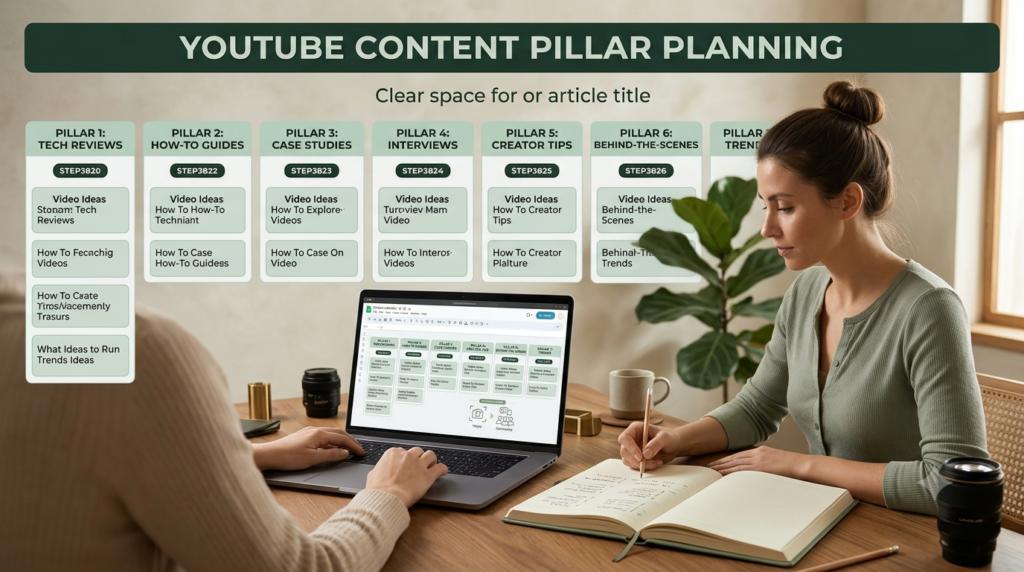
Pillar 1: YouTube SEO
Pillar 2: Content Strategy
Pillar 3: Channel Branding
Pillar 4: Analytics
Pillar 5: Shorts Growth
Pillar 6: Monetization
Pillar 7: YouTube Problems
Next, create 5–10 subtopics under every pillar.
You can then turn each subtopic into a video, blog post, playlist or supporting resource.
This creates a connected content ecosystem.
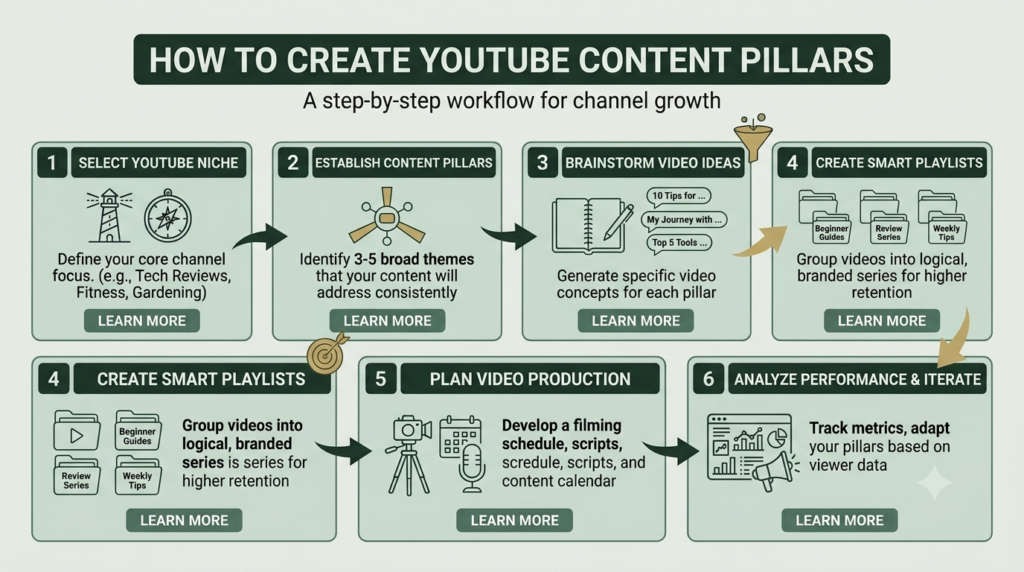
How Content Pillars Become the Backbone of Your Channel
A well-organized content system can support sustainable YouTube channel growth by helping creators publish consistently and develop related videos around their audience’s needs. When viewers find useful content on a particular topic, relevant follow-up videos and playlists give them a reason to explore more of the channel. Growth is not guaranteed, so measure results through watch time, audience retention, returning viewers, and subscriber trends.
A useful way to visualize the structure is:
Channel niche → Content pillars → Subtopics → Keywords → Videos → Playlists → Audience data
This is why YouTube content pillars are more than a list of topics.
They create relationships between your content.
For SEO, this structure can also help you build topical depth on your website by connecting related articles around a central subject.
Your YouTube channel, blog content and playlists can therefore support the same overall topical entity: your niche and the problems you solve.
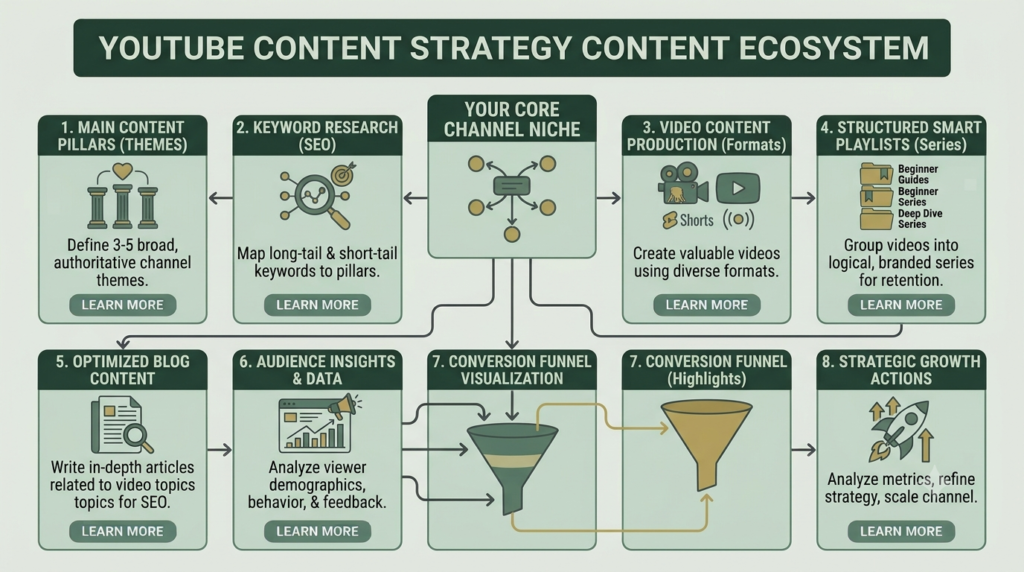
How to Optimize Content Pillars to 100% SEO
There is no legitimate guarantee that any article will score exactly 100/100 in every SEO plugin. A high score should support quality rather than replace it.
For maximum on-page optimization:
- Put the seed keyword in the SEO title.
- Use it naturally in the introduction.
- Include it in at least one H2.
- Include it in the URL.
- Use related keywords naturally.
- Keep paragraphs short.
- Use descriptive subheadings.
- Add relevant internal links.
- Link to authoritative external sources.
- Add useful images with descriptive alt text.
- Include an FAQ section.
- Add appropriate Article and Breadcrumb schema.
- Make the page mobile-friendly.
- Avoid keyword stuffing.
- Check the article for readability before publishing.
Most importantly, make the article genuinely useful. YouTube’s recommendation system focuses on helping viewers find content they are likely to watch and enjoy, so optimizing only for keywords is not enough.
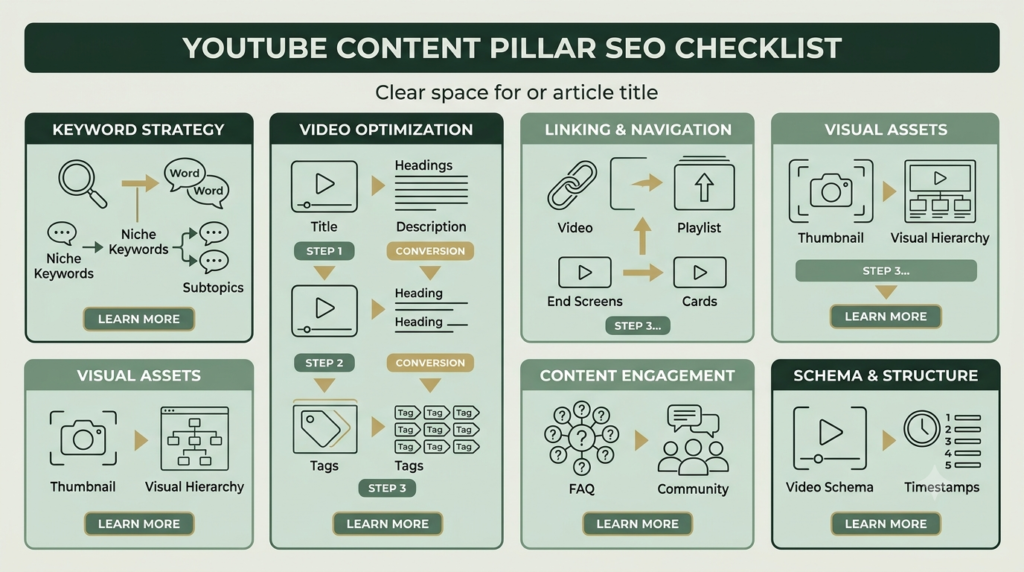
Common Content Pillar Mistakes
Avoid these mistakes:
Too many pillars: Ten or fifteen unrelated pillars can dilute your channel.
Pillars that are too broad: “Business” is difficult to turn into a focused content system.
Pillars without audience relevance: A topic may have search volume but still be wrong for your viewers.
Never reviewing performance: Your strongest pillar today may not remain your strongest pillar forever.
Chasing every trend: YouTube recommends sustainable content rather than constantly following short-lived trends.
Simple YouTube Content Pillar Checklist
Before publishing, ask:
- Does this video belong to one of my core pillars?
- Does it solve a specific audience problem?
- Is the search intent clear?
- Does it connect with other videos?
- Can it belong to a relevant playlist?
- Does the title accurately describe the benefit?
- Is the thumbnail easy to understand?
- Have I used relevant keywords naturally?
- Can Analytics help me improve the next video?
If most answers are yes, your content system is moving in the right direction.
Final Thoughts
YouTube content pillars give creators a practical framework for turning scattered ideas into a consistent content system.
Instead of asking, “What should I post today?” you can ask, “Which audience problem should I solve next within my content pillars?”
That small change can make planning easier and your channel much more focused.
Start with five to seven strong pillars, create useful subtopics under each one, connect related videos through playlists and review your Analytics regularly. Over time, your pillars can become the backbone of your YouTube content strategy and support sustainable YouTube channel growth.
Ready to Build Your Content Pillars?
Choose your main YouTube niche today, identify five core audience problems, and turn each problem into a content pillar. Then create your first five YouTube video ideas under each pillar.
Consistency becomes much easier when you know exactly what your channel stands for.
Frequently Asked Questions
What are YouTube content pillars?
YouTube content pillars are the main recurring topics that organize a channel’s videos around a specific niche and audience.
How many content pillars should a YouTube channel have?
For a beginner, five to seven focused pillars are usually easier to manage than a large collection of unrelated topics.
Are content pillars important for YouTube SEO?
Yes. They can help organize related topics, keywords, videos and playlists into a clearer content strategy. However, rankings depend on many factors, so pillars alone do not guarantee higher rankings.
Can one video belong to more than one content pillar?
Usually, it is better to give each video one primary pillar. A video can naturally connect to related topics, but one clear primary purpose keeps your content system easier to manage.
Should content pillars change over time?
Yes. Review your Analytics regularly. If certain topics consistently attract and satisfy your audience, you can expand those pillars. YouTube recommends using performance patterns and audience insights to inform future content decisions.