
7 Powerful Ways to Bring Business Online and Offline & Grow Fast in 2026
Starting a business is no longer simply about opening a shop, renting an office or putting up a signboard.
In 2026, customers may discover your business through Google Search, Google Maps, Instagram, YouTube, WhatsApp, a recommendation from a friend—or by simply walking past your physical location.
That is why the smartest approach is not to choose between Business online and offline marketing. The goal is to connect both.
If you want to bring business online and offline, think of your business as one system with several customer entry points. Your website, social media profiles, Google presence, physical store, packaging, referrals and customer service should all communicate the same brand and lead customers toward the next step.
This guide explains how to bring business online, connect it with offline marketing, attract customers and build a system that can grow without depending on one source of traffic.
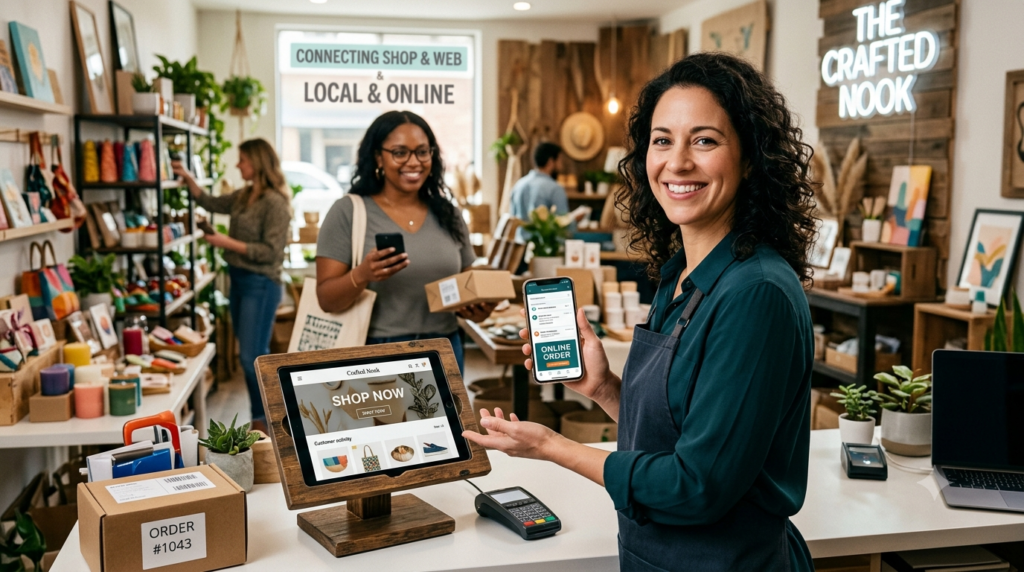
What Does It Mean to Bring Business Online and Offline?
Bringing a business online means creating digital assets through which customers can discover, understand, contact and buy from your business.
These can include:
- A professional website
- Google Search visibility
- Google Business Profile for eligible local businesses
- Social media accounts
- WhatsApp Business
- Online reviews
- Email marketing
- Online booking or ordering
- Digital payments
- Online advertising
- Helpful content and videos
Bringing a business offline means developing physical customer touchpoints such as:
- A shop or office
- Visiting customers
- Local networking
- Printed brochures
- Business cards
- Packaging
- Events
- Local partnerships
- Referrals
- Community activities
- Demonstrations
The real opportunity comes from connecting the two.
For example, a customer may see a flyer offline, search the company on Google, visit its website, read reviews, send a WhatsApp message and finally purchase offline.
That is an online-to-offline customer journey.
The opposite can also happen.
A customer visits your physical store, scans a QR code, follows your Instagram account, joins your WhatsApp list and later purchases another product online.
That is an offline-to-online customer journey.
1. Build Your Business Foundation Before Marketing
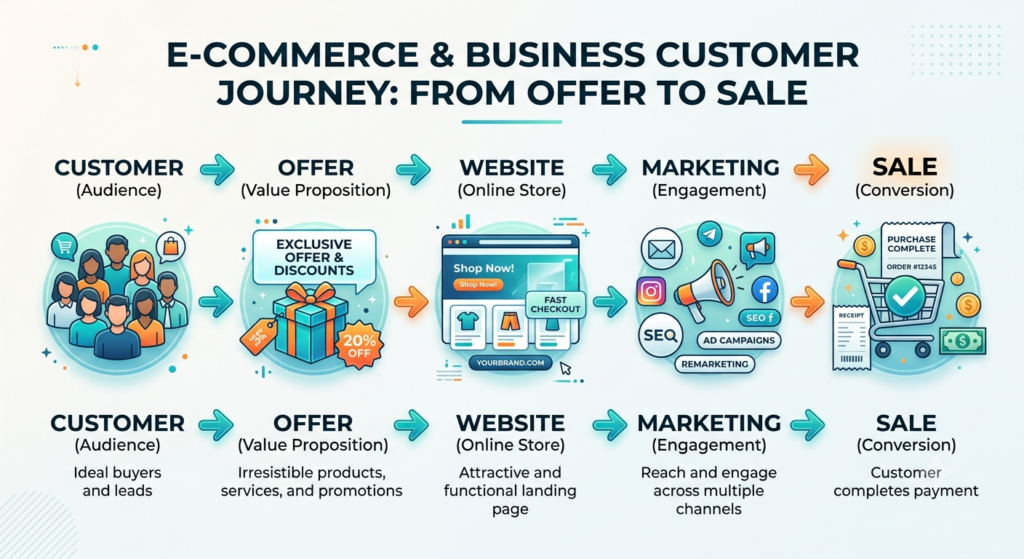
One of the biggest mistakes beginners make is promoting a business before defining what the business actually offers.
Before spending money on advertising, establish five fundamentals.
A. Define your customer
Ask:
- Who needs my product or service?
- What problem are they trying to solve?
- Where do they currently look for solutions?
- What prevents them from buying?
- Why should they trust my business?
Do not try to sell to everyone.
A small business often grows faster when it becomes extremely clear about the customer it serves.
B. Define your offer
Your offer should communicate:
What you sell + who it helps + what problem it solves + why it is valuable.
For example:
Affordable bookkeeping services for small businesses that need accurate monthly accounts without hiring a full-time accountant.
This is much stronger than:
We provide professional financial solutions.
Specificity improves marketing.
C. Create consistent branding
Use the same:
- Business name
- Logo
- Colours
- Typography
- Tone of voice
- Phone number
- Website
- Social media identity
Consistency makes a small business look more established.
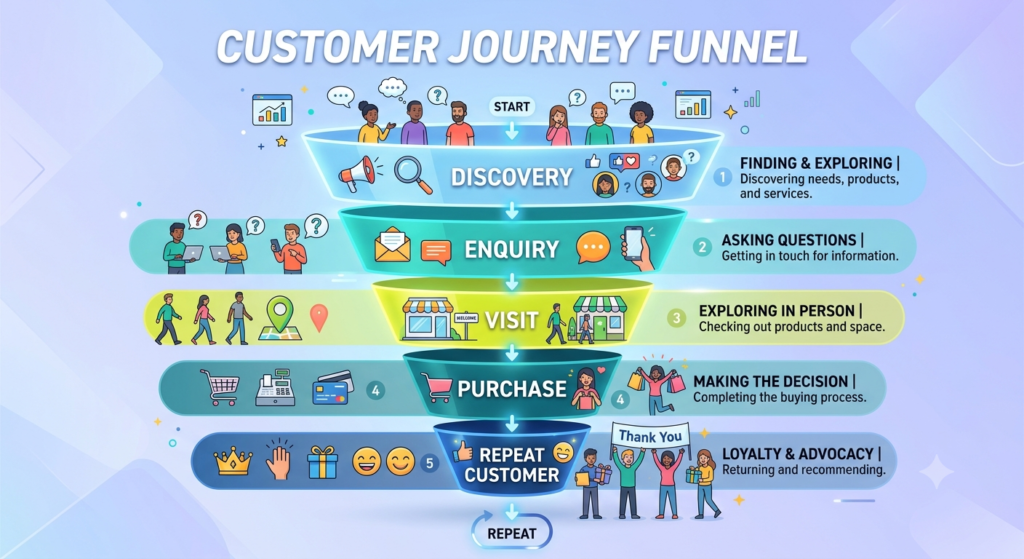
D. Establish your basic customer journey
A simple journey can be:
Discovery → Trust → Enquiry → Purchase → Delivery → Review → Repeat purchase → Referral
Your marketing should support every stage to grow business online and offline.
E. Establish your measurement system
Track:
- Website visitors
- Leads
- Calls
- WhatsApp enquiries
- Store visits
- Purchases
- Conversion rate
- Average order value
- Repeat customers
- Customer acquisition cost
Without measurement, “growth” becomes a feeling rather than a business metric.
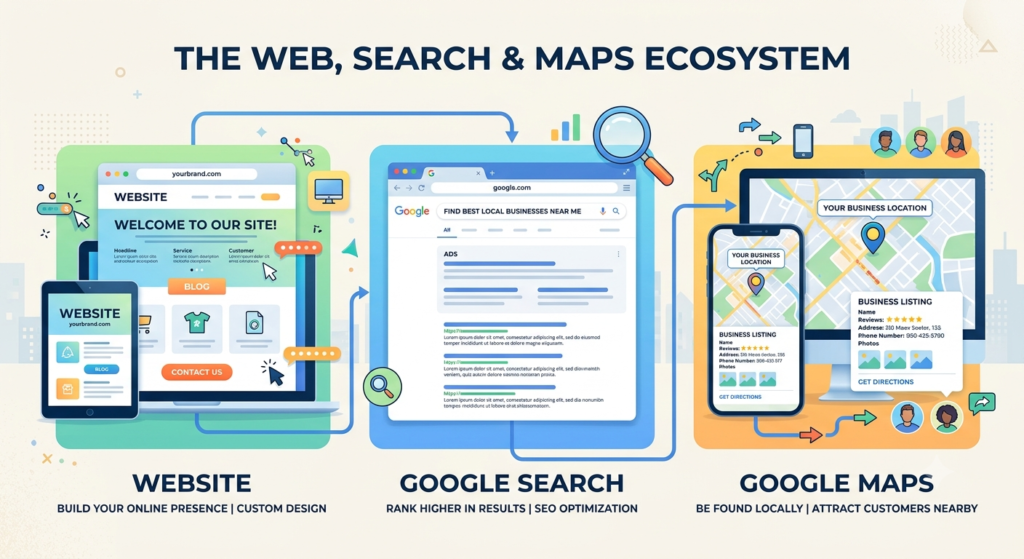
2. Create Your Digital Home: Your Website
Your website should become the central asset of your business online and offline strategy.
Social media platforms can change their algorithms, reach can fall and accounts can experience restrictions. Your website gives you a digital property that you control.
A basic business website should contain:
Homepage
Explain immediately:
- What you offer
- Who you serve
- Your main benefit
- What the visitor should do next
About page
Explain the story, experience, values and people behind the business.
Products or services
Give every important service or product enough information to make an informed decision.
Contact page
Include appropriate contact options such as:
- Phone
- Contact form
- Location, where relevant
FAQ
Answer common buying objections.
Reviews or testimonials
Social proof helps reduce uncertainty.
Privacy and legal pages
Use the appropriate policies for your business and jurisdiction.
Your website should also be:
- Mobile-friendly
- Fast
- Secure with HTTPS
- Easy to navigate
- Search-engine accessible
- Built around clear calls to action
For Aahraa, your existing Digital Marketing for Startups page can serve as a relevant internal link from this article.
3. Get Found on Google
Search engines can become one of the most valuable long-term acquisition channels for a small business.
Your objective is not simply to “put keywords everywhere.”
Instead, create useful content around the questions your customers actually ask.
Basic SEO checklist
For every important page:
- Choose one primary search intent.
- Create a clear SEO title.
- Write a useful meta description.
- Use a descriptive URL.
- Put the main topic naturally in the H1.
- Use related terms in H2/H3 headings.
- Add internal links.
- Add relevant external references.
- Optimise images.
- Make the page useful enough to deserve links and mentions.
4. Use Google Business Profile for Eligible Offline Businesses
If customers visit your location or you travel to customers, Google Business Profile can be extremely important for local visibility.
Google says eligible storefront and service-area businesses can use a Business Profile to appear on Google Search and Maps, manage business information, publish photos and videos, interact with customers and collect reviews. Online-only businesses are not eligible for a Business Profile.
How to set it up
Create or claim the appropriate profile and verify it.
Then make your information consistent:
- Business name
- Category
- Phone number
- Website
- Hours
- Service area
- Address where applicable
- Photos
- Products/services where available
Keep it active
Add genuine:
- Product photographs
- Team photographs
- Store photographs
- Work examples
- Updates
- Offers
- Useful information
Most importantly, encourage genuine customers to leave honest reviews.
Do not buy fake reviews.
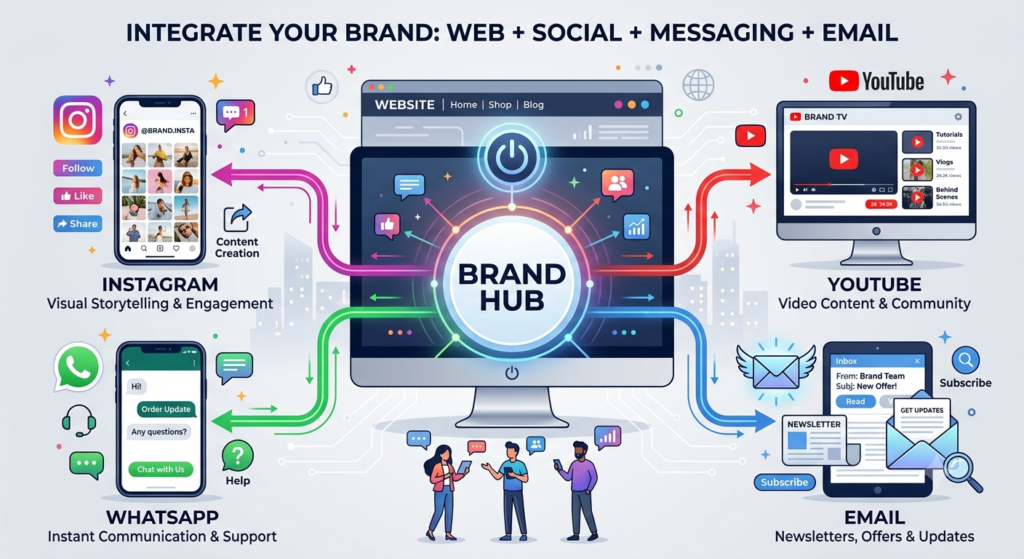
5. Connect Social Media With Your Business
Social media should not become your entire business.
Instead, use it as a discovery and relationship channel.
Choose platforms according to your customers.
For example:
| Channel | Main purpose | Best use |
|---|---|---|
| Discovery | Reels, products, visual storytelling | |
| Community | Local audiences, groups, updates | |
| YouTube | Education | Tutorials, demonstrations, reviews |
| Professional trust | B2B, expertise, networking | |
| Conversion | Enquiries, follow-ups, customer service | |
| Discovery | Visual products, ideas and inspiration | |
| Retention | Offers, education and repeat sales |
You do not need to dominate every platform.
Choose two or three channels that your customers actually use.
A simple content system
Create four content categories:
Educate: Teach something useful.
Demonstrate: Show your product or service.
Prove: Show testimonials, results or customer experiences.
Invite: Ask people to contact, visit, book or purchase.
This prevents your social media from becoming a constant stream of advertisements.
6. Combine Business Online and Offline Marketing
This is where many small businesses can create an advantage.
Your Business online and offline channels should reinforce one another.
Offline → Online
Put a QR code on:
- Business cards
- Packaging
- Flyers
- Receipts
- Posters
- Product labels
- Menus
- Brochures
The QR code can lead to:
- Website
- Product catalogue
- Review page
- Booking page
- Social media
- Special offer
Online → Offline
Use your website and social media to promote:
- Store visits
- Events
- Workshops
- Demonstrations
- Local offers
- Appointments
- Pickup options
For example:
Instagram → Google/website → WhatsApp → physical appointment → purchase
This creates a connected customer journey.
7. Build a Repeatable Growth System
Getting customers once is not the same as building a scalable business.
The strongest businesses develop systems.
A simple system is:
Traffic → Leads → Conversion → Delivery → Retention → Referral
Traffic
Bring potential customers through:
- SEO
- Social media
- Google Business Profile
- Referrals
- Partnerships
- Advertising
- Content
- Offline promotion
Leads
Give people a simple way to contact you.
Examples:
- Phone
- Booking form
- Website form
Conversion
Improve conversion with:
- Clear offers
- Transparent pricing
- Reviews
- Demonstrations
- FAQs
- Guarantees where appropriate
- Easy payment
Retention
After the purchase:
- Follow up
- Ask whether the customer is satisfied
- Provide useful information
- Offer relevant products
- Request an honest review
- Stay connected
Referral
A satisfied customer can become another acquisition channel.
Ask happy customers whether they know someone who could benefit from your product or service.
Scaling: What Is the Difference Between Growing and Scaling?
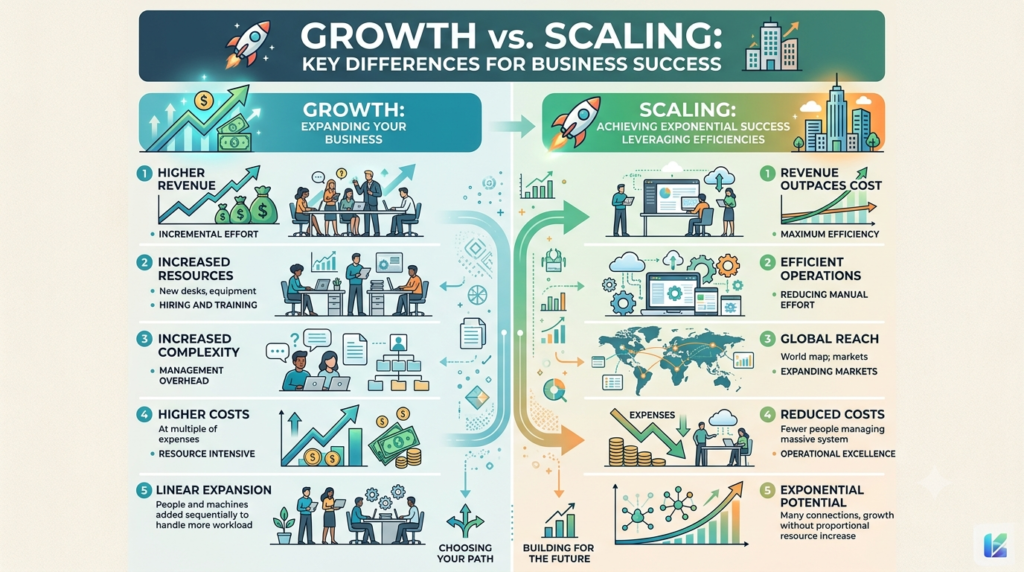
Growth and scaling are related, but they are not identical.
Growth often means increasing revenue by increasing resources.
Scaling means increasing revenue while keeping the growth in costs and complexity under control.
Different Methods of Scaling your Business Online and Offline
| Scaling method | What it means | Example | Main advantage | Main risk |
|---|---|---|---|---|
| Geographic scaling | Enter new locations | Open another city/service area | Larger market | Higher operational complexity |
| Product scaling | Add related products | Add complementary products | More revenue per customer | Too many products |
| Digital scaling | Sell online | Website/e-commerce | Wider reach | Competition |
| Content scaling | Produce reusable content | Blog/video library | Long-term traffic | Takes time |
| Automation scaling | Automate repetitive tasks | Email/WhatsApp workflows | Saves time | Poor automation can hurt experience |
| Partnership scaling | Work with complementary businesses | Referral partnerships | Shared audiences | Dependence on partners |
| Paid-ad scaling | Increase advertising | Google/Meta campaigns | Faster traffic | Rising acquisition costs |
| Team scaling | Delegate work | Hire specialists | More capacity | Management overhead |
| Franchise/licensing scaling | Replicate a proven model | License a process | Rapid expansion | Quality control |
| Customer-retention scaling | Increase repeat purchases | Membership/reorder system | Higher customer value | Requires good service |
The best method for Business Online and Offline, depends on the business model.
Why This Business Online and Offline, Is the Backbone of Your Business Entity
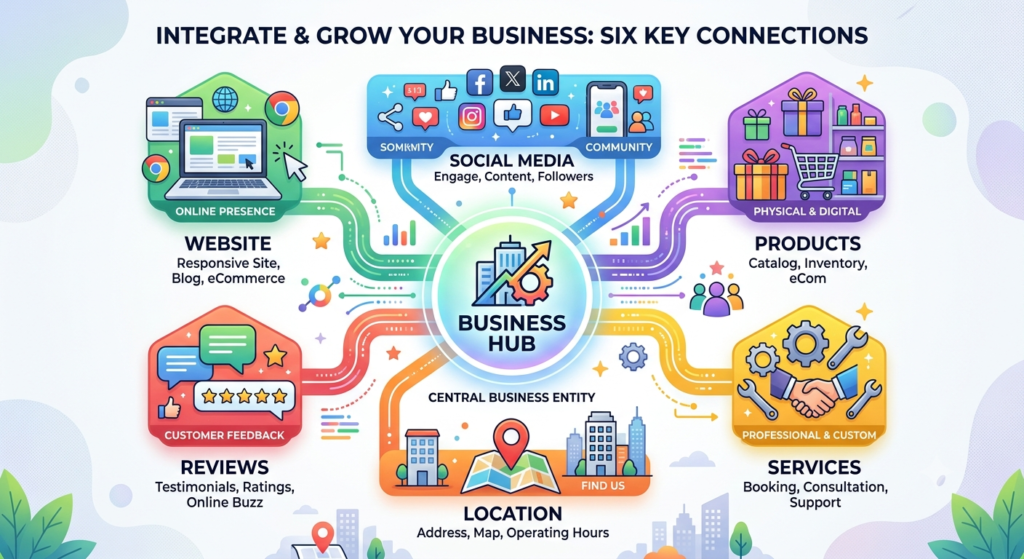
Your business has many public representations:
Business name → website → social profiles → Google presence → products → services → people → locations → content → reviews
If these elements contradict one another, search engines and customers have a harder time understanding the business.
Think of your business identity as an entity graph.
At the centre is:
Your Business online and offline
Connected to:
- Official website
- Business name
- Logo
- Founder
- Services
- Products
- Locations
- Social profiles
- Contact information
- Reviews
- Articles
- Images
Frequently Asked Questions About Business Online and Offline
1. How can I build a business online and offline?
Build a business online and offline with a website, social media, Google visibility, offline promotion, referrals and connected customer journeys.
2. How can a small business work online and offline?
A small business can combine a website, social media, WhatsApp and SEO with local networking, referrals, events and offline business marketing.
3. Can an offline business grow online?
Yes, digital marketing for small business, SEO, social media, Google Business Profile and online reviews can help an offline business reach more customers.
4. How do I connect my business online and offline?
Connect both channels through QR codes, website links, WhatsApp, social media, email, packaging, business cards and consistent branding.
5. Why does need both for a business online and offline marketing?
Combining online and offline marketing increases visibility, builds trust and creates more opportunities for customer discovery, enquiries and sales.
6. How can Google Business Profile support an online and offline business?
For eligible businesses, Google Business Profile supports local business marketing by helping customers find business information, reviews, locations and contact details on Google.
7. What is the best business online and offline strategy?
The best online and offline business strategy combines a clear offer, website, relevant marketing channels, customer follow-up and measurement of actual sales.
8. How can I scale my business online and offline with a small budget?
Use SEO, content, referrals, partnerships, customer retention and small business automation before increasing spending on paid advertising.
The 2026 Fast-Growth Formula for Business Online and Offline
If you are a complete beginner, do not try to implement 50 marketing tactics simultaneously.
Start with this sequence:
1. Define the customer
↓
2. Create a strong offer
↓
3. Build your website
↓
4. Establish Google/Search visibility
↓
5. Create selected social channels
↓
6. Connect WhatsApp or another enquiry channel
↓
7. Start offline promotion
↓
8. Connect offline customers to digital channels
↓
9. Collect genuine reviews and feedback
↓
10. Measure leads and sales
↓
11. Improve the conversion process
↓
12. Automate repetitive tasks
↓
13. Scale the channel that actually produces profitable customers
The most important principle is simple:
Do not scale a broken system.
If 100 people visit your website and nobody contacts you, buying more traffic may only increase the number of people who leave.
First improve the offer, trust, messaging and conversion process.
Then scale.
Final Takeaway
To bring business online and offline successfully in 2026, you do not need to become active on every platform or spend thousands on advertising.
You need a connected system.
Your website becomes the digital home.
Search engines help people discover you.
Google Business Profile can help eligible local businesses appear on Search and Maps.
Social media creates awareness and relationships.
WhatsApp and other communication channels can turn interest into conversations.
Offline marketing creates local trust and physical experiences.
Reviews strengthen credibility.
Email and customer follow-up support retention.
Automation reduces repetitive work.
Analytics tells you what is actually producing results.
And scaling allows the successful parts of the system to reach more customers without increasing complexity at the same rate.
The objective is therefore not simply to “go online.”
The objective is to build one connected business where online discovery, offline trust, digital conversion, customer retention and scalable systems work together.
That is the foundation of sustainable business growth in 2026.