
Digital Marketing Strategies for Startups: A Simple Step-by-Step Guide
Starting a business is exciting, but getting your first customers can be challenging. A digital marketing strategy for startups gives a new business a practical way to reach the right audience, build trust and generate leads without wasting time or money.
That is where a digital marketing strategies for startups becomes important.
Instead of trying every marketing channel at once, a startup needs a simple system that connects the right audience, the right message, the right marketing channels and measurable business goals.
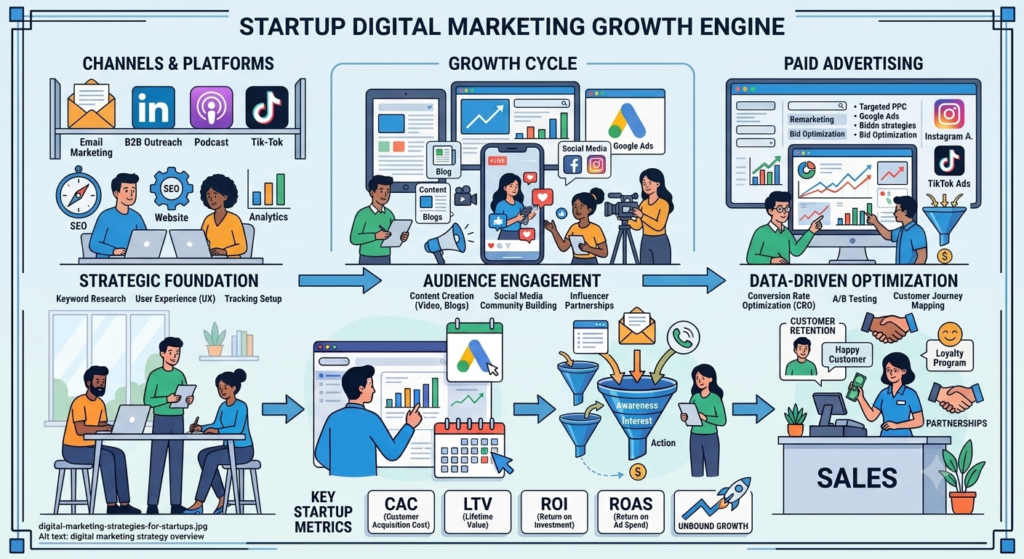
The best digital marketing strategies for startups focus on reaching the right audience, building trust and turning online visitors into customers.
This guide explains how to build that strategy without wasting your limited time or budget.
What Is a Digital Marketing Strategies for Startup?
A digital marketing strategy is a planned approach to using online channels to attract potential customers, build trust and generate leads or sales.
For a startup, this can include:
- Search engine optimization (SEO)
- Content marketing
- Social media marketing
- Google Ads
- Email marketing
- WhatsApp marketing
- Landing pages
- Analytics and performance tracking
You do not need to use all of these channels immediately.
The better approach is to start with the channels that are most relevant to your customers and business goals.
Step 1: Define Your Target Customer
Before creating content or running advertisements, decide exactly who you want to reach.
Ask:
- Who has the problem my business solves?
- What does this person need?
- What questions do they ask before buying?
- Where do they search for solutions?
- What would make them trust a new business?
For example, a startup selling accounting software to small businesses has a very different audience from a startup selling skincare products.
The clearer your customer profile, the easier it becomes to create useful content and advertising.
Step 2: Set One Clear Marketing Goal
Clear goals make digital marketing strategies for startups easier to plan, measure and improve.
Choose a business goal instead.
Your first goal might be:
- Generate 20 qualified leads
- Get your first 10 customers
- Increase website enquiries
- Generate product sales
- Build organic search traffic
- Grow an email list
Your marketing activities should support that goal.
For example, if your immediate goal is lead generation, a landing page, SEO content and a simple enquiry system may be more valuable than spending hours creating daily social media posts.
Step 3: Build Your Website as Your Foundation
Your website should explain three things quickly:
What do you offer?
Who is it for?
Why should someone trust you?
Create clear pages for your main services or products and make it easy for visitors to take the next step.
That might be:
- Contacting you
- Booking a consultation
- Requesting a quote
- Buying a product
- Joining your email list
Your website should also be easy for search engines to understand. Google recommends clear page organization, descriptive URLs, useful titles and relevant internal links.
For startups, your website becomes the central point connecting SEO, social media, advertising and other marketing activities.
Step 4: Use SEO to Build Long-Term Visibility
SEO can help your startup appear when people search for problems, questions or services related to your business.
Start with topics your potential customers genuinely care about.
For example, a digital marketing startup could create content around:
- Digital marketing for startups
- SEO for new businesses
- How startups can get customers online
- Social media marketing for small businesses
- Google Ads for startups
- Content marketing for new businesses
Create a strong main page around your core topic and then publish supporting articles that answer specific questions.
Link the supporting articles back to the relevant main page.
This creates a logical content structure for both visitors and search engines. Google specifically notes that links help it discover pages and understand relationships between pages.
Step 5: Create Useful Content
A strong content plan is one of the most practical digital marketing strategies for startups because it helps businesses answer customer questions while building credibility. Focus on topics that are useful, specific and connected to what your audience may eventually buy.
The best digital marketing strategies for startups combine helpful content with a clear next step. Each article, guide or social post should help readers understand a problem and encourage them to explore your products, services or other useful resources.
A useful startup content plan could include:
Educational content:
Explain concepts your customers don’t understand.
Problem-solving content:
Answer questions and solve common problems.
Comparison content:
Help customers choose between alternatives.
Case-study content:
Show how a product or service can produce results.
Conversion content:
Explain your service and give visitors a clear next step.
Google’s guidance emphasizes original, helpful, reliable and people-first content rather than content produced primarily to manipulate search rankings.
Step 6: Choose Social Media Carefully
Choosing the right platforms is one of the most important digital marketing strategies for startups because it helps you reach potential customers without wasting resources.
Choose one or two platforms where your potential customers are actually active.
For example:
- Instagram can work well for visual brands and consumer businesses.
- LinkedIn can be useful for B2B startups.
- YouTube can work well for educational and demonstration-based businesses.
- Facebook can still be useful for certain communities and customer groups.
Focus on consistency and usefulness rather than trying to publish constantly.
Your social media should ultimately support your business rather than become a full-time job.
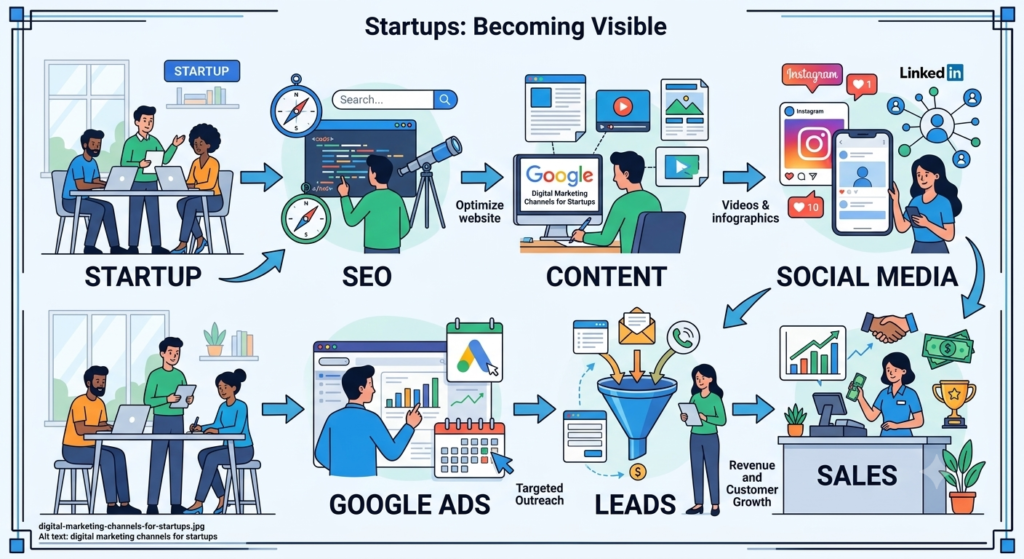
Step 7: Consider Paid Advertising After Your Foundation Is Ready
Google Ads and social advertising can help startups reach potential customers faster than waiting for organic traffic.
However, advertising should not be the first solution to every problem.
Before spending money, make sure you have:
- A clear offer
- A relevant landing page
- A defined target audience
- A clear call to action
- A way to track leads or sales
- A realistic test budget
Start small, measure the results and improve what is working before increasing spending.
Step 8: Measure What Actually Matters
Digital Marketing Strategies for Startups aid in Marketing which becomes much easier when you know what is producing results.
Track metrics such as:
- Website visitors
- Search impressions
- Search clicks
- Leads
- Conversion rate
- Cost per lead
- Sales
- Customer acquisition cost
Do not judge your entire strategy by follower counts or website traffic alone.
A smaller audience that produces customers can be more valuable than thousands of visitors who never buy.
Google Search Console can help website owners understand their performance in Google Search and identify opportunities or problems.
A Simple Startup Marketing Plan
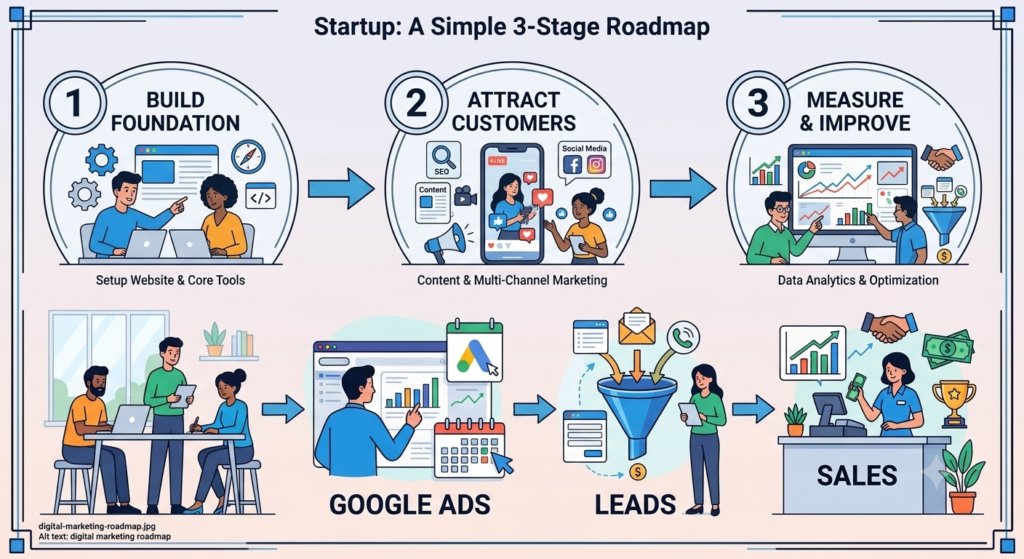
If your resources are limited, start with this basic system:
Month 1:
Build or improve your website, define your target customer and establish your main offer.
Month 2:
Create useful SEO content around your main business topic and begin consistent social media activity.
Month 3:
Measure search traffic, enquiries and conversions. Improve the pages and content that show potential.
Once you understand which channels are producing results, you can gradually expand.
Common Digital Marketing Mistakes Startups Should Avoid
Successful digital marketing strategies for startups should focus on sustainable growth rather than trying to achieve everything at once.
Trying every channel at once
Being active on six platforms does not automatically produce six times the results.
Changing strategy every few days
SEO and content marketing require time. Google notes that changes can take weeks or even months to show their full effect in Search.
Focusing only on rankings
A ranking is useful only when it brings the right audience and eventually contributes to your business goals.
Creating content only for keywords
Keywords help you understand search intent, but your article should primarily help the reader.
Spending on ads before fixing the funnel
More traffic cannot solve a confusing offer, weak landing page or unclear call to action.
Final Thoughts
A successful digital marketing strategies for startups does not have to be complicated.
Start with a clearly defined customer and business goal. Build a useful website, create helpful content, focus on a small number of relevant marketing channels and measure the results.
Most importantly, give your strategy enough time to produce meaningful data before constantly changing direction.
If you are building a startup and want a practical overview of the channels that can help you grow online, explore our Digital Marketing for Startups guide and see how SEO, content marketing, social media and paid advertising can work together.
Choosing the right digital marketing strategies for startups allows a new business to grow without spreading its time and budget too thin.
Frequently Asked Questions
How much should a startup spend on digital marketing?
There is no single amount that works for every startup. Begin with a budget that the business can afford, test your chosen channel and increase spending only when you understand the results.
Which digital marketing channel is best for startups?
There is no universally best channel. The right choice depends on your audience, offer, industry, budget and business goals. SEO can support long-term visibility, while paid advertising can provide faster testing and traffic.
Is SEO worth it for a new startup?
Yes, SEO can be valuable for startups because it can build long-term organic visibility. However, it should be treated as a longer-term investment rather than an instant source of traffic.
How long does startup SEO take to work?
Results vary significantly by website, competition, content quality and authority. Google recommends allowing time to assess the effect of changes rather than expecting immediate results.
Should startups use social media and SEO together?
Yes. They can support different parts of the customer journey. SEO can help people discover your website through search, while social media can help you build awareness, relationships and trust.
How do digital marketing strategies for startups help a new business?
Effective digital marketing strategies for startups help new businesses reach their target audience, build online visibility and turn interested visitors into potential customers.
Which digital marketing strategies for startups should I start with?
The right digital marketing strategies for startups depend on your audience, goals and budget. Most businesses can begin with a combination of SEO, useful content and one suitable social media channel.
Can digital marketing strategies for startups work with a small budget?
Yes. Many digital marketing strategies for startups can be started with limited resources. SEO, content marketing and organic social media can help build visibility before investing heavily in paid advertising.