
What Is YouTube Problem-Based Content? Complete Beginner’s Guide in 2026
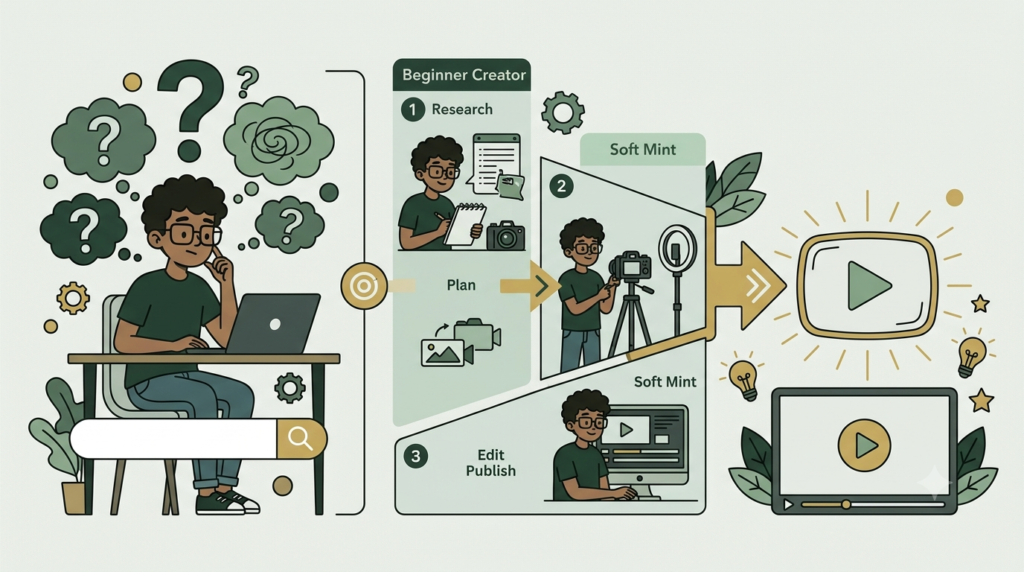
Creating random YouTube videos can be frustrating, especially when you spend hours making content but receive very few views. A better approach is to create videos around problems your audience already wants to solve. This is the foundation of YouTube problem-based content.
Instead of asking, “What video should I make today?”, ask, “What problem is my audience trying to solve?” That simple change can help you discover better YouTube video ideas, create a stronger YouTube content strategy, understand audience problems, and develop useful problem-based YouTube content.
What Is YouTube Problem-Based Content?
YouTube problem-based content is content created specifically to identify, explain, and solve a problem faced by a target audience.
The problem could be simple, practical, technical, financial, educational, or related to a particular goal.
For example:
- “Why is my YouTube channel not getting views?”
- “How do I find keywords for YouTube videos?”
- “Why are my YouTube Shorts not getting reach?”
- “How can beginners create better thumbnails?”
- “How do I choose a profitable YouTube niche?”
Each question represents a real audience problem. Your video becomes useful when it provides a clear solution.
The basic formula
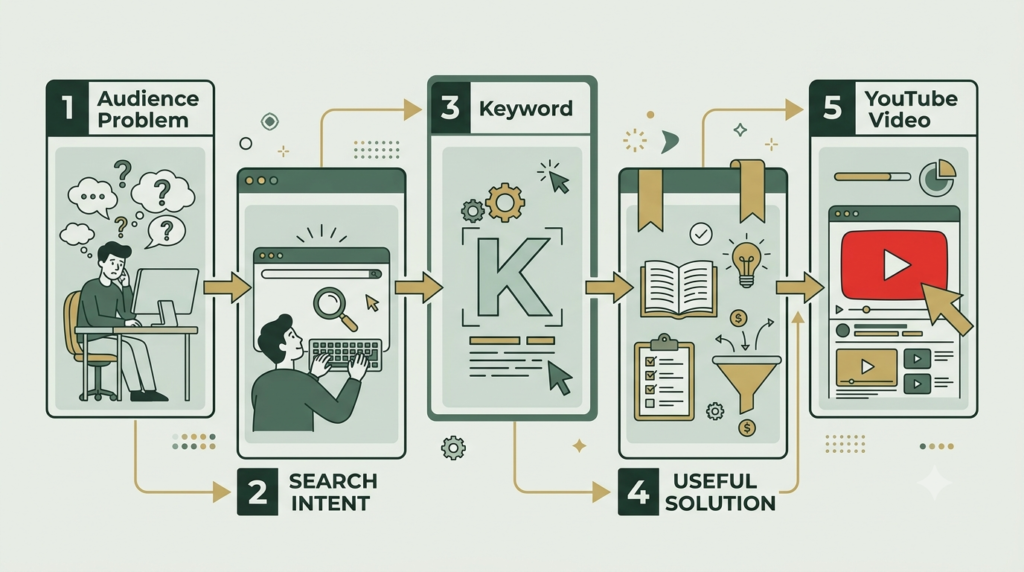
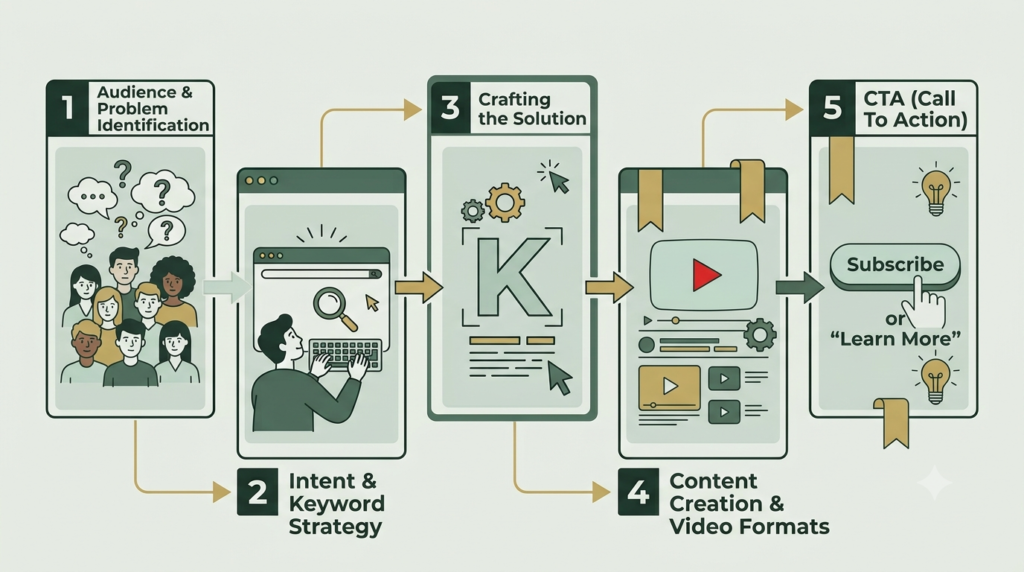
Audience problem → Search intent → Useful solution → YouTube video → Trust → Next action
This makes problem-based content much more strategic than simply publishing whatever topic comes to mind.
Why Is Problem-Based Content Important?
People usually search YouTube because they want something.
They may want to:
- solve a problem
- learn a skill
- compare options
- avoid a mistake
- achieve a goal
- understand something confusing
- find a faster way to complete a task
When your video directly addresses that need, the content has a clear purpose.
Problem-based content can help you:
- Discover relevant video topics.
- Match content with audience search intent.
- Build topical authority.
- Improve content relevance.
- Generate multiple related videos.
- Create stronger internal content connections.
- Develop products or services around genuine audience needs.
Most importantly, it gives your channel a reason to exist from the viewer’s perspective.
The Main Elements of YouTube Problem-Based Content
| Element | What it means | Example |
|---|---|---|
| Audience | The person experiencing the problem | Beginner YouTuber |
| Problem | The difficulty they face | Low video views |
| Search intent | What they want to accomplish | Increase views |
| Keyword | Words used to search | YouTube not getting views |
| Solution | Your useful answer | SEO and content improvements |
| Format | How you present the solution | Tutorial |
| CTA | The next useful action | Read a related guide |
These elements work together. A keyword alone does not create valuable content. The keyword should represent a genuine need.
How to Find Audience Problems
Start with your target audience rather than starting with keywords.
1. Look at YouTube search suggestions
Type a broad topic into YouTube’s search box.
For example:
YouTube SEO
You may discover searches related to:
- YouTube SEO for beginners
- YouTube SEO keywords
- YouTube SEO mistakes
- YouTube SEO tips
- YouTube SEO tools
These suggestions can reveal what people are actively trying to understand.

2. Study comments
Comments can be an excellent source of real-world questions.
Look for phrases such as:
- “How do I…?”
- “Why isn’t…?”
- “Can someone explain…?”
- “What should I do if…?”
- “I tried this but…”
Turn recurring questions into potential videos.
3. Study competitor videos
Don’t simply copy popular videos.
Instead, identify the problem behind the topic.
For example, if a competitor has a popular video called “How to Get More YouTube Views,” investigate the smaller problems surrounding that goal:
- poor titles
- weak thumbnails
- wrong keywords
- low audience retention
- inconsistent publishing
- unclear niche
Each problem could become a separate video.
How to Turn a Problem Into a YouTube Video
Use this simple five-step process.
Step 1: Identify the problem
Write the problem in one sentence.
Example: “Beginners cannot find relevant YouTube keywords.”
Step 2: Identify the desired result
Ask what the viewer wants instead.
Example: “They want keywords that can help them create searchable videos.”
Step 3: Find the search phrase
Convert the problem into a natural search query.
Possible keyword:
YouTube keyword research for beginners
Step 4: Create a useful solution
Structure the video around practical steps.
For example:
- Understand search intent.
- Find seed keywords.
- Check related searches.
- Evaluate competition.
- Select a realistic keyword.
- Create the video around the searcher’s need.
Step 5: Give the viewer a next step
Your CTA should logically follow the problem.
For example: “If you want to improve your YouTube SEO further, read our beginner’s guide to YouTube keyword research.”
How Problem-Based Content Becomes the Backbone of Your Content Strategy
Problem-based content can become the backbone of your YouTube content strategy because one audience problem can produce an entire content cluster.
Imagine the main problem is:
“My YouTube channel is not growing.”
You can create supporting videos about:
- keyword research
- video titles
- thumbnails
- descriptions
- tags
- playlists
- analytics
- Shorts SEO
- audience retention
- content planning
Now you have a connected group of videos rather than unrelated uploads.
This is where problem-based thinking becomes powerful for topical authority and entity understanding.
Search engines and viewers can more easily understand that your channel consistently covers a specific subject and its related subtopics.

YouTube Problem-Based Content vs Random Content
Random content
A creator chooses a topic because it seems interesting.
The problem:
- unclear audience
- weak search intent
- inconsistent topics
- difficult content planning
Problem-based content
A creator begins with an audience need.
The advantages:
- clearer purpose
- stronger relevance
- easier keyword research
- better content clustering
- more useful videos
- easier product development
Problem-based does not mean every video must target a high-volume keyword. A valuable video can answer a specific question even when the search volume is relatively small.
Common Mistakes to Avoid
Avoid these mistakes when creating problem-based YouTube content:
- Choosing keywords without understanding the problem.
- Copying competitors word-for-word.
- Creating exaggerated solutions.
- Making the introduction too long.
- Solving a different problem from the title.
- Using keywords unnaturally.
- Ignoring beginner questions.
- Adding unnecessary information.
- Using clickbait that does not match the video.
- Forgetting a relevant next step.
The goal is not simply to attract a click. The goal is to satisfy the viewer who clicked.
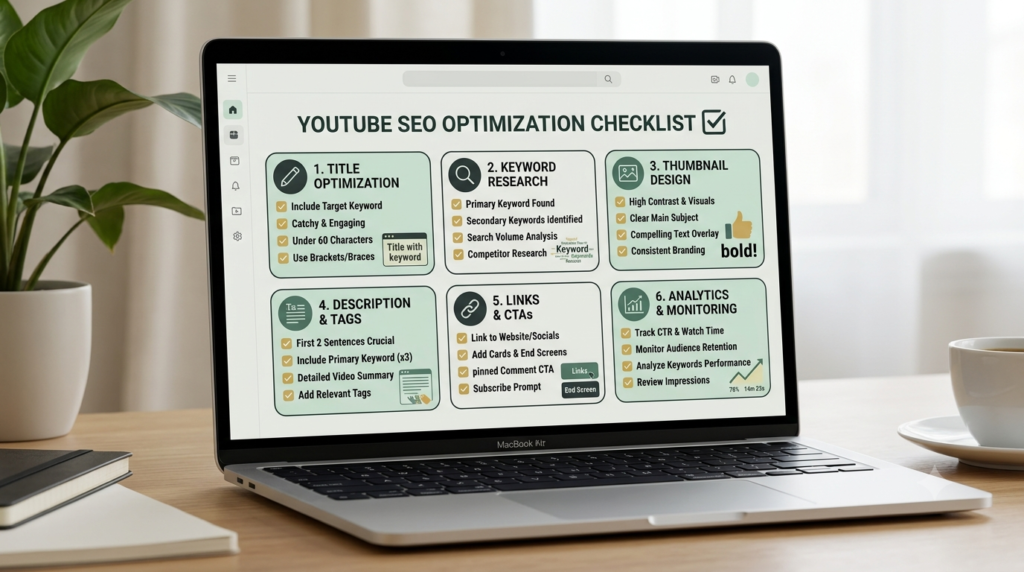
How to Optimize Problem-Based Content to 100 SEO
No SEO plugin score can guarantee rankings, but you can systematically optimize the important elements.
Before publishing
Check that:
- Your primary keyword matches the actual problem.
- The title clearly communicates the benefit.
- The introduction naturally includes the seed keyword.
- Your main heading supports the search intent.
- Related keywords appear naturally.
- The video provides a complete solution.
- Your thumbnail communicates one clear idea.
- Your description explains the video accurately.
- Relevant internal links are included.
- Authoritative external resources support important claims.
- Your CTA is relevant rather than distracting.
After publishing
Review:
- impressions
- click-through rate
- average view duration
- audience retention
- traffic sources
- search terms
- comments
- returning viewers
Use this information to identify new problems and create follow-up videos.
A Simple Problem-Based Content Workflow
Use this workflow whenever you need a new video idea:
Find problem → Understand audience → Research keyword → Check search intent → Create solution → Optimize video → Publish → Analyze → Find next problem
This creates a continuous content cycle.
One useful video can also lead to several related blog posts, Shorts, checklists, tutorials, or digital products.
Final Take away
YouTube problem-based content is a practical way to stop guessing what to publish and start creating content around genuine audience needs.
The strongest approach is simple: identify a problem, understand why people are searching for a solution, create a genuinely useful answer, optimize it for YouTube SEO, and use the results to discover the next problem.
When repeated consistently, this approach can become the backbone of your channel’s content strategy, topical authority, and future monetization opportunities.
Ready to improve your YouTube growth strategy? Explore Aahraa’s YouTube SEO resources and use the next audience problem as your next content opportunity.
Frequently Asked Questions
What is YouTube problem-based content?
YouTube problem-based content is a video strategy where creators identify a specific audience problem and create useful content designed to explain or solve it.
How do I find problems for YouTube videos?
Use YouTube search suggestions, comments, competitor videos, forums, customer questions, Google searches, and your own audience feedback to identify recurring problems.
Is problem-based content good for YouTube SEO?
Yes. It can align a video with search intent because the content begins with a specific question, difficulty, or desired outcome.
Can one problem create multiple YouTube videos?
Yes. A broad problem can contain many smaller problems. For example, “My channel is not growing” can lead to videos about keywords, titles, thumbnails, retention, analytics, and content planning.
Does every problem-based video need high search volume?
No. A specific problem with lower search volume can still be valuable if it attracts the right audience and provides a strong solution.
How often should I create problem-based content?
There is no universal number. Focus on consistently publishing useful content and use performance data and audience questions to determine what to create next.