
11 Powerful YouTube SEO Strategies: Beginner Guide for 2026!
YouTube SEO helps creators organize and present video content so that YouTube can better understand its topic and match it with viewers who may find it useful. For beginners, YouTube SEO is not about repeating keywords everywhere. It is about creating relevant content, understanding your audience, and making the topic clear through the title, thumbnail, description, video content, and supporting information.
YouTube explains that Search considers how well the title, description, and video content match a viewer’s search, along with engagement. Recommendations are personalized and also consider viewer behavior and satisfaction.
This guide explains 11 YouTube SEO strategies you can apply step by step in 2026.
What Is YouTube SEO?
YouTube SEO is the process of improving your video’s relevance, clarity, discoverability, and presentation so that it can be understood by both viewers and YouTube’s systems.
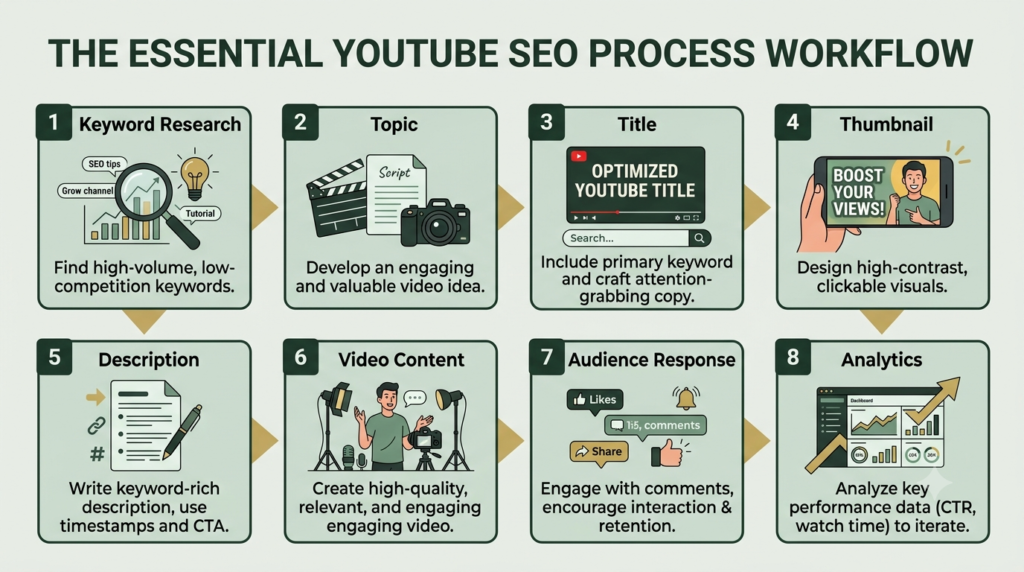
A simple YouTube SEO structure looks like this:
Keyword Research → Topic → Title → Thumbnail → Description → Video Content → Viewer Response → Analytics
Each element supports the others.
For example, if your primary topic is YouTube keyword research, your title, thumbnail, description, spoken content, and related videos should consistently support that topic.
Why YouTube SEO Matters
YouTube Search aims to show relevant results for a viewer’s query. YouTube also recommends videos based on personalization and how viewers respond to content.
Therefore, SEO should not be treated as a collection of tricks. Your objective is to make it easy for the right audience to understand and enjoy your content.
11 Powerful YouTube SEO Strategies
1. Start With Audience and Search Intent
Before creating a video, identify what your audience wants to learn.
Search intent means the reason behind a search. A person searching “how to do YouTube keyword research” probably wants a tutorial, while someone searching “YouTube keyword research tools” may be comparing tools.
Ask:
- What problem does the viewer have?
- What question are they asking?
- What information do they expect?
- What type of video would satisfy that search?
Starting with intent helps you create a video that has a clear purpose.
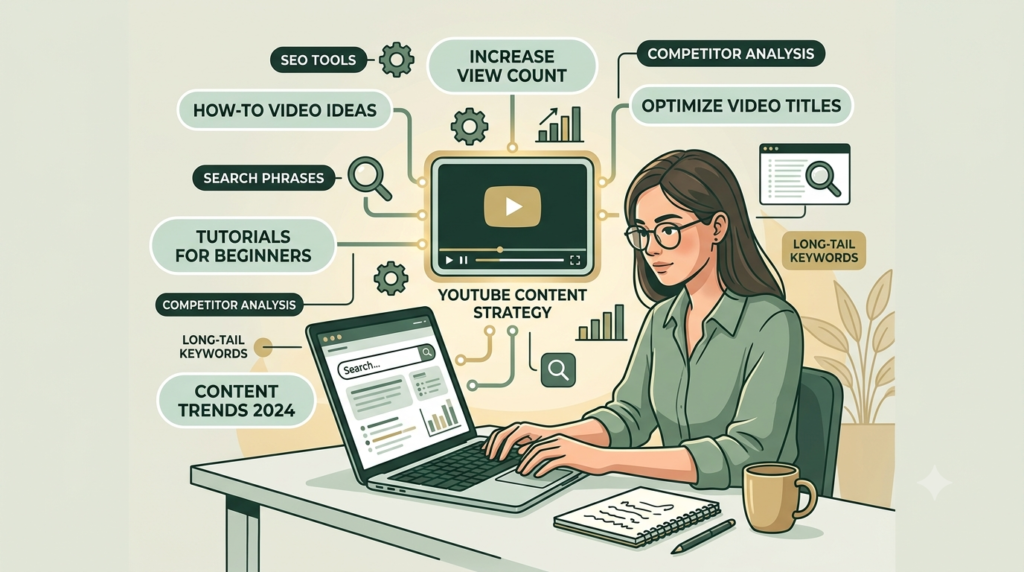
2. Conduct YouTube Keyword Research
Keyword research is the foundation of many YouTube SEO strategies.
Find words and phrases that accurately describe your topic. Look at YouTube search suggestions, competitor topics, related searches, and questions your audience asks.
For example, a broad topic such as YouTube SEO can lead to more specific topics:
- YouTube SEO for beginners
- YouTube SEO tips
- YouTube video SEO
- how to do YouTube SEO
- YouTube keyword research
Choose one primary topic for each video rather than trying to rank one video for every possible keyword.
3. Write a Clear, Search-Friendly Title
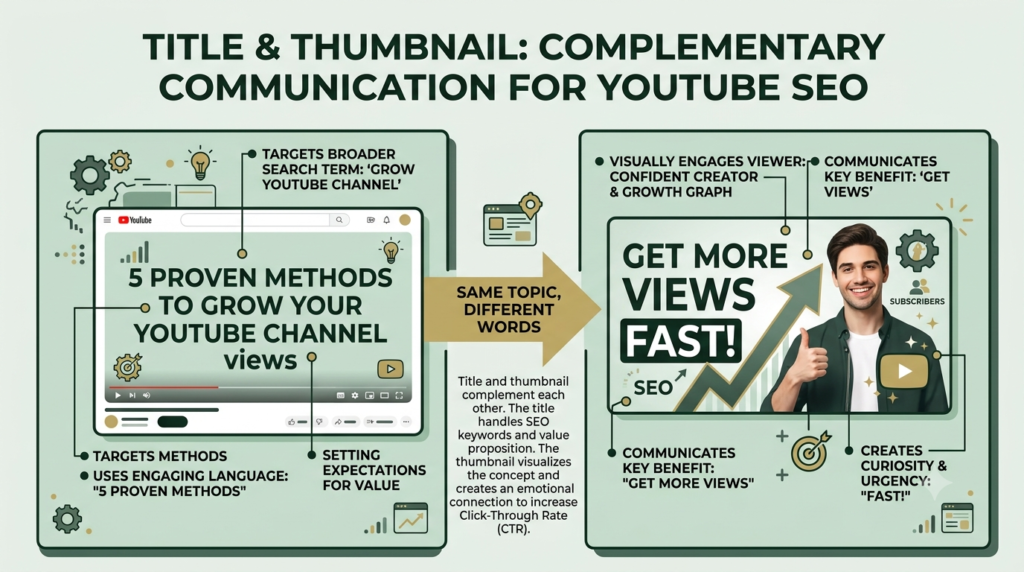
Your title should tell viewers exactly what the video offers.
Use your primary keyword naturally when it fits, but do not force it into an awkward sentence.
A useful title can communicate:
- The topic
- The benefit
- The audience
- The format
- A specific number or outcome
For example:
11 Powerful YouTube SEO Strategies for Beginners
Your title should accurately represent the video. YouTube specifically recommends compelling titles that accurately represent the content and warns against misleading or deceptive titles.
4. Create a Relevant Thumbnail
Your thumbnail works with your title to communicate the video’s value.
Keep the design:
- Clear
- Readable
- Relevant
- Visually distinctive
- Easy to understand on smaller screens
Avoid creating a thumbnail that promises something the video does not provide.
YouTube identifies title and thumbnail as important parts of how content is presented to potential viewers.
5. Optimize the Video Description
Your description provides additional context about the video.
Start with a concise explanation of what viewers will learn. Then add relevant supporting information, links, timestamps when appropriate, and a clear call to action.
Use your primary and related keywords naturally.
Do not write a description that is simply a list of keywords.
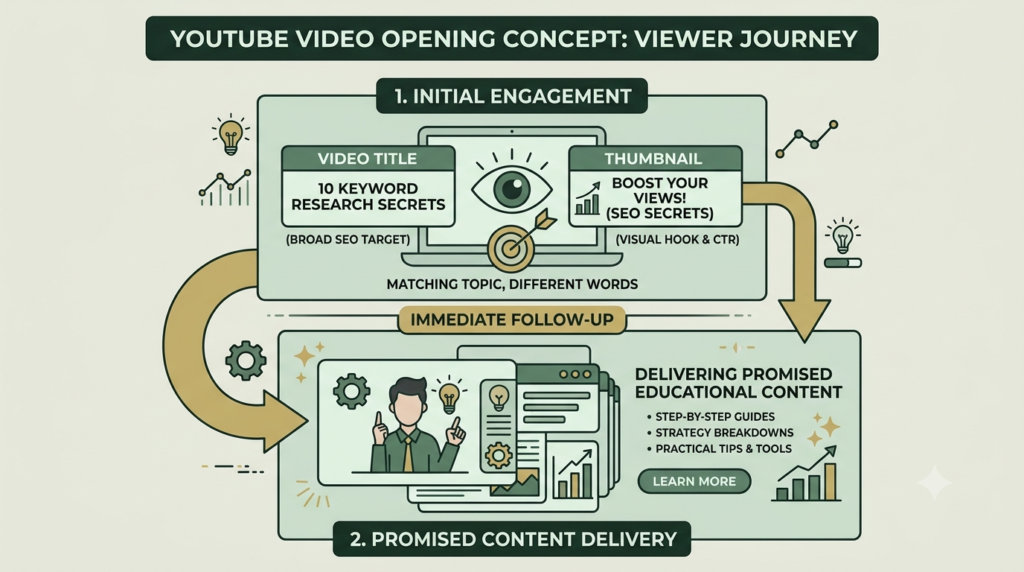
6. Deliver the Value Promised by the Title
One of the most important YouTube SEO tips is to make the actual video match the promise made by the title and thumbnail.
If your title says:
“11 YouTube SEO Strategies for Beginners”
the video should actually explain those strategies.
Your opening should quickly establish what viewers will learn rather than making them wait through a long introduction.
YouTube’s current creator guidance emphasizes viewer appeal, engagement, and satisfaction. It also recommends delivering on the promise made by the title and thumbnail.
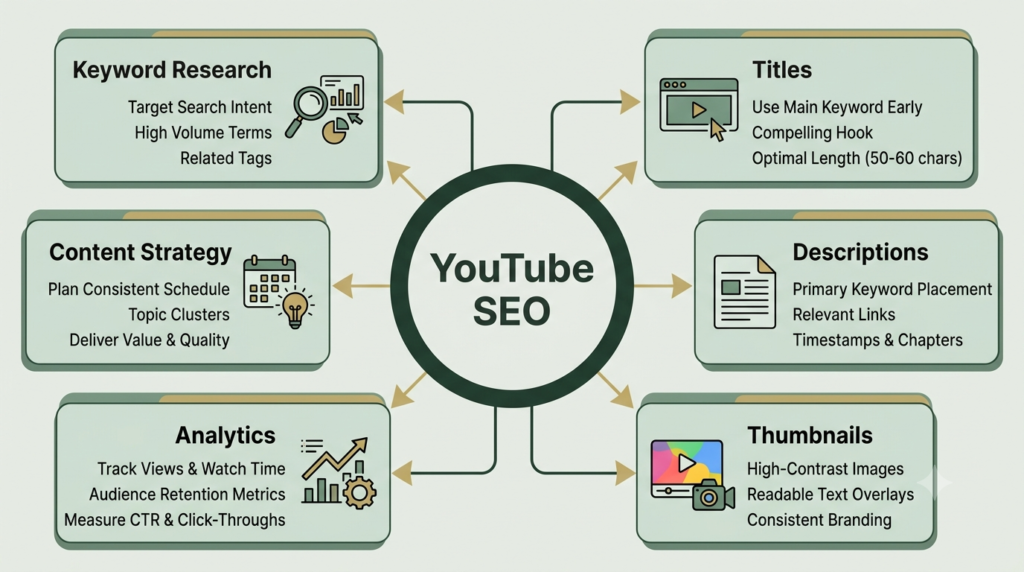
7. Organize Related Videos Into Topic Clusters
A single video is only one part of a channel’s content ecosystem.
Create related videos around a central subject.
For example:
YouTube SEO Pillar
→ Keyword Research
→ Video Titles
→ Video Descriptions
→ Thumbnail Optimization
→ YouTube Analytics
→ YouTube Content Strategy
This creates a clear topical structure.
For Aahraa, this approach is especially useful because your website articles can also support the same YouTube topic cluster.
8. Use Playlists and Internal Video Connections
Organize related videos into useful playlists.
For example:
YouTube SEO for Beginners
could contain:
- YouTube Basics
- Keyword Research
- Video Titles
- Video Descriptions
- Thumbnail Optimization
- YouTube SEO Strategies
You can also use relevant cards and end screens where appropriate to guide viewers toward related content. YouTube’s official optimization guidance specifically identifies titles, descriptions, thumbnails, cards, end screens, and playlists as useful video features.
The objective is to make the next useful piece of content easy to find.
9. Study YouTube Analytics
SEO does not stop when you publish the video.
Use YouTube Analytics to understand how viewers respond.
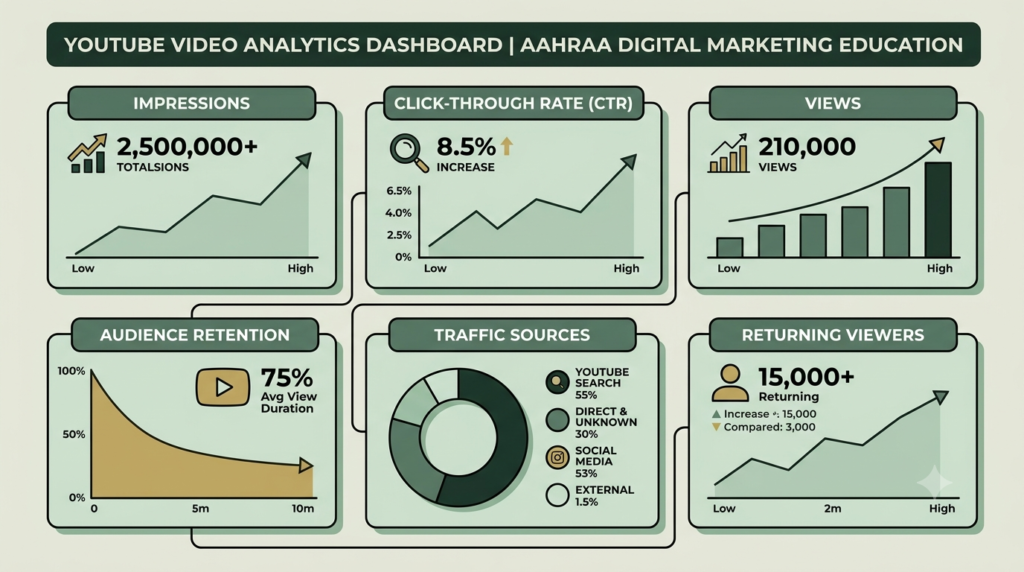
Review relevant metrics such as:
- Impressions
- Click-through rate
- Views
- Average view duration
- Audience retention
- Traffic sources
- Returning viewers
- Audience information
Analytics can help you identify where viewers lose interest and which topics attract your intended audience.
YouTube recommends using audience and performance information to understand what viewers enjoy and to improve future content.
10. Improve Content Based on Viewer Response
Do not assume that every video needs the same strategy.
Look for patterns.
For example:
| Observation | What to review |
|---|---|
| Many impressions but few clicks | Title and thumbnail |
| Good clicks but early drop-off | Opening and content delivery |
| Strong retention but low impressions | Topic interest and competition |
| Traffic from YouTube Search | Search intent and topic relevance |
| Traffic from Suggested Videos | Related content and viewer behavior |
These observations should guide your next experiment.
YouTube explains that performance involves viewer appeal, engagement, and satisfaction, rather than a single ranking factor.
11. Keep Improving Your YouTube SEO Strategy
YouTube SEO is not a one-time task.
Topics change, audiences change, competition changes, and YouTube’s systems continue to evolve.
However, do not change successful videos unnecessarily. YouTube notes that changing a title or thumbnail can change how viewers respond to a video; the change in performance comes from those new viewer interactions, not simply from making the edit.
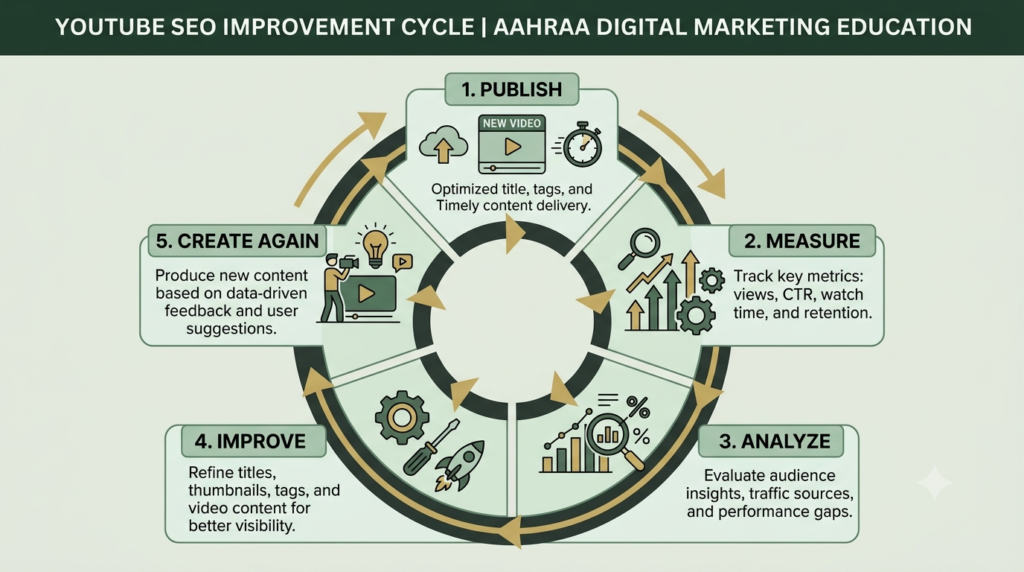
A better approach is:
Publish → Measure → Learn → Improve → Create the next useful video
How YouTube SEO Is the Backbone of Your Content Entity
This is an important concept for Aahraa’s topical authority.
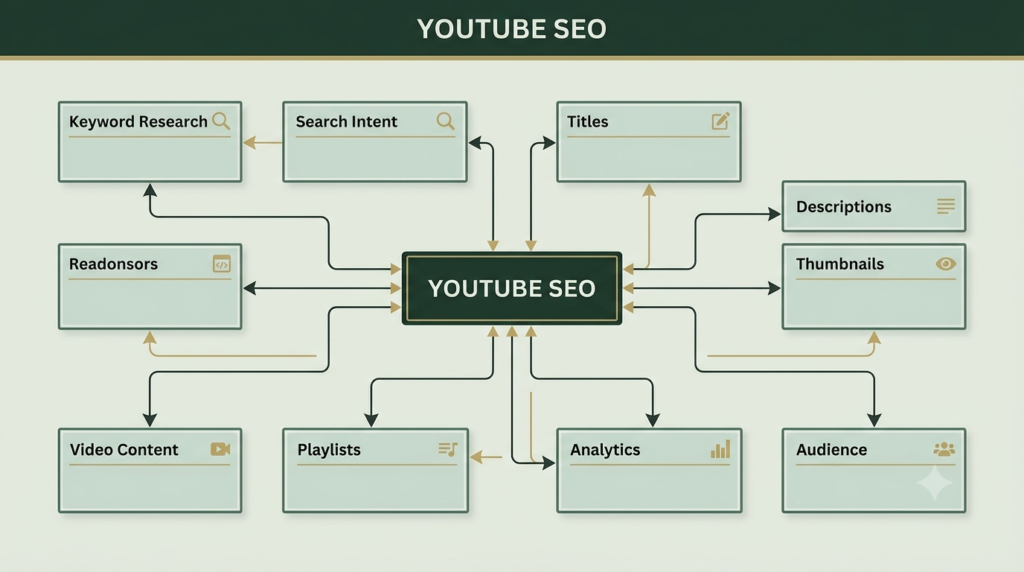
An entity is a clearly identifiable subject, concept, person, organization, product, or topic. In this content cluster, the main entity is YouTube SEO.
Your supporting concepts are connected entities or subtopics:
YouTube SEO
→ Keyword Research
→ Search Intent
→ Video Titles
→ Video Descriptions
→ Thumbnails
→ Video Content
→ Playlists
→ Analytics
This relationship tells a clearer topical story.
Your website can reinforce these relationships through internal links. For example, your YouTube Keyword Research article links to the YouTube SEO article, while the YouTube SEO article links back to keyword research and forward to titles, descriptions, thumbnails, and analytics.
This is why YouTube SEO becomes the backbone of the cluster: it connects individual topics into one coherent subject rather than leaving them as isolated articles.
How to Optimize This Article Toward 100/100
Use this final optimization process after publishing.
Step 1: Check the SEO Title
Recommended title:
11 Powerful YouTube SEO Strategies: Beginner Guide for 2026!
This contains:
- Number: 11
- Power word: Powerful
- Positive/beginner-friendly wording: Guide
- Seed keyword: YouTube SEO
- Year: 2026
It is 60 characters including the final exclamation mark.
Step 2: Check the Meta Description
Learn 11 powerful YouTube SEO strategies for beginners to optimize videos, improve discoverability, reach viewers, and grow your channel in 2026.
This is 145 characters and contains the seed keyword.
Step 3: Check the URL
Recommended slug:
youtube-seo-strategies-beginners-guide-2026
It is well below your 75-character maximum and contains the seed keyword.
Step 4: Check Keyword Use
Use the primary keyword naturally in:
- SEO title
- Introduction
- At least one H2
- URL
- Meta description
- Relevant body sections
- Image alt text where genuinely descriptive
- Schema information
Your four supporting keywords should appear naturally:
- YouTube SEO strategies
- YouTube SEO tips
- YouTube video SEO
- how to do YouTube SEO
Do not force all keywords into every section.
Step 5: Check Internal Links
Connect this article with your existing YouTube cluster:
- YouTube Basics
- YouTube Keyword Research
- YouTube Video Titles
- YouTube Video Descriptions
- YouTube Thumbnail Optimization
- Comprehensive YouTube Optimization Guide
Step 6: Check Mobile Readability
Before publishing:
- Keep paragraphs short.
- Use H2 and H3 headings.
- Use bullets.
- Keep tables simple.
- Check images on mobile.
- Avoid very large blocks of text.
Step 7: Check Rank Math
Run your normal Rank Math check.
A 90+ score is already a strong practical result. Do not rewrite useful content simply to force a plugin score to 100.
100/100 YouTube SEO Checklist
Before publishing, check:
☐ Seed keyword in SEO title
☐ Number in title
☐ Power word in title
☐ Title within 60 characters
☐ Seed keyword in introduction
☐ Seed keyword in an H2
☐ Seed keyword in URL
☐ Seed keyword in meta description
☐ Meta description is 145 characters
☐ Four supporting keywords used naturally
☐ No keyword stuffing
☐ Clear H2/H3 hierarchy
☐ Short paragraphs
☐ Table included
☐ Bullet points included
☐ Eight useful images planned
☐ Descriptive alt text added
☐ Internal links added
☐ Authoritative external links added
☐ One clear CTA
☐ Mobile readability checked
☐ FAQ included
☐ Schema keywords prepared
☐ Schema description prepared
☐ Breadcrumb title added
☐ Rank Math reviewed
☐ Sitemap submitted after publication
☐ Indexing requested after publication
FAQ: YouTube SEO for Beginners
What is YouTube SEO?
YouTube SEO is the process of making your video topic, title, description, content, thumbnail, and related information clear and relevant so YouTube can better understand the content and viewers can find and evaluate it.
How do I do YouTube SEO?
Start with audience research and keyword research. Then create a relevant video, write a clear title and description, create an accurate thumbnail, deliver the promised value, organize related videos, and use Analytics to learn from viewer response.
Does YouTube SEO guarantee more views?
No. SEO can improve relevance and discoverability, but it does not guarantee views. YouTube recommendations and search are influenced by relevance, viewer personalization, performance, engagement, satisfaction, topic interest, competition, and other factors.
Are YouTube tags important for SEO?
Tags can help with common spelling mistakes, but YouTube says they are not essential for discovery. Your main attention should go toward the topic, title, thumbnail, description, and video itself.
How often should I optimize YouTube videos?
Review performance regularly, but don’t change successful videos simply for the sake of optimization. Use Analytics to identify genuine opportunities for improvement and apply what you learn to future videos.
Conclusion
YouTube SEO works best as a complete system rather than a single optimization technique. Start with audience needs and search intent, conduct keyword research, create a useful video, and make the title, thumbnail, description, and content support the same topic.
Your Aahraa YouTube cluster can then connect keyword research → titles → descriptions → thumbnails → SEO → analytics into one strong topical structure.
The goal is not to manipulate an algorithm. The goal is to make useful content easier for the right viewers to understand, discover, and enjoy. YouTube’s own guidance emphasizes relevance, viewer response, personalization, and satisfaction as important parts of discovery.