
Pinterest Optimization: 11 Powerful Positive Strategies for Success in 2026
Pinterest has changed significantly from the platform many people once associated mainly with recipes, weddings, fashion, and home decoration. In 2026, businesses can use Pinterest as a visual discovery platform, search engine, content distribution channel, and traffic source.
That makes Pinterest optimization increasingly relevant to businesses that want sustainable organic digital visibility.
For a beginner, however, Pinterest can feel confusing. What should you optimize first? Which keywords should you use? How should boards be structured? Does Pinterest SEO matter? How does Pinterest fit into an overall SEO strategy?
This complete beginner’s guide answers those questions step by step.
More importantly, it explains how Pinterest connects with Pinterest SEO, Pinterest marketing strategy, digital visibility, and startup social media branding.
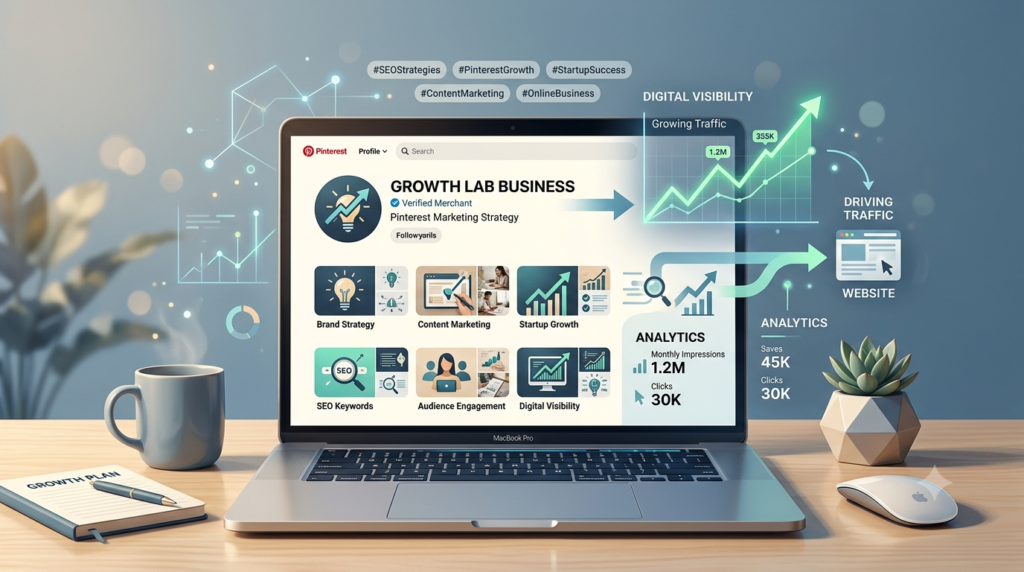
What Is Pinterest Optimization?
Pinterest optimization is the process of improving your Pinterest profile, boards, pins, descriptions, keywords, links, and supporting website so that your content can be discovered by the right audience.
Think of it as SEO for a visual discovery platform.
A basic Pinterest workflow looks like this:
Keyword → Search → Pin → Click → Website → Action
For example, someone might search for
“Pinterest marketing strategy for startups”
They discover an optimized pin, click it, reach your website, read your article, and potentially subscribe, purchase, or explore another page.
This is why Pinterest should not be treated simply as a place to upload attractive pictures.
It should be connected to your broader content and SEO ecosystem.
Why Pinterest profile optimization Matters in 2026
Businesses increasingly compete for attention across search engines, social platforms, marketplaces, and AI-driven discovery systems.
Creating content alone is no longer enough.
People need to discover that content.
This is where Pinterest content strategy becomes valuable.
A well-optimized Pinterest presence can support:
- Brand discovery
- Website traffic
- Content distribution
- Product discovery
- Organic reach
- Brand recognition
- Visual search visibility
- Content repurposing
- Audience development
- marketing of Digital products
For startups in particular, Pinterest can become part of a broader startup social media branding system.
Instead of creating completely different content for every platform, one blog post can become several Pinterest pins, social posts, carousel ideas, email topics, and short educational pieces.
Pinterest Optimization vs Pinterest SEO
These terms are related but not identical.
Pinterest content strategy is the broader process of improving your entire Pinterest presence.
Pinterest SEO focuses more specifically on helping Pinterest understand and surface your content for relevant searches.
For example:
| Pinterest Optimization | Pinterest SEO |
|---|---|
| Profile branding | Keyword research |
| Board organization | Pin titles |
| Visual design | Pin descriptions |
| Content strategy | Search relevance |
| Website experience | Searchable board names |
| Analytics | Keyword placement |
| Posting consistency | Content relevance |
Therefore, Pinterest SEO is an important component of Pinterest profile optimization rather than the entire strategy.
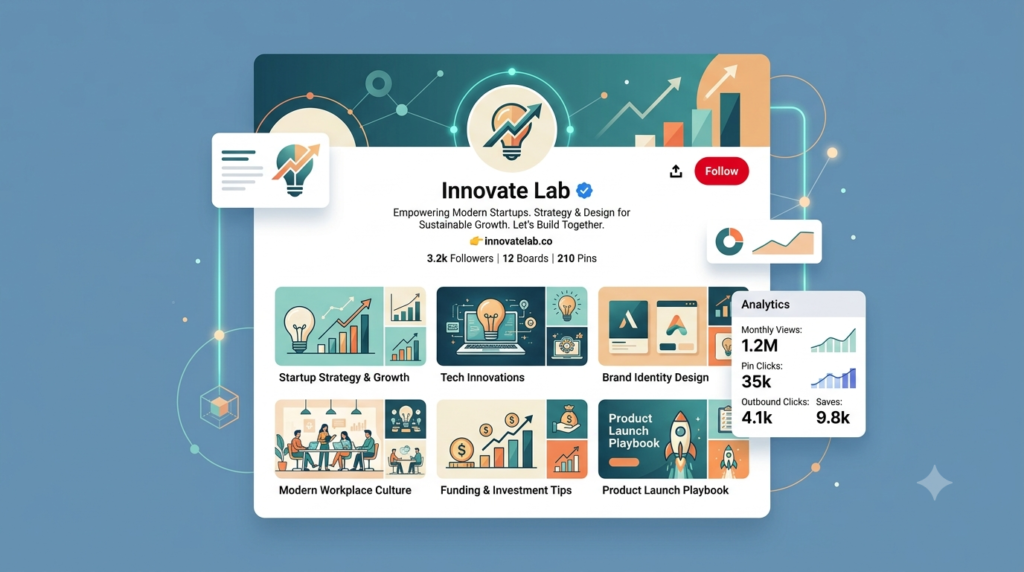
1. Optimize Your Pinterest Business Profile
Your profile is the foundation of your Pinterest presence.
Before publishing dozens of pins, make sure your profile communicates three things:
Who are you?
What do you offer?
Who do you help?
Use your business name consistently across your website and other social platforms.
Your profile description should naturally include relevant terms.
For example:
Helping startups improve digital visibility through SEO, social media, website strategy, and practical digital resources.
Do not fill the description with disconnected keywords.
Write for humans first.
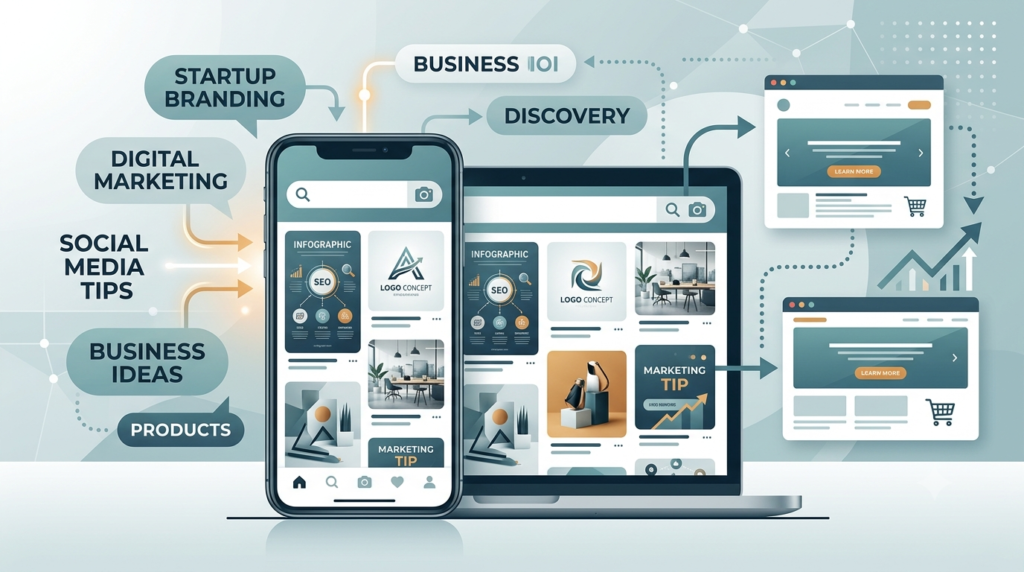
2. Build Keyword-Focused Pinterest Boards
Boards provide Pinterest with additional context about your content.
Instead of creating vague boards such as:
- My Ideas
- Inspiration
- Business
- Things I Like
create descriptive boards such as:
- Pinterest SEO Tips
- Startup Social Media Branding
- Digital Visibility Strategies
- Social Media Marketing Tips
- Startup Marketing Ideas
This helps establish topical relevance.
How to optimize a board
- Choose one clear topic.
- Give it a descriptive name.
- Write a useful keyword-relevant description.
- Add relevant pins.
- Keep unrelated subjects out of the board.
A focused board creates a stronger content relationship between the board, pins, keywords, and destination pages.
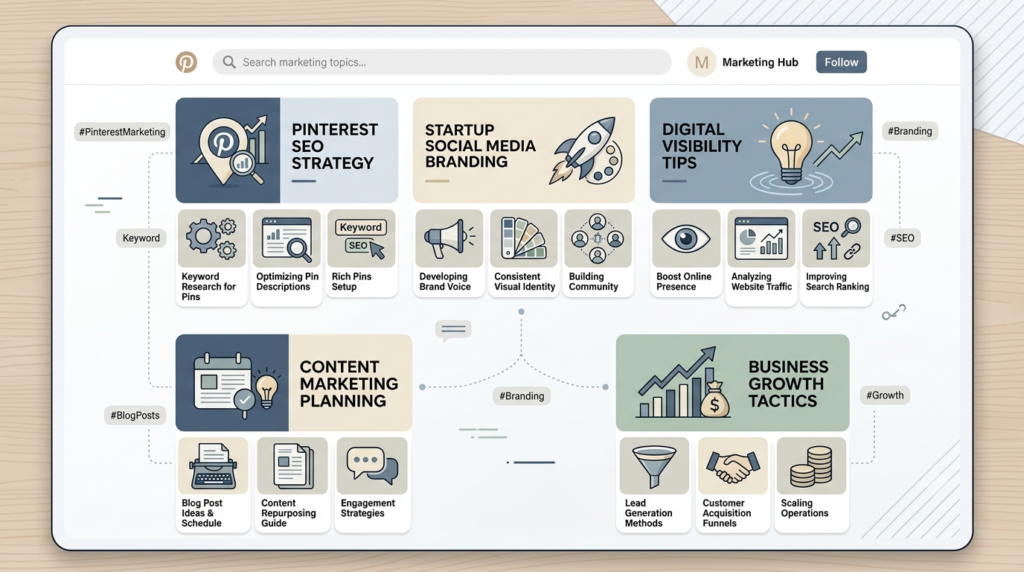
3. Conduct Pinterest Keyword Research
Keyword research is one of the most important parts of Pinterest SEO.
Start by identifying what your target audience might actually search for.
For example, a digital marketing business could research:
- Pinterest marketing strategy
- social media tips
- startup marketing
- SEO tips
- content marketing
- digital visibility
- branding ideas
Don’t limit yourself to one keyword.
Build a keyword cluster.
Primary keyword
Pinterest optimization
Secondary keywords
Pinterest SEO
Pinterest marketing strategy
digital visibility
startup social media branding
Semantic variations
Pinterest marketing
Pinterest search
visual search optimization
Pinterest business strategy
Pinterest content strategy
Pinterest keyword research
This semantic structure helps search systems understand the overall subject rather than relying on repetitive exact-match phrases.
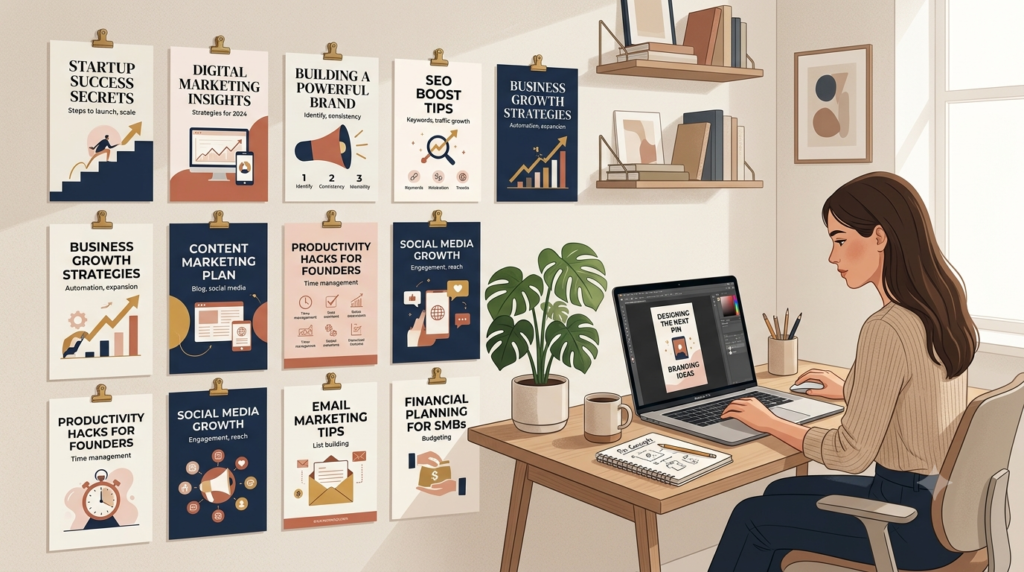
4. Create Search-Friendly Pins
A beautiful graphic is useful, but a beautiful graphic that communicates a clear idea is more valuable.
Your pin should quickly answer:
What will I learn if I click this?
Examples:
- 11 Pinterest SEO Tips for Beginners
- How to Improve Pinterest Visibility
- Pinterest Marketing Strategy for Startups
- Beginner’s Guide to Pinterest Keywords
Use a strong visual hierarchy.
The headline should be readable even on a small mobile screen.
Your existing vertical-pin image from the previous plan fits perfectly here, so keep that image rather than creating another one.
5. Optimize Pin Titles and Descriptions
Your pin title should describe the content accurately.
For example:
Pinterest search optimization: 11 Strategies for Beginners
A description could explain what the reader will gain:
Discover practical Pinterest search optimization strategies for improving Pinterest SEO, increasing digital visibility, and building a consistent Pinterest marketing strategy in 2026.
Notice that the keywords are integrated naturally.
Keyword stuffing reduces readability and provides little value to the audience.
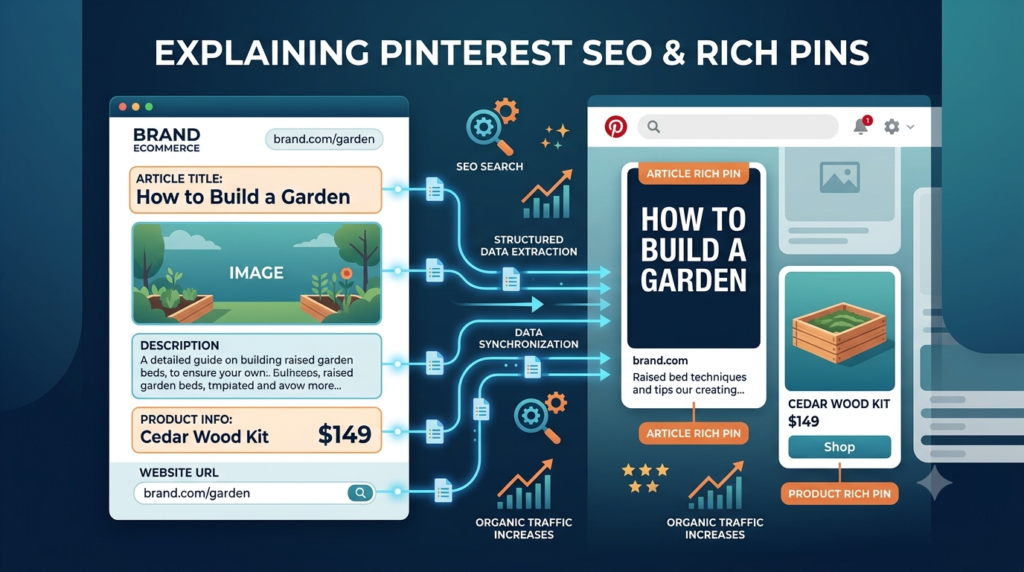
6. Connect Pinterest to Your Website
Pinterest works best when it is connected to a useful destination.
Every promotional pin should ideally lead to a relevant page rather than simply sending visitors to your homepage.
For example:
Pin: Pinterest SEO checklist
Destination: Pinterest SEO blog
Pin: Startup branding ideas
Destination: Startup branding service page
Pin: Digital marketing bundle
Destination: Relevant product landing page
This creates a logical journey:
Pinterest → Relevant page → Useful information → Next action
That is much stronger than sending every visitor to the same generic homepage.
7. Understand the Three Parts of SEO
Pinterest profile optimization should not be isolated from your website SEO.
A business website generally needs three complementary SEO areas.
| SEO Type | What It Means | Main Elements | Beginner Action |
|---|---|---|---|
| On-Page SEO | Optimizing content on your website | Title, headings, keywords, URLs, images, internal links, content | Optimize each page around one primary search intent |
| Off-Page SEO | Signals from outside your website | Backlinks, mentions, citations, digital PR, brand references | Earn relevant and trustworthy mentions |
| Technical SEO | Making the website accessible to search engines and users | Crawling, indexing, speed, mobile usability, redirects, sitemap, structured data | Fix technical errors and make pages easy to crawl |
| Pinterest SEO | Improving discovery within Pinterest | Keywords, boards, pin titles, descriptions, relevance | Optimize profile, boards and pins |
On-Page SEO
On-page SEO concerns what exists on your page.
Important elements include:
- SEO title
- Meta description
- H1
- H2/H3 headings
- Primary keyword
- Supporting keywords
- Search intent
- Internal links
- External references
- Image alt text
- Readability
- Useful content
Off-Page SEO
Off-page SEO concerns signals generated outside your website.
Examples include:
- Relevant backlinks
- Brand mentions
- Digital PR
- Industry references
- Business citations
Quality matters more than collecting random backlinks.
Technical SEO
Technical SEO ensures search engines can efficiently discover, crawl, understand, and index your website.
Important areas include:
- XML sitemap
- Robots.txt
- HTTPS
- Mobile responsiveness
- Page speed
- Canonical URLs
- Redirects
- Broken links
- Indexing
- Structured data
These three SEO areas work together.
A technically perfect website with poor content may not satisfy users.
Excellent content on a technically inaccessible website may struggle to be discovered.
That is why SEO should be treated as an interconnected system.
8. Make Pinterest the Backbone of Your Content Ecosystem
Pinterest can become more than another social account.
It can act as a content distribution backbone.
Imagine publishing one comprehensive blog.
From that one article, you could create:
1 blog → 5 Pinterest pins → 3 Instagram posts → 2 Facebook posts → 1 email → 1 infographic
This creates content efficiency.
For example, this article could generate separate Pinterest pins about:
- Pinterest keyword research
- Pinterest SEO
- Pinterest board optimization
- Pinterest analytics
- Pinterest marketing strategy
Each pin can target a slightly different search intent while directing interested users toward the appropriate content.
This is particularly useful for startups with limited time and resources.
9. Strengthen Digital Visibility With Consistency
Digital visibility rarely comes from one piece of content.
It develops through repeated useful signals.
Create a realistic publishing schedule.
For example:
Monday: educational pin
Tuesday: checklist pin
Wednesday: blog promotion pin
Thursday: statistic/tip pin
Friday: product or service pin
The exact frequency matters less than whether you can maintain quality consistently.
Avoid publishing large quantities of low-value content simply to appear active.
10. Use Pinterest Analytics to Improve Your Strategy
Once your account has enough activity, review performance data.
Look for:
- Impressions
- Saves
- Outbound clicks
- Engagement
- Top-performing content
- Audience interests
Suppose five pins promote the same article.
If one receives significantly more outbound clicks, study what made it different.
Perhaps it had:
- A clearer headline
- Better visual hierarchy
- A stronger benefit
- Better keyword alignment
Create additional variations based on the evidence.
This transforms Pinterest from a guessing game into a measurable marketing process.

11. Build Startup Social Media Branding Around a Consistent Identity
Pinterest should look like part of your business rather than an isolated account.
Your startup social media branding should remain recognizable across platforms.
Keep consistent:
- Logo
- Typography
- Brand colors
- Writing style
- Visual hierarchy
- Messaging
- Audience positioning
However, consistency does not mean every platform should look identical.
Pinterest is visual and search-driven.
Instagram is more relationship and engagement oriented.
Your website is conversion-focused.
Each channel should perform its own role while maintaining the same underlying brand identity.
How to Optimize Pinterest to 99/100
There is no universal Pinterest or SEO setting that guarantees a literal 99/100 score.
However, you can create a practical optimization checklist.
Profile
☐ Business account
☐ Clear profile name
☐ Keyword-relevant description
☐ Website connected
☐ Consistent branding
Boards
☐ Keyword-focused names
☐ Useful descriptions
☐ Clear topical categories
☐ Relevant pins only
Pins
☐ Vertical design
☐ Clear headline
☐ Strong visual hierarchy
☐ Relevant keywords
☐ Accurate destination URL
☐ Useful description
☐ Appropriate call to action
Website
☐ Mobile friendly
☐ Fast enough for users
☐ Relevant landing page
☐ Internal links
☐ Correct indexing
☐ HTTPS
☐ Structured data where appropriate
Content
☐ Matches search intent
☐ Original and useful
☐ Human-written
☐ Updated when necessary
☐ Consistent publishing
Measurement
☐ Monitor analytics
☐ Identify high-performing pins
☐ Test different creative approaches
☐ Improve weak content
☐ Track website traffic
This checklist gives you a much more meaningful optimization process than chasing a score alone.
Pinterest Search Optimization and Digital Visibility
The real value of Pinterest search optimization is not simply gaining impressions.
The bigger objective is building a discoverable digital ecosystem.
Consider the relationship:
Pinterest → Discovery
Website → Education
SEO → Search visibility
Branding → Recognition
Landing page → Conversion
Analytics → Improvement
When these components work together, Pinterest becomes part of a larger digital marketing system.
How Beginners Can Start Pinterest growth strategy
If you are completely new, don’t attempt everything on the first day.
Follow this sequence:
Step 1
Create or optimize your Pinterest business profile.
Step 2
Create 5–8 focused boards.
Step 3
Research keywords around your main business topics.
Step 4
Create several fresh vertical pins.
Step 5
Write keyword-relevant titles and descriptions.
Step 6
Connect each pin to a relevant website page.
Step 7
Publish consistently.
Step 8
Review analytics.
Step 9
Improve the content that receives meaningful engagement.
This approach is easier to maintain than trying to master every Pinterest feature simultaneously.

Common Pinterest content strategy Mistakes
Avoid these common problems:
1. Treating Pinterest only as Instagram
Pinterest is strongly search and discovery oriented, so keyword organization matters.
2. Using generic board names
Specific board names communicate clearer topical relevance.
3. Sending every pin to the homepage
Match each pin to the most relevant destination.
4. Using keyword stuffing
Write naturally and prioritize usefulness.
5. Ignoring mobile users
Design must remain readable on smaller screens.
6. Publishing without measuring
Analytics should influence future content decisions.
7. Using inconsistent branding
A fragmented visual identity can weaken recognition.
Frequently Asked Questions
What is Pinterest profile optimization?
Pinterest profile optimization is the process of improving a Pinterest profile, boards, pins, descriptions, keywords, links, and related website content to increase relevant discovery and traffic.
Is Pinterest SEO different from Google SEO?
Yes. Both use principles of relevance and search intent, but Pinterest has its own discovery environment involving profiles, boards, pins, visual content, and Pinterest-specific search behavior.
How does Pinterest help digital visibility?
Pinterest can expose business content to people searching for ideas, products, information, and inspiration. Pins can also direct users to relevant website pages.
Is Pinterest useful for startups?
It can be particularly useful for startups that have visually useful content, educational resources, products, services, or strong search-oriented content.
How many Pinterest boards should a beginner create?
Start with a manageable number of highly relevant boards rather than creating dozens of poorly defined boards.
Does every Pinterest pin need a keyword?
Pins should be relevant to what people search for, but keywords should be used naturally rather than inserted mechanically.
Conclusion
Pinterest strategy is not simply about creating attractive graphics.
It is a structured process that combines keyword research, Pinterest SEO, content strategy, visual communication, website optimization, analytics, and consistent startup social media branding.
For modern businesses, Pinterest can become an important part of a broader digital visibility strategy.
The strongest approach is simple:
Understand the audience → research the search intent → create useful content → optimize the pin → connect it to the right webpage → measure the result → improve.
When Pinterest, on-page SEO, off-page SEO, technical SEO, content marketing, and branding work together, each channel supports the others.
That is what turns Pinterest from another social platform into a meaningful component of a modern digital marketing ecosystem.