
16 Powerful Performance Marketing Strategies: The Complete Beginner’s Guide in 2026 for Maximum Growth and ROI
Performance Marketing: The Complete Beginner’s Guide in 2026
Introduction
Imagine spending ₹10,000 on advertising and knowing exactly how many people saw our advertisement, clicked it, contacted our business, purchased our product, and how much revenue that campaign generated.
That is the power of performance marketing.
Traditional advertising often makes it difficult to connect spending with measurable results. Performance marketing changes that approach. Instead of simply asking, “How many people saw my advertisement?”, businesses can ask much more useful questions:
- How many people clicked?
- How many became leads?
- How many purchased?
- What did each customer cost?
- Which campaign generated the highest return?
- Where is the advertising budget being wasted?
For a beginner, these numbers can initially look complicated. Terms such as CTR, CPC, CPA, conversion rate, ROAS, Quality Score and impression share may seem like a different language.
They are not.
Once we understand what each metric means and what action to take when a number is weak, we can manage campaigns much more confidently.
This complete beginner’s guide to performance marketing in 2026 explains the entire process in simple language, including the major Google Ads campaign types, marketing funnel, important metrics, landing pages, artificial intelligence, optimization and future trends.
What Is Performance Marketing?
Performance marketing is a results-focused approach to digital advertising in which campaigns are measured using specific actions and business outcomes.
Those actions may include:
- Website visits
- Clicks
- Lead submissions
- Phone calls
- Purchases
- App installations
- Sign-ups
- Bookings
- Subscription registrations
The important idea is measurability.
For example, suppose a business spends ₹20,000 on Google Ads.
The campaign produces:
- 15,000 impressions
- 900 clicks
- 45 leads
- 10 sales
- ₹80,000 revenue
The advertiser can calculate the cost of generating traffic, leads and sales and then compare that cost with revenue.
That is why performance marketing is much more than “running advertisements.” It is a continuous cycle of planning → advertising → measuring → analyzing → optimizing → scaling.
Why Performance Marketing Is the Backbone of Digital Business
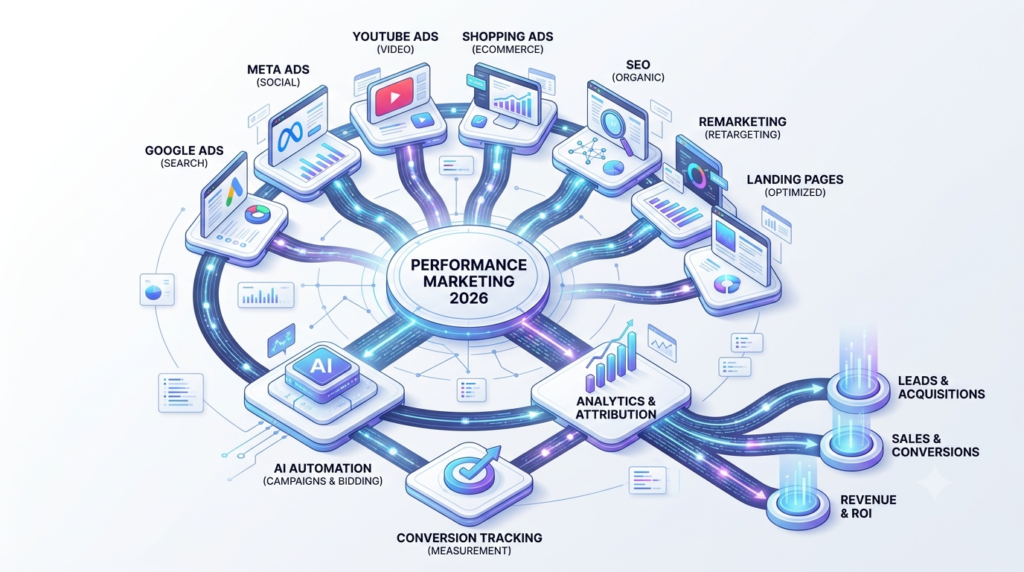
Performance marketing has become the backbone of digital growth because it connects different parts of the customer journey.
Think of a digital business as a system.
Content attracts attention.
SEO captures organic searches.
Advertising creates additional reach and immediate traffic.
Landing pages turn visitors into leads or customers.
Analytics measures what happened.
Remarketing brings interested people back.
Email or CRM systems nurture prospects.
Sales and eCommerce systems generate revenue.
Performance marketing connects these activities through measurable data.
This makes it useful for almost every type of entity:
Startups
Startups can test offers and audiences without waiting months to understand whether their marketing works.
eCommerce businesses
Online stores can measure product clicks, purchases, revenue and advertising return.
Service businesses
Agencies, consultants, clinics, education providers and other service businesses can measure enquiries and leads.
Local businesses
Businesses can use advertising to generate calls, directions, bookings and local enquiries.
SaaS companies
Software companies can measure trials, registrations, subscriptions and customer acquisition cost.
The real strength is not simply advertising. It is the ability to make data-backed decisions.
Key Performance Marketing Channels
Performance marketing includes several advertising channels:
Google Ads
Most powerful intent-based advertising platform.
Meta Ads
Ideal for audience targeting and social engagement.
LinkedIn Ads
Best for B2B lead generation.
Microsoft Ads
Often lower CPC with quality traffic.
Affiliate Marketing
Performance-based partnerships.
Native Advertising
Seamless content-driven promotion.
Email Marketing
Highly effective for retention and remarketing.
Understanding the Performance Marketing Funnel
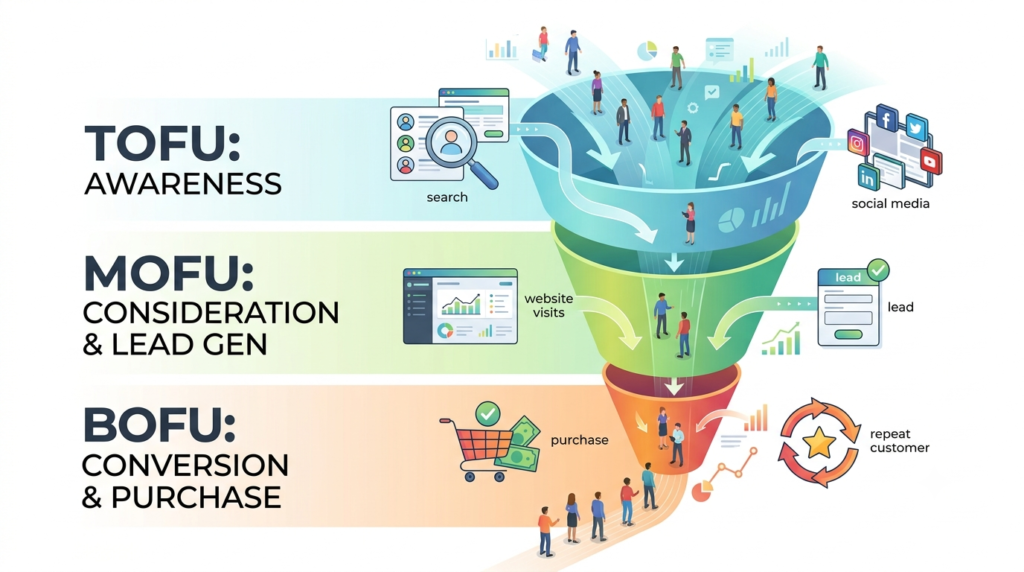
Before choosing a campaign, understand where our customer is in the buying journey.
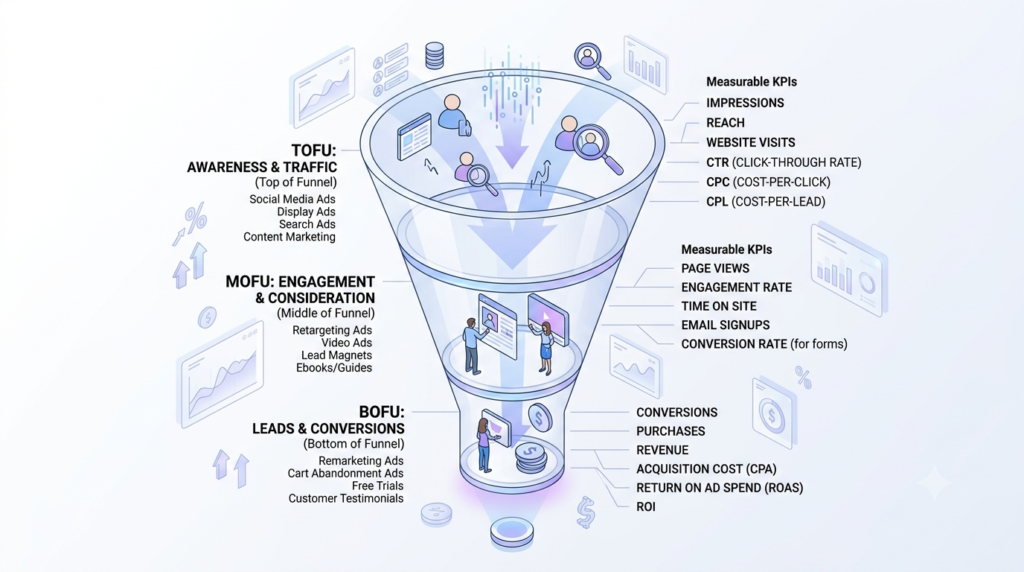
TOFU — Top of Funnel
At this stage, people may not know our brand.
The objective is:
Awareness
Useful campaign types include:
- Display
- YouTube
- Demand Gen
The question is:
“How can I get the right people to notice me?”
MOFU — Middle of Funnel
People now know about our business and may be researching alternatives.
The objective is:
Consideration
Useful activities include:
- Search advertising
- Educational content
- Video
- Remarketing
The question becomes:
“Why should this person consider my business?”
BOFU — Bottom of Funnel
The customer has strong purchase intent.
The objective is:
Conversion
Useful campaigns include:
- Search
- Shopping
- Performance Max
- Remarketing
The question is:
“How can I make it easy for this person to take action?”
A strong performance marketing strategy does not depend on one campaign. It builds a connected customer journey.
Google Ads Campaigns: The Beginner’s Overview
Google Ads remains one of the most important platforms for performance advertising because businesses can reach people at different stages of intent.
Google currently identifies major campaign types including Search, Display, Video, Demand Gen, App, Shopping and Performance Max.
Let’s understand each one.
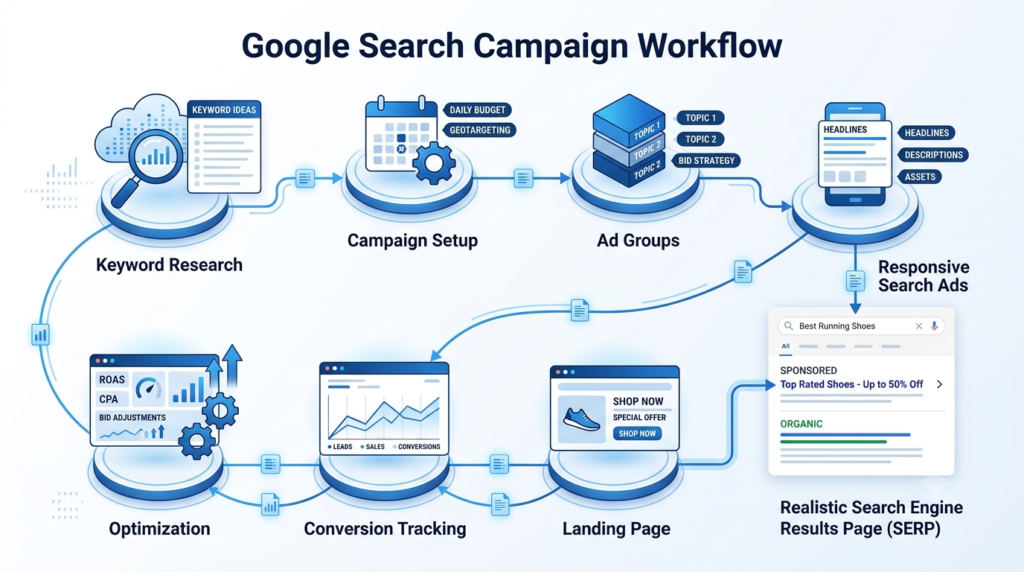
1. Google Search Campaigns
Search campaigns show text-based advertisements when people search for relevant products or services.
For example, someone searches:
“digital marketing agency for startups”
A relevant business can appear in the search results.
This is powerful because the user has already expressed an intention.
Google describes Search campaigns as a way to reach people actively searching for products or services, particularly for sales, leads and website traffic.
Best for
- Leads
- Sales
- Service businesses
- High-intent searches
- Local services
Important metrics
- CTR
- CPC
- Conversion rate
- CPA
- Impression share
- Quality Score
Beginner optimization
If impressions are high but clicks are low, improve the advertisement.
If clicks are high but conversions are low, investigate the landing page, offer, keyword intent and conversion tracking.
If CPC is high, examine Quality Score, competition, keyword selection and search terms.
2. Google Display Campaigns
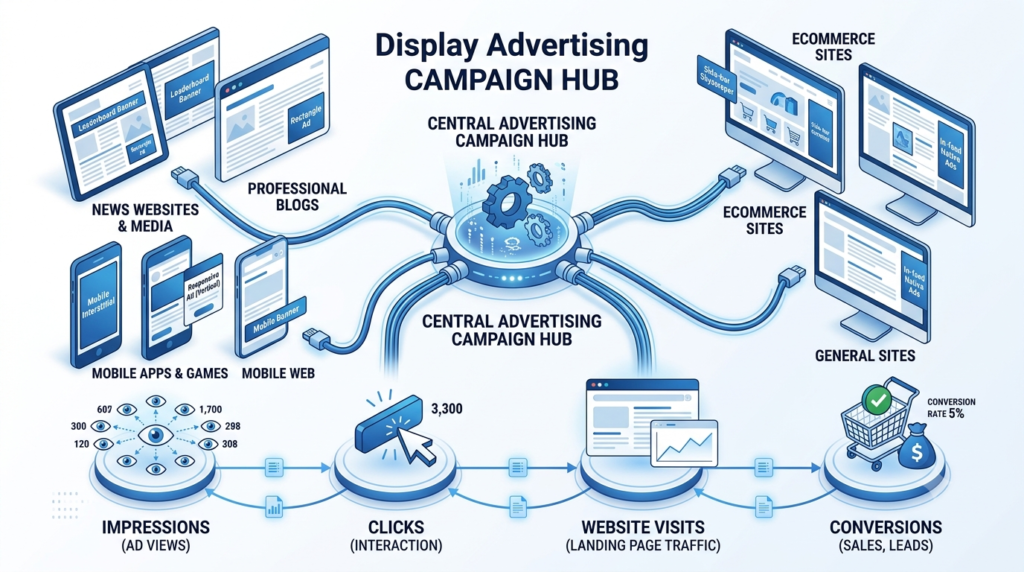
Display advertising uses visual advertisements across websites, apps and eligible Google properties.
Display is generally more suitable for reaching people while they are browsing rather than actively searching for a product.
Google describes Display as a way to expand reach beyond Search using visually engaging advertisements.
Best for
- Brand awareness
- Remarketing
- Audience expansion
- Visual promotion
Important metrics
- Impressions
- Reach
- CTR
- Frequency
- Conversions
- CPA
Beginner optimization
If people see our advertisement but do not interact with it, test different:
- Images
- Headlines
- Offers
- Calls-to-action
Also monitor placements and audience quality.
2026 note: Google is changing how Display inventory is integrated with Demand Gen. Google announced a phased 2026 migration path for eligible advertisers, so always check the current campaign options inside our own Google Ads account rather than relying on an old tutorial.
3. Google Shopping Campaigns
Shopping advertising is designed primarily for retailers.
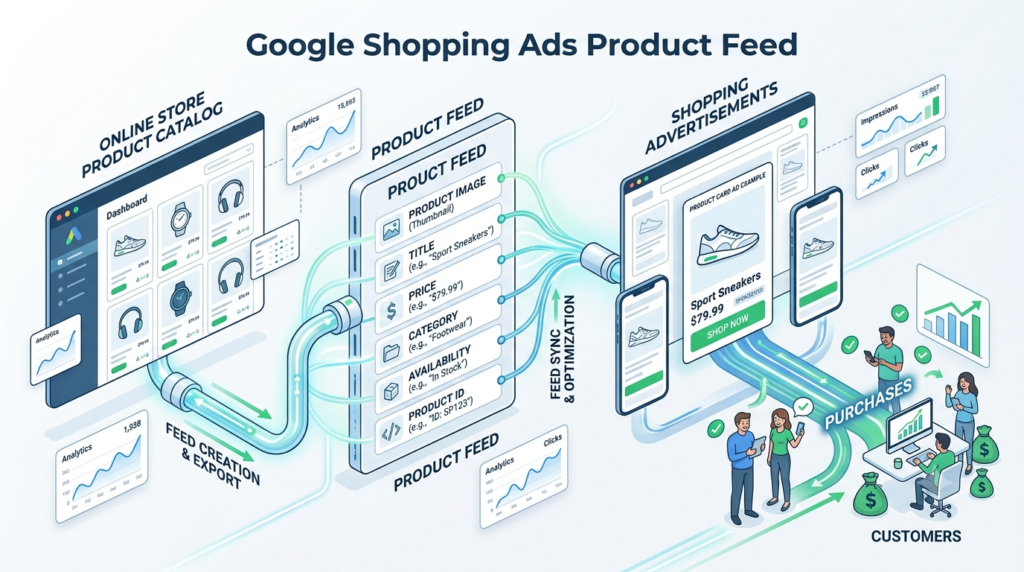
Instead of showing only text, Shopping ads can show information such as:
- Product image
- Product title
- Price
- Store name
This gives shoppers useful information before they click.
Best for
- eCommerce
- Retail
- Product-based businesses
Important metrics
- Product impressions
- CTR
- CPC
- Conversion rate
- CPA
- ROAS
Beginner optimization
Start with the product feed.
Improve:
- Product titles
- Product descriptions
- Images
- Prices
- Product identifiers
- Product categorization
A weak product feed can limit campaign performance even when the advertising strategy is good.
4. Performance Max Campaigns
Performance Max is one of Google’s most important AI-powered campaign types.
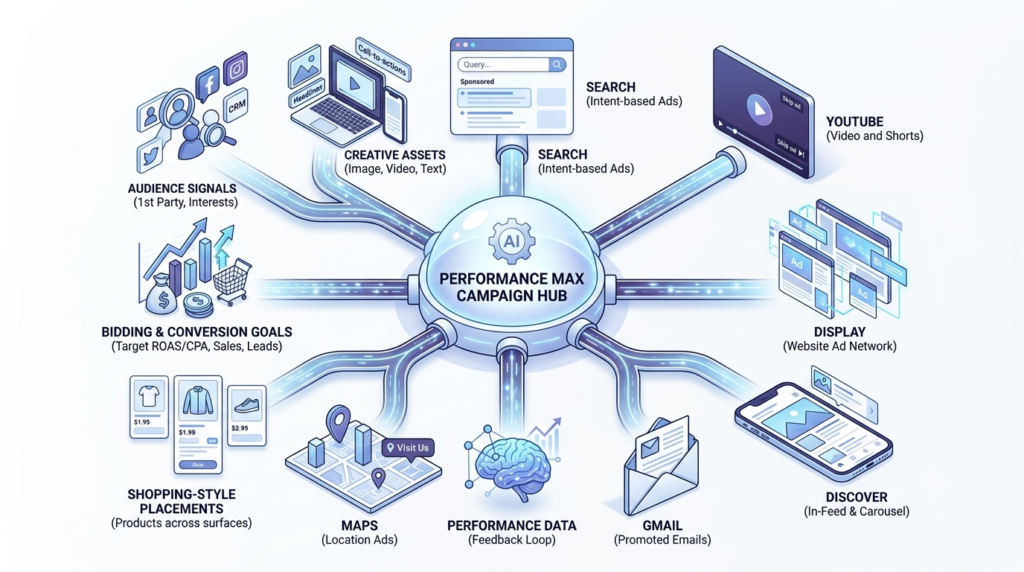
It can access multiple Google advertising surfaces from a single campaign, including Search, YouTube, Display, Discover, Gmail, Maps and Shopping-related inventory.
Instead of manually deciding every placement, advertisers provide Google with:
- Conversion goals
- Budget
- Creative assets
- Audience signals
- Product data where applicable
Google AI then uses these inputs to optimize toward the selected business goals.
Best for
- Sales
- Lead generation
- eCommerce
- Conversion-focused growth
Important metrics
- Conversions
- Conversion value
- CPA
- ROAS
- Asset performance
- New customer performance
Beginner mistake
Do not assume that automation means “set it and forget it.”
We still need:
- Accurate conversion tracking
- Good creative assets
- Appropriate goals
- Budget control
- Search-term and campaign insights
- Landing-page quality
Performance Max is powerful, but the quality of the information we give the system matters.
5. YouTube and Video Campaigns
Video advertising allows businesses to reach people through YouTube and eligible video inventory.
Video campaigns can support different objectives, including awareness, views, engagement, leads and conversions.
Best for
- Brand storytelling
- Product demonstrations
- Education
- Awareness
- Retargeting
- Lead generation
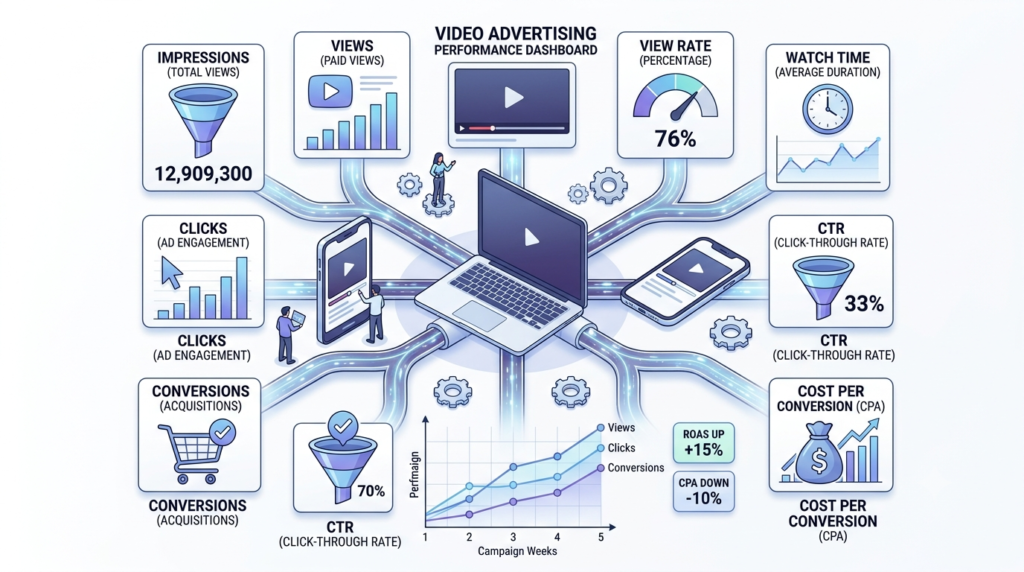
Important metrics
- Views
- View rate
- Watch time
- Engagement
- CTR
- Conversions
- CPA
Beginner optimization
Do not spend the first 20 seconds explaining our company.
Start with the audience’s problem.
For example:
“Are we spending money on Google Ads but still don’t know which campaign is profitable?”
Then explain the solution.
A clear opening, useful content and strong call-to-action are more valuable than simply making a beautiful video.
6. Demand Gen Campaigns
Demand Gen campaigns are designed to create interest and consideration using visual advertising experiences across Google’s feed-based surfaces.
Google describes Demand Gen as appearing across places such as YouTube feeds, Gmail and Discover.
Best for
- Creating demand
- Product discovery
- Visual storytelling
- Audience nurturing
- Consideration
Important metrics
- CTR
- Engagement
- Conversion rate
- CPA
- Conversion value
Beginner approach
Do not expect every user to purchase immediately.
Use Demand Gen to introduce:
- A problem
- A solution
- A product
- A useful resource
- A compelling offer
Then use remarketing and conversion campaigns to move interested users further down the funnel.
7. App Campaigns
App campaigns are designed to help businesses promote mobile applications.
Google can automatically create and distribute advertisements using information and assets provided for the app across eligible Google surfaces.
Goals may include
- App installs
- App engagement
- App actions
- Pre-registration where eligible
Important metrics
- Cost per install
- Install volume
- Engagement
- Retention
- In-app conversion value
The important lesson is that an inexpensive installation is not automatically a successful acquisition.
A user who installs the app and never uses it may be less valuable than a user who costs more but becomes a paying customer.
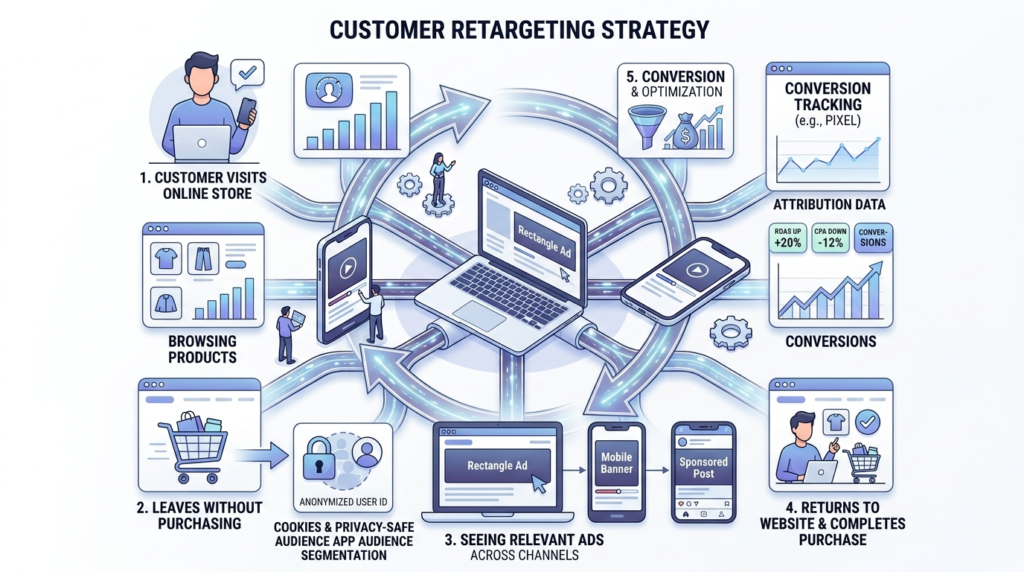
8. Remarketing
Remarketing focuses on people who have already interacted with our business.
For example:
A person visits our website.
They view a product.
They leave without purchasing.
Later, our advertisement reminds them about the product.
That is remarketing.
Useful audiences
- Website visitors
- Product viewers
- Cart abandoners
- Previous customers
- Lead visitors
- Video viewers
Why it matters
The audience already knows something about our business.
Our message can therefore be more specific.
For example:
“Still comparing our options? See what is included in our complete starter package.”
The goal is not to repeatedly show the same advertisement. It is to provide a relevant next reason to return.
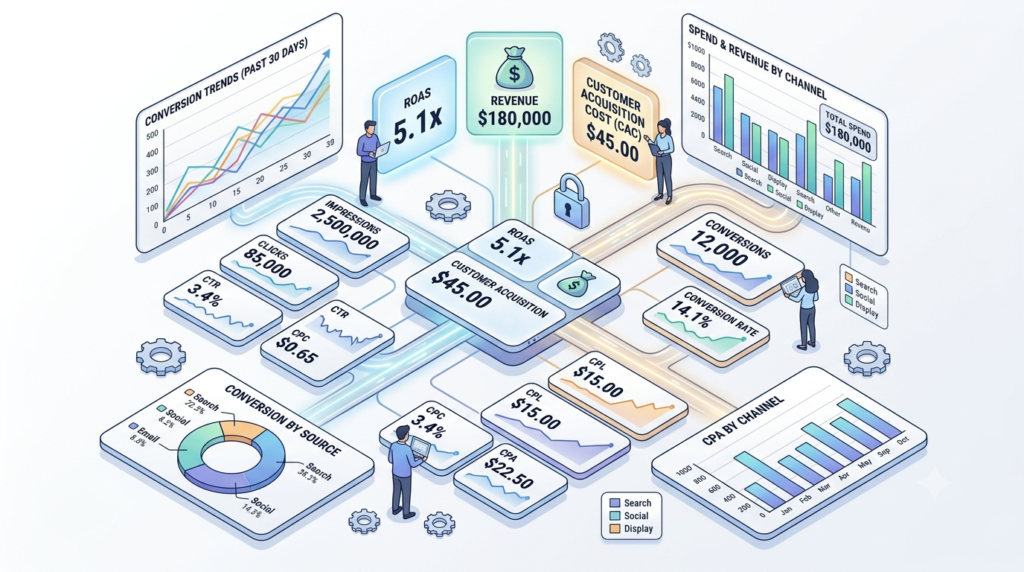
9.Performance Marketing Metrics Every Beginner Should Know
The dashboard contains many numbers, but start with these.
Impressions
The number of times an advertisement is shown.
High impressions mean visibility, not necessarily success.
Clicks
The number of times users click an advertisement.
Clicks tell us that people are taking an initial action.
CTR — Click-Through Rate
CTR tells us how frequently people click after seeing the advertisement.
Formula:
CTR = Clicks ÷ Impressions × 100
A low CTR may indicate weak messaging, poor targeting or low relevance.
CPC — Cost Per Click
CPC tells us the average amount paid for a click.
Formula:
Cost ÷ Clicks
A high CPC is not automatically bad.
If an expensive click produces a profitable customer, it may be better than a cheap click that never converts.
Conversion Rate
Conversion rate tells us what percentage of visitors completed the desired action.
Formula:
Conversions ÷ Clicks × 100
If 500 people click and 25 convert:
Conversion rate = 5%
CPA — Cost Per Acquisition
CPA tells us how much it costs to generate one conversion.
Formula:
Advertising spend ÷ Conversions
For example:
₹10,000 ÷ 50 conversions = ₹200 CPA
Our acceptable CPA depends on our profit margin and customer value.
ROAS — Return on Ad Spend
ROAS measures revenue generated in relation to advertising spend.
Formula:
Revenue ÷ Advertising spend
If we spend ₹20,000 and generate ₹100,000 in tracked revenue:
ROAS = 5X
However, remember that ROAS is not the same as profit.
We must also consider:
- Product cost
- Shipping
- Salaries
- Taxes
- Platform fees
- Other operating costs
10.How to Diagnose a Poor Campaign
Instead of immediately increasing the budget, ask four questions.
Problem 1: Low impressions
Check:
- Budget
- Targeting
- Keyword coverage
- Search volume
- Eligibility
- Bidding
Problem 2: High impressions but low CTR
Improve:
- Headlines
- Offer
- Relevance
- Audience
- Creative
Problem 3: High clicks but low conversions
Investigate:
- Landing page
- Offer
- Page speed
- Mobile experience
- Conversion tracking
- Search intent
Problem 4: Conversions but poor profitability
Review:
- CPA
- Average order value
- ROAS
- Customer quality
- Product margin
- Campaign allocation
This simple diagnostic process prevents emotional decision-making.
11.Landing Pages: Where Advertising Becomes Business
An advertisement can bring a visitor.
The landing page must convince that visitor to take action.
A good landing page should answer three questions quickly:
What are we offering?
Why should I trust you?
What should I do next?
Include:
- Clear headline
- Relevant message
- Benefits
- Proof
- Strong CTA
- Easy navigation
- Mobile-friendly design
- Fast loading experience
Do not send every advertisement to our homepage simply because it is convenient.
A campaign about one specific service should ideally lead to a page that continues the same message.
12.How Artificial Intelligence Is Changing Performance Marketing
AI is now deeply integrated into digital advertising.
Google uses AI for activities such as automated bidding, audience signals, asset combinations and real-time optimization in Performance Max.
But AI does not remove the need for marketers.
Human decisions are still needed for:
- Business objectives
- Offers
- Positioning
- Customer understanding
- Creative direction
- Conversion definitions
- Profitability
- Brand safety
Think of AI as an optimization engine.
We still need to decide where we want to go.
13.A Simple Performance Marketing Optimization Routine
If we are a beginner, do not try to change everything every day.
Every week
Check:
- Spend
- Impressions
- CTR
- CPC
- Conversions
- CPA
- Search terms
- Major audience differences
Every two weeks
Review:
- Advertisement performance
- Landing pages
- Devices
- Locations
- Audience segments
- Creative performance
Every month
Review:
- ROAS
- Revenue
- Customer acquisition cost
- Campaign profitability
- Budget allocation
- Best-performing products or services
Then make controlled changes.
14. The Golden Rule: Do Not Optimize Blindly
A campaign can have:
Excellent CTR + terrible conversions
or:
Low CTR + highly profitable conversions
Therefore, never optimize a campaign based on one metric alone.
For example, a high CTR can look impressive, but if the clicks do not produce customers, the campaign may still be wasting money.
The final objective is not simply traffic.
It is business results.
15. Performance Marketing in 2026: What Beginners Should Focus On
The digital advertising environment is becoming increasingly automated and multi-channel.
The strongest fundamentals remain:
- Understand the customer.
- Define one clear objective.
- Track conversions correctly.
- Match campaign type to customer intent.
- Build relevant landing pages.
- Monitor meaningful metrics.
- Test rather than guess.
- Protect the advertising budget.
- Scale what works.
- Stop what consistently fails.
Google itself emphasizes selecting campaign types according to marketing goals, brand strategy and the level of control required.
16. The Future of Performance Marketing
The next phase of performance marketing will be increasingly influenced by:
- Artificial intelligence
- Predictive analytics
- First-party data
- Automated bidding
- Creative automation
- Cross-channel measurement
- Privacy-focused measurement
- Customer lifetime value
- Omnichannel customer journeys
The marketer’s role is therefore changing.
The job is moving away from simply pressing buttons inside an advertising platform.
The modern performance marketer needs to understand the whole system:
Customer → Offer → Creative → Campaign → Landing Page → Conversion → Revenue → Optimization
That is the real performance marketing ecosystem.
Conclusion: Performance Marketing Is a Growth System, Not Just Advertising
Performance marketing can look complicated when we first open an advertising dashboard.
There may be dozens of columns, campaign settings and unfamiliar terms.
But the underlying logic is simple:
Get the right message in front of the right person, measure what happens, improve the weak points and invest more in what produces profitable results.
Google Search can capture existing demand.
Display can expand awareness.
Shopping can showcase products.
Performance Max can use Google’s automated systems across multiple surfaces.
Video can tell our story.
Demand Gen can create interest.
App campaigns can acquire users.
Remarketing can bring interested people back.
Together, these campaigns can form a complete customer acquisition system.
The goal of performance marketing is not to chase every available click. It is to build a measurable path from attention to action and from action to sustainable business growth.