
7 Powerful Meta Ad Campaign Types for Smarter Growth
If you are new to Meta advertising (Meta Ad campaign), the biggest challenge is often not creating an advertisement. It is understanding which campaign objective to choose and why.
Meta advertising(Meta Ad campaign) allows businesses to promote products, services, content and apps across Meta’s ecosystem. But one campaign does not serve every purpose. A campaign designed to generate website visits is fundamentally different from one designed to generate purchases.
That is why understanding Meta Ad campaign types is important before spending money.
The simplest way to think about Meta campaigns is this:
Different objectives tell Meta what kind of result you want from your advertising.
In this guide, we will look at the major Meta Ad campaign objectives, when each is useful, what makes each unique, and how different meta Ad campaigns can work together.
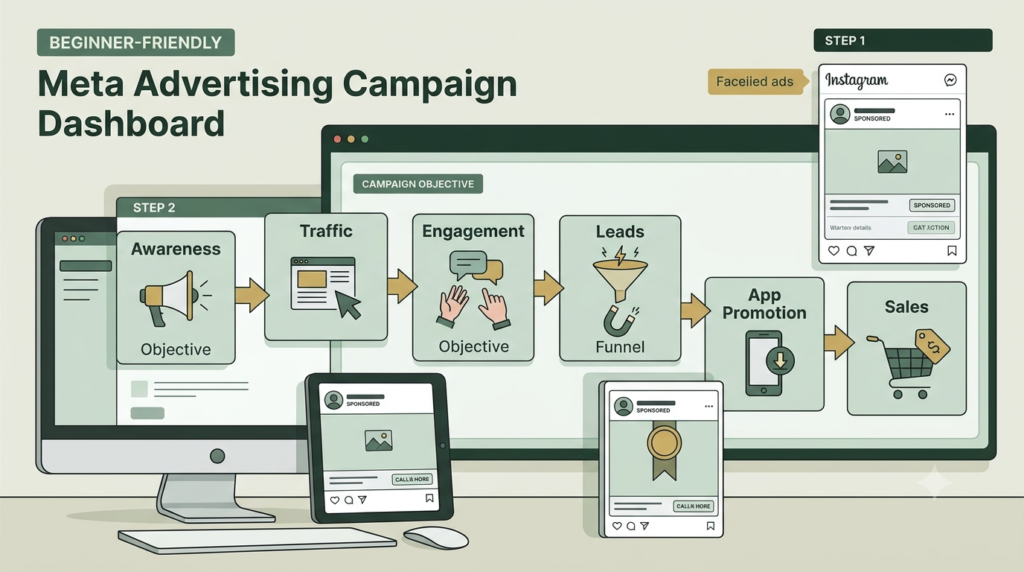
What Are Meta Ad Campaign Types?
Meta Ad campaign are campaign objectives designed around different business outcomes.
Depending on your account, market, destination and available features, Meta Ads Manager can present objectives such as:
The important point is that the objective is not merely a label.
It influences what Meta’s delivery system is trying to optimize for.
For example, if your goal is to sell a digital product, simply generating thousands of impressions is not necessarily the same as generating purchases.
Your campaign should therefore begin with the question:
“What action do I want the customer to take?”
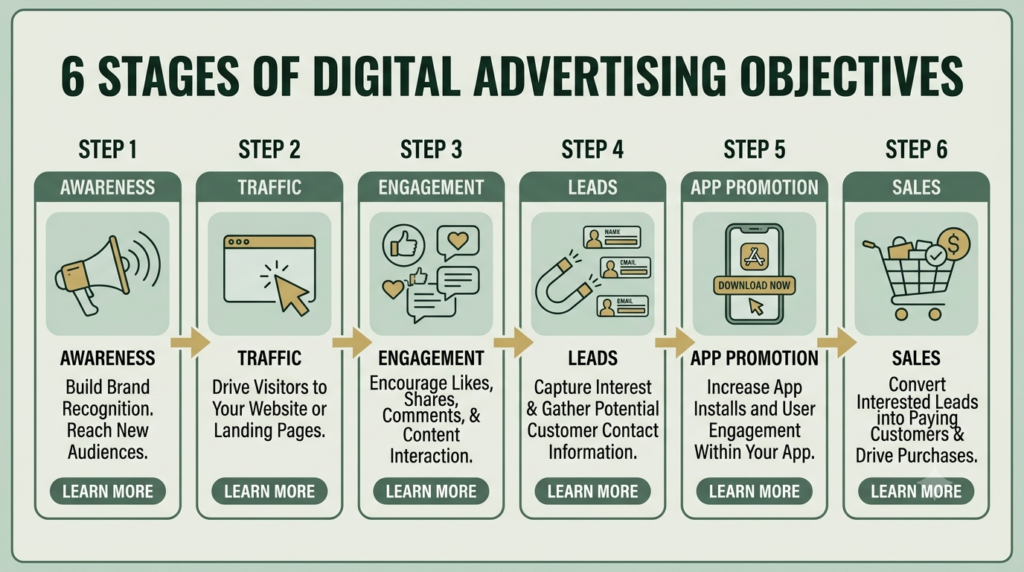
1. Awareness Campaigns
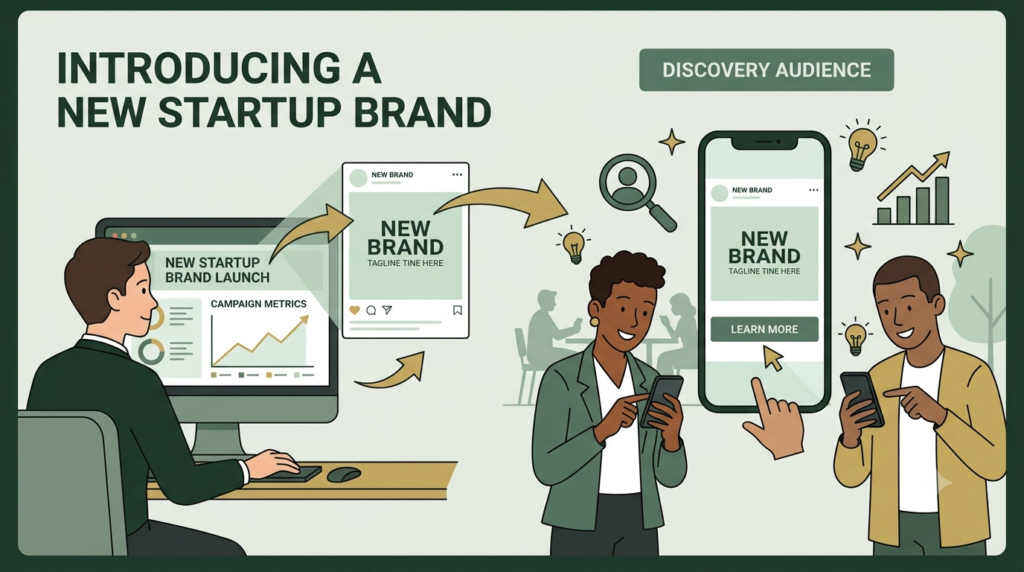
An Awareness campaign is designed primarily to introduce your business, product or message to people.
It can be useful when your audience does not know you yet.
When should you use it?
Consider awareness when you want to:
- Introduce a new brand
- Increase recognition
- Promote a new business
- Build familiarity with a product
- Reach people at the beginning of the customer journey
What makes it unique?
Awareness is mainly about being seen and remembered rather than immediately asking someone to purchase.
Imagine launching a new digital marketing agency.
Instead of immediately asking strangers to buy a service, you could first introduce your brand through useful educational content.
Example
A startup marketing agency could run an awareness campaign featuring
“5 Digital Marketing Mistakes New Startups Make”
The audience learns about the business before receiving a stronger offer later.
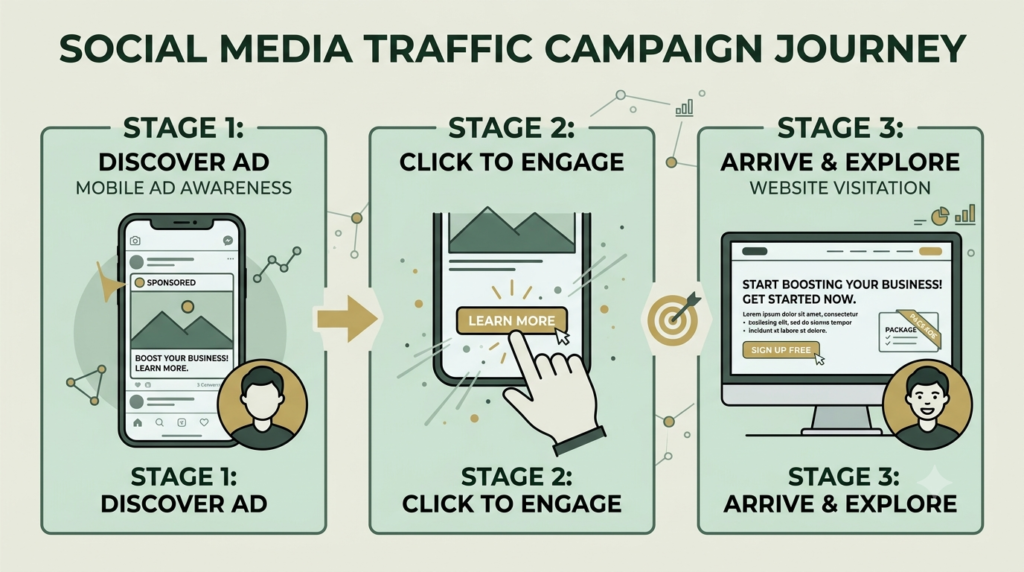
2. Traffic Campaigns
Traffic campaigns are designed to encourage people to visit a destination such as a website, landing page or other supported destination.
This makes traffic particularly useful when your website contains the next step.
When should you use it?
Traffic can be useful for:
- Blog articles
- Landing pages
- Product information pages
- Website content
- Free resources
- Educational guides
What makes it unique?
The central purpose is getting people to a destination.
For example, suppose you have published a detailed article about SEO for startups.
A traffic campaign could send interested people directly to that article.
Important consideration
A click alone does not guarantee a sale.
You should make sure the destination page is:
- Mobile-friendly
- Fast enough to use comfortably
- Relevant to the advertisement
- Easy to understand
- Equipped with a clear next action
Traffic is therefore often more useful when the page receiving visitors is already prepared to continue the customer journey.
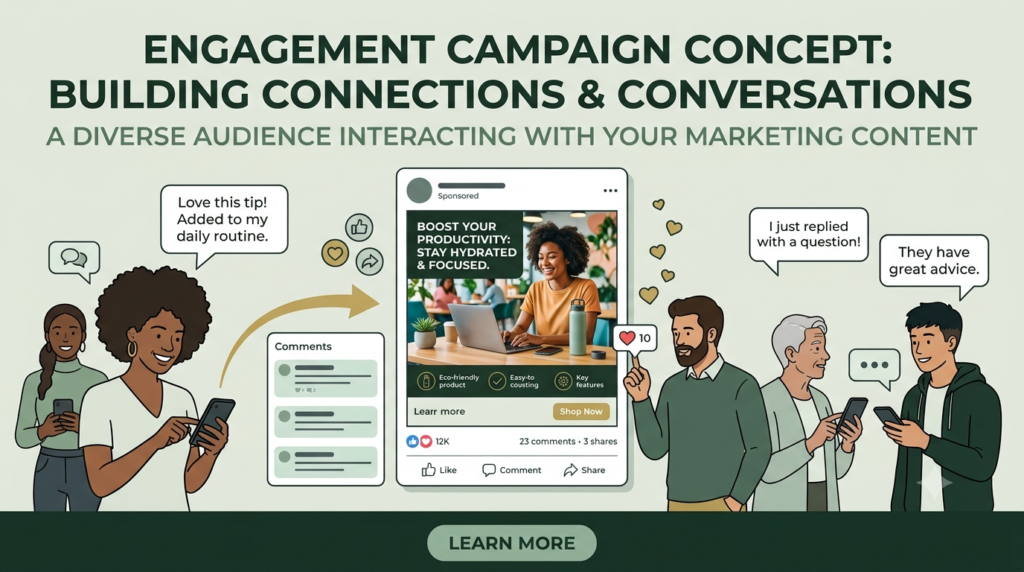
3. Engagement Campaigns
Engagement campaigns focus on interactions with your content or business.
Depending on the setup available in your account, this can include actions such as interactions with posts, video engagement or other supported engagement outcomes.
When should you use it?
Engagement can help when you want to:
- Encourage conversations
- Increase interactions
- Promote content
- Build social activity
- Generate responses around an offer
- Develop familiarity with your brand
What makes it unique?
Engagement is about interaction rather than simply exposure.
For example, a business could promote a useful post asking:
“What is your biggest digital marketing challenge?”
People can respond with their experiences.
That interaction can provide useful audience insights while helping the business become more familiar to potential customers.
4. Leads Campaigns
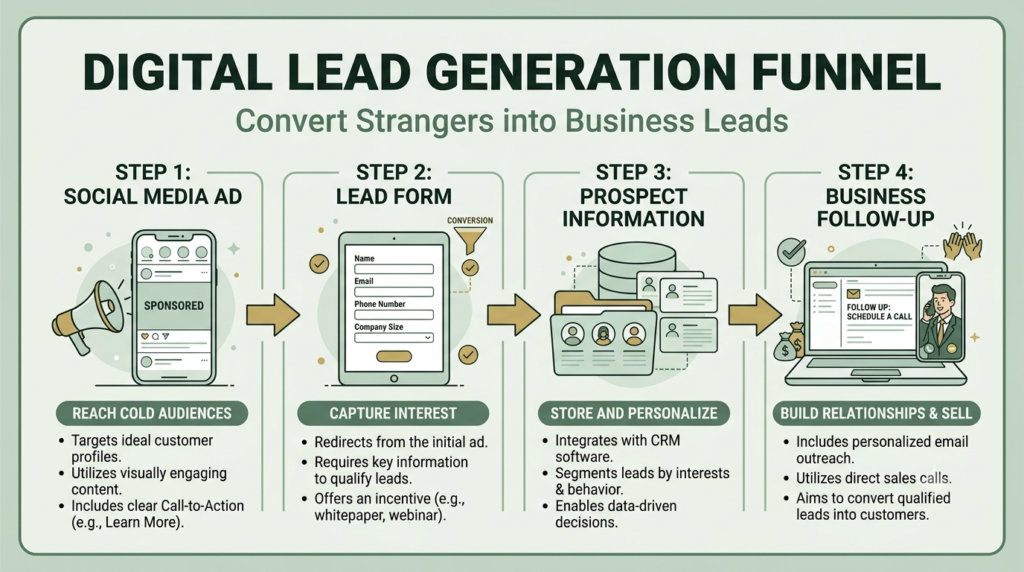
Lead campaigns are designed to help businesses collect information from potential customers.
A lead might provide details such as:
- Name
- Email address
- Phone number
- Business information
- Answers to qualifying questions
The exact fields and available lead experiences can vary by setup.
When should you use it?
Lead campaigns can be useful for:
- Consultations
- Service businesses
- Coaching
- Web design
- Marketing services
- Free consultations
- Webinars
- Lead magnets
- Business enquiries
What makes it unique?
The focus is moving from anonymous audience → identifiable prospect.
For example:
Advertisement → Free SEO Checklist → Lead Form → Follow-up
The lead does not necessarily purchase immediately.
Instead, you have created an opportunity to continue the relationship.
5. App Promotion Campaigns
If your business has a mobile application, app promotion campaigns are designed around app-related outcomes.
They can be useful for businesses whose primary customer experience happens inside an app.
When should you use it?
Consider this objective when you want to:
- Encourage app installations
- Promote app usage
- Re-engage app users
- Encourage specific app actions
What makes it unique?
The destination is the app ecosystem, rather than simply a website.
For example, a fitness application could advertise a new workout feature to people who may be interested in installing the app.
App campaigns therefore make more sense when the app itself is an important part of the business model.
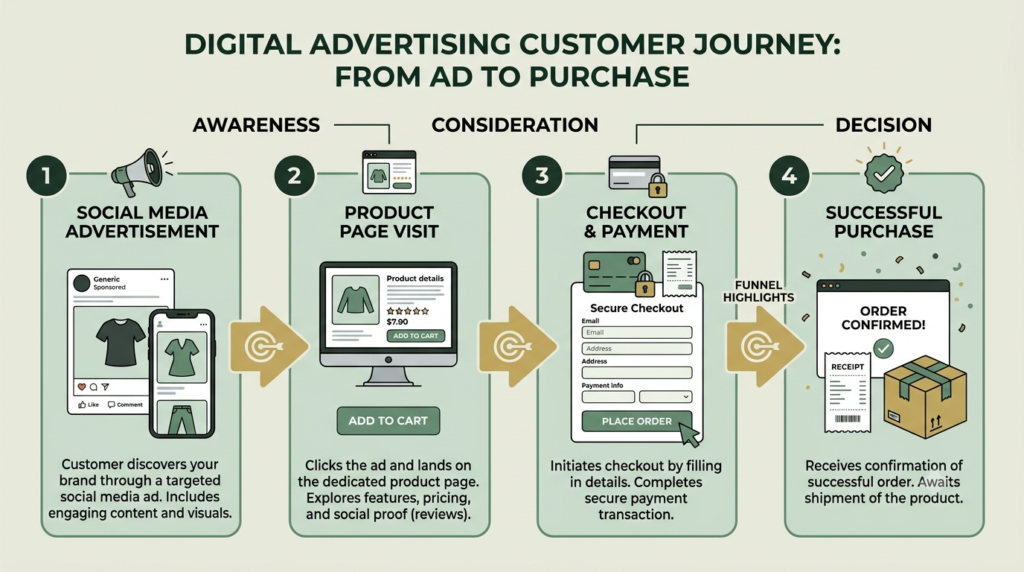
6. Sales Campaigns
Sales campaigns are designed around purchasing or other conversion-oriented outcomes.
For an online store or digital-product business, this can be particularly relevant.
When should you use it?
Sales campaigns may be appropriate when you want to:
- Sell products
- Generate purchases
- Promote an ecommerce offer
- Drive conversion-oriented actions
- Reconnect with people who have already shown buying intent
What makes it unique?
The focus is much closer to the bottom of the customer journey.
For example:
Advertisement → Product page → Checkout → Purchase
For a ₹500 digital savings challenge, the campaign could introduce the product and direct people toward the purchase experience.
However, the campaign should be supported by a working product page, payment process and delivery system.
Meta Ad Campaign Types at a Glance
| Campaign objective | Main purpose | Useful for |
|---|---|---|
| Awareness | Introduce and build recognition | New brands |
| Traffic | Send people to a destination | Websites and landing pages |
| Engagement | Encourage interaction | Content and conversations |
| Leads | Collect prospects | Services and consultations |
| App promotion | Encourage app-related actions | Mobile applications |
| Sales | Encourage purchases/conversions | Ecommerce and digital products |
These objectives are not interchangeable. Your choice should follow the business outcome you actually need.
How Meta Ad Campaign Types Can Work Together
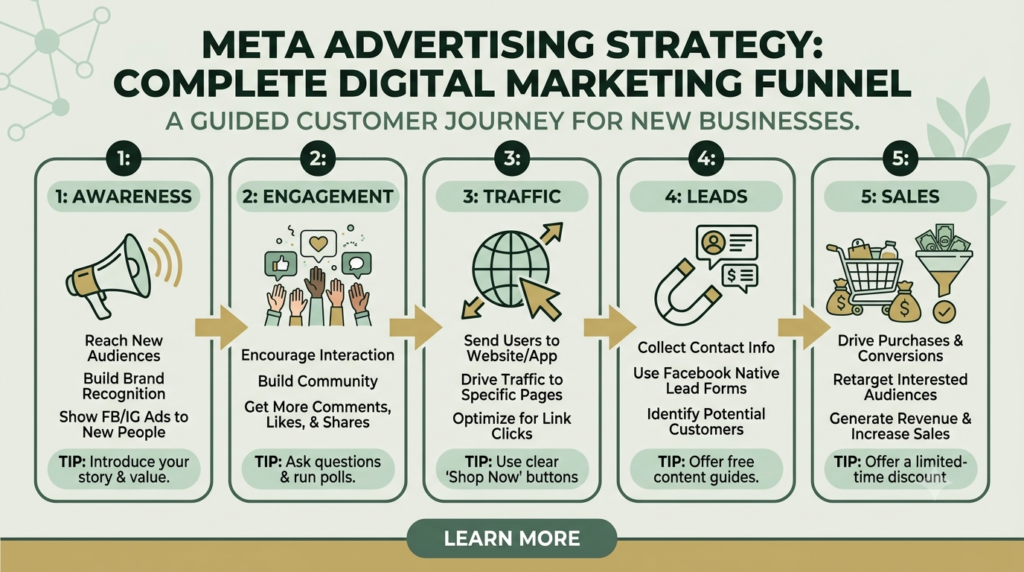
One of the most useful concepts for beginners is that Meta Ad campaigns do not always have to operate independently.
They can form a customer journey.
Consider this simple example:
Stage 1: Awareness
Introduce your brand.
↓
Stage 2: Engagement
Encourage people to interact with useful content.
↓
Stage 3: Traffic
Send interested people to an educational article or landing page.
↓
Stage 4: Leads
Offer a free resource in exchange for contact information.
↓
Stage 5: Sales
Present a relevant paid product or service.
This is not a mandatory sequence.
You do not need to run every objective.
Instead, use the stages that match your actual business model.
For example, a digital product business might use:
Traffic + Sales
while a consulting business might use:
Engagement + Leads
and an established ecommerce business may concentrate heavily on:
Sales + retargeting audiences
The important principle is purposeful combination, not running more campaigns simply because more campaigns exist.
How to Create a Meta Ad Campaign as a Beginner
The basic workflow of Meta Ad campaign is straightforward.
Step 1: Define the business goal
Write one sentence:
“I want people to ______.”
Examples:
- Visit my website.
- Submit an enquiry.
- Download my app.
- Purchase my product.
- Interact with my content.
Step 2: Choose the Meta Ad campaign objective
Select the objective that most closely corresponds to the action you want.
Do not choose an objective simply because it has a lower-looking cost per result.
The result itself needs to be meaningful to your business.
Step 3: Define your audience
Think about:
- Location
- Age where relevant
- Customer interests where useful
- Existing customers
- Website visitors
- Social media engagement
- Other eligible custom audiences
Your audience strategy should become more sophisticated as you collect real data.
Step 4: Set your budget
Start with a budget that you can afford to test.
Do not assume that increasing the budget automatically fixes an ineffective advertisement.
First understand whether the:
audience + offer + creative + destination
make sense together.
Step 5: Create the advertisement
Your advertisement normally needs a clear:
- Visual
- Primary message
- Offer
- Call to action
- Destination
The creative should communicate the benefit quickly.
Step 6: Check the destination
Before publishing, test the entire journey.
For a digital product:
Ad → Sales page → Payment → Thank-you page → Product delivery
One broken link can waste otherwise useful advertising traffic.
Step 7: Monitor meaningful metrics
Depending on the campaign objective, examine metrics such as:
- Reach
- Impressions
- Cost per result
- Click-through rate
- Landing-page views
- Leads
- Purchases
- Cost per purchase
- Conversion rate
Do not judge every campaign using one metric.
A sales campaign should ultimately be evaluated against business outcomes, not merely impressions.
How to Improve a Meta Ad Campaign
Optimization does not mean changing everything every day.
Instead, identify the weakest part of the customer journey.
If people see the ad but do not interact
Review:
- Hook
- Creative
- Offer
- Audience relevance
If people click but do not continue
Review:
- Landing page
- Page speed
- Message consistency
- Offer clarity
If people submit leads but do not become customers
Review:
- Lead quality
- Follow-up
- Offer
- Sales process
If people reach checkout but do not purchase
Review:
- Price presentation
- Trust signals
- Payment experience
- Product explanation
- Checkout friction
This approach helps you solve the actual problem rather than randomly changing the campaign.
Meta also supports testing approaches such as A/B testing, while its current advertising ecosystem increasingly incorporates Advantage automation and placement optimization.
Common Beginner Mistakes
Avoid these common problems:
- Choosing an objective without defining the desired outcome
- Changing campaigns too frequently
- Sending every advertisement to the homepage
- Using unclear calls to action
- Ignoring mobile users
- Measuring only likes
- Creating too many campaigns at once
- Advertising before testing the payment process
- Sending cold audiences directly to a complicated offer
- Changing audience, creative and budget simultaneously
A simple campaign with a clear purpose can be easier to understand and improve than a complicated campaign structure.
FAQ: Meta Ad Campaign Types
What are the main Meta Ad campaign types in 2026?
The major objectives commonly presented in Meta advertising include Awareness, Traffic, Engagement, Leads, App promotion and Sales. Available options can vary depending on account setup and advertising circumstances.
Which Meta Ad campaign should a beginner use?
There is no single objective that fits every beginner. Choose according to the action you want the audience to take.
Can I combine different Meta Ad campaign objectives?
Yes. Different objectives can support different stages of a customer journey. For example, awareness can introduce a brand while sales campaigns can focus on purchase-oriented outcomes.
Is a Traffic campaign good for selling products?
Traffic can send people to a product or landing page, but visiting a page is different from purchasing. If your primary goal is purchase conversion, consider whether a sales-oriented setup better matches that goal.
Should I run Awareness, Traffic and Sales together?
Not automatically. Use multiple objectives when each has a clear role. A small business may not need all of them simultaneously.
How much should I spend on Meta Ads Campaign?
There is no universal budget that guarantees results. Start with an amount you can afford to test, define your success metric, and evaluate the resulting business outcome.
What is the difference between an Meta ad campaign and an ad?
A campaign establishes the overall objective. An ad set generally controls audience, budget/schedule and placements depending on the campaign setup. The ad contains the creative and messaging shown to people
Final Takeaway: Build Around the Customer Journey
The real power of Meta Ad campaign types is not in knowing the names of every objective.
It is in understanding why each objective exists.
Awareness helps introduce.
Traffic helps bring people to a destination.
Engagement encourages interaction.
Leads help turn interested people into identifiable prospects.
App promotion supports app-related growth.
Sales focuses on purchase-oriented outcomes.
Think of your campaigns as parts of a customer journey rather than isolated advertisements.
Before launching your next campaign, ask three simple questions:
- Who am I trying to reach?
- What action do I want them to take?
- What happens after they take that action?
When those three answers are clear, your Meta Ad campaign strategy becomes much easier to build, measure and improve.
Ready to improve your digital marketing skills? Explore more practical beginner-friendly guides on Aahraa and build your strategy one step at a time.