
7 Powerful Ways of Creating Ads for Campaigns in 2026: A Complete Beginner’s Guide
Creating an advertisement can look complicated when you are seeing campaign objectives, audiences, creatives, headlines, descriptions, placements, budgets and analytics for the first time. The good news is that creating ads for campaigns becomes much easier when you understand the basic structure behind every advertisement.
An ad is not simply a beautiful image or catchy sentence. It is a communication system connecting a business, audience, message, creative, offer, landing page and campaign objective.
In 2026, advertisers can use several creative approaches, including static images, videos, carousels, search ads, responsive ads, display-style creatives and product-focused ads. Google, for example, uses responsive search ads that combine multiple headlines and descriptions to create combinations relevant to individual searches.
This guide explains the major ad creation methods, how each works, when to use them and how to optimize your ads.

What Is creating ads for campaigns?
creating ads for campaigns is the process of turning a marketing objective into an advertisement that communicates a clear message to a specific audience.
A basic advertisement contains:
- Campaign objective
- Target audience
- Offer
- Hook
- Creative
- Headline
- Description
- Call to action
- Landing page
- Tracking
- Performance measurement
Think of it as a chain:
Objective → Audience → Problem → Message → Creative → CTA → Landing Page → Conversion
If one part is disconnected, the advertisement can attract attention without producing the desired result.
That is why creating ads for campaigns should begin with strategy rather than design
7 Different Methods of Creating Ads for Campaigns
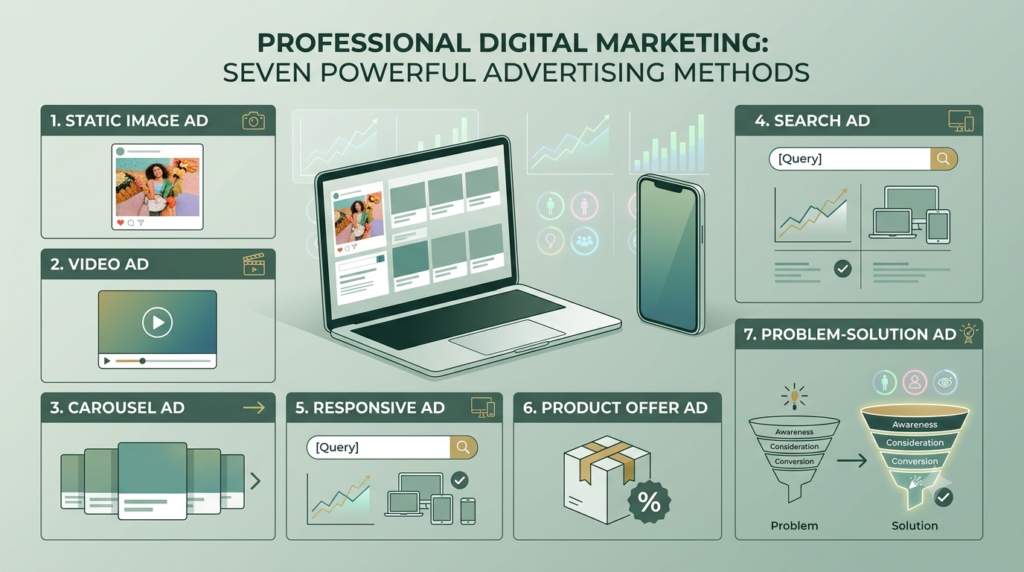
1. Static Image Ads
Static image ads are one of the simplest methods of creating ads for campaigns.
They use a single visual containing a product, service, person, offer or message.
Basic structure
Hook + Visual + Benefit + CTA
For example:
“Build Your Startup’s Online Presence”
Digital marketing services designed for growing startups.
Get Started
When to use them
Static ads can work well for:
- Product promotions
- Service awareness
- Limited-time offers
- Lead magnets
- Website traffic
- Brand awareness
- Digital products
How to create one
- Define one objective.
- Choose one audience.
- Select one primary benefit.
- Create a simple visual.
- Add a short headline.
- Add a CTA.
- Link to the most relevant landing page.
- Test the creative.
Avoid filling the entire design with text. The viewer should understand the main message quickly.
2. Video Ads
Video ads combine visuals, movement, sound, text and storytelling.
They can be useful when your product or service needs demonstration or explanation.
TikTok’s current creative guidance emphasizes native-feeling, short, authentic and testable creative, with hooks, storytelling and captions playing important roles.
A simple video formula
Hook → Problem → Solution → Benefit → CTA
Example:
0–3 seconds:
“Struggling to get your startup noticed online?”
3–10 seconds:
Show the problem.
10–20 seconds:
Introduce your solution.
20–30 seconds:
Show the benefit.
Final seconds:
“Explore our startup marketing services.”
Types of video ads
- Product demonstration
- Tutorial
- Problem-solution
- Customer story
- Behind-the-scenes
- Educational
- Before-and-after
- Founder message
- Screen recording
Beginner tip
Do not start by trying to produce a complicated commercial. A clear mobile-friendly video with a strong opening can be easier to test and improve.
3. Carousel Ads
Carousel ads allow several images or cards to appear within one advertisement.
Each card can communicate a different benefit, feature, product or step.
Example for a digital marketing agency
Card 1: SEO
Card 2: Social Media
Card 3: Website Development
Card 4: Branding
Card 5: Get Started
Why use this ad creation method?
Carousel advertising is useful when you need to explain multiple aspects of an offer without creating separate advertisements for every point.
How to create a carousel
- Choose one creating ads for campaign’s objective.
- Decide the story sequence.
- Create consistent visuals.
- Give every card one message.
- Keep branding consistent.
- Use a clear final CTA.
- Test different card orders when the platform allows it.
Important: Don’t make every card look like a completely different advertisement. The carousel should feel like one connected story.
4. Search Ads
Search ads are different because the user is already expressing an intention through a search query.
Instead of interrupting someone’s browsing experience, the advertisement can respond to an active search.
Google’s responsive search ads allow advertisers to provide multiple headlines and descriptions, which Google’s systems can combine into different ad variations. Google currently allows up to 15 headlines and 4 descriptions in a responsive search ad.
Example
Keyword: digital marketing for startups
Headline ideas:
- Digital Marketing for Startups
- Grow Your Startup Online
- Startup SEO & Social Media
- Build Your Online Presence
How to create effective search ads
Use:
- Relevant keywords
- Specific benefits
- Clear differentiation
- Strong CTAs
- Relevant landing pages
- Appropriate assets
Google recommends providing multiple unique assets rather than creating repetitive headlines and descriptions.
5. Responsive Ads
Responsive ads are built from multiple creative assets rather than one fixed advertisement.
For search campaigns, Google can combine headlines and descriptions. For responsive display advertising, assets can include headlines, descriptions, images and logos, which systems can arrange into different combinations.
Main elements
- Headlines
- Descriptions
- Images
- Logo
- Business name
- CTA
- Final URL
How to improve them
Create assets that work individually.
For example, if a headline is displayed without another headline, it should still make sense.
Avoid submitting:
- Five nearly identical headlines
- Repeated descriptions
- Unclear CTAs
- Irrelevant images
- Generic claims
Google recommends using relevant assets and reviewing asset-level performance to understand what resonates with customers.
6. Product or Offer Ads
Product-focused advertising places the product or offer at the centre of the creative.
This is useful for:
- Digital products
- E-commerce
- Courses
- Templates
- Services
- Special offers
- Bundles
Simple structure
Product → Benefit → Proof/Feature → Price or Offer → CTA
For example:
₹500 Savings Challenge
Save consistently with a simple printable challenge.
Download Now
The important principle is to communicate the outcome, not just the product name.
Instead of:
“3-page savings PDF
try: “Turn small daily savings into a simple 30-day money habit.”
7. Problem-Solution Ads
Problem-solution advertising starts with the audience’s pain point.
Formula
Problem → Agitation → Solution → Benefit → CTA
Example:
“Your website looks good—but visitors aren’t finding you on Google?”
Then introduce the relevant SEO service.
This method works particularly well for service businesses because the audience can recognize its problem before seeing the solution.
How to create it
Ask:
- What problem does my customer have?
- What happens if the problem continues?
- What solution do I provide?
- What specific benefit can I explain?
- What action should the person take?
Keep the language human. Don’t exaggerate the customer’s problem.
The Core Elements Behind Every Advertisement
Regardless of the campaign ad format, the underlying structure remains similar.
| Element | Purpose |
|---|---|
| Objective | Defines what the campaign should achieve |
| Audience | Identifies who should see the advertisement |
| Hook | Creates initial attention |
| Creative | Communicates visually or through video |
| Headline | Explains the central message |
| Description | Provides additional context |
| Offer | Gives the audience a reason to act |
| CTA | Tells people what to do next |
| Landing Page | Continues the message after the click |
| Tracking | Measures results |
| Optimization | Improves future performance |
This is why ad creative can be considered the backbone of creating ads for campaigns execution: the creating ads for campaigns objective determines what you want, but the ad is the actual message delivered to the audience.
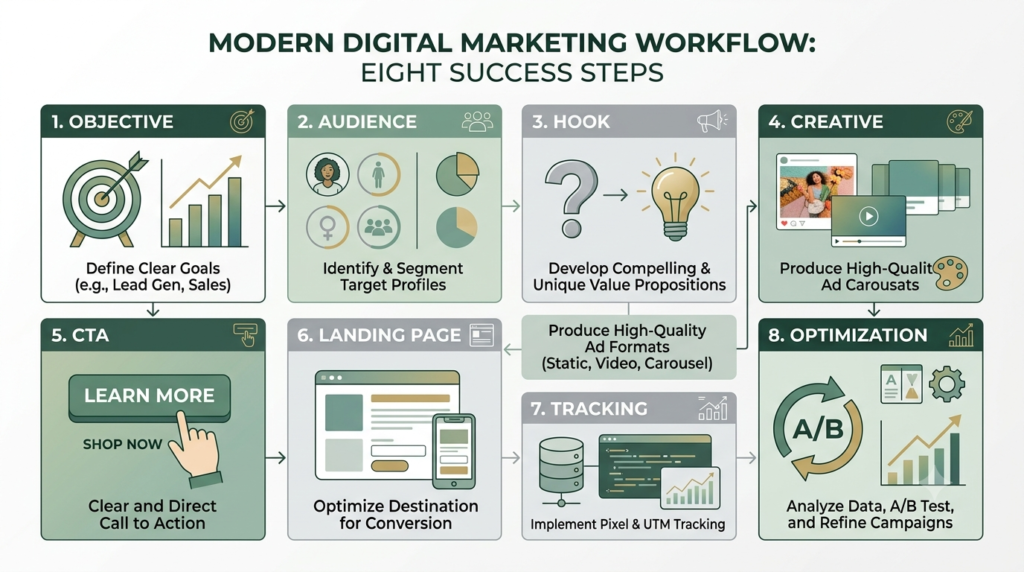
How to Create Ads for a Campaign: Beginner Process
Follow this simple workflow.
Step 1: Select the objective
Choose one primary goal:
Step 2: Define the audience
Write down:
- Who are they?
- What do they need?
- What problem are they experiencing?
- What language do they use?
- What would make them stop scrolling?
Step 3: Choose the ad creation method
Match the format to the message.
Simple offer → Image ad
Demonstration → Video
Multiple benefits → Carousel
Search intent → Search ad
Multiple assets → Responsive ad
Specific customer problem → Problem-solution ad
Step 4: Write the hook
The first line or visual should quickly communicate relevance.
Step 5: Build the creative
Use:
- One visual focus
- Clear typography
- Brand identity
- Strong contrast
- Adequate spacing
- Mobile-friendly design
Step 6: Add the CTA
Examples:
- Learn More
- Shop Now
- Download Now
- Get Started
- Book Now
- Sign Up
Step 7: Connect the landing page
The landing page should match the advertisement.
If the ad says: “Download the Free SEO Checklist”
the landing page should immediately provide that experience—not send the visitor to an unrelated homepage.

How to Correct Common Ad-Creation Problems
| Problem | Correction |
|---|---|
| Low clicks | Test a stronger hook |
| High clicks but no conversions | Check landing-page relevance |
| Low engagement | Improve creative/message fit |
| Repetitive ads | Create genuinely different variations |
| Poor search relevance | Align keywords, copy and landing page |
| High cost | Review audience, creative and conversion data |
| Creative fatigue | Refresh the creative |
| Weak CTA | Use one clear action |
| Confusing design | Remove unnecessary text |
| Poor mobile experience | Design for mobile first |
For Google responsive search ads, Google’s current guidance emphasizes unique headlines, relevant keywords, varied assets and limited pinning unless a specific reason requires it
The Ad-to-Conversion Connection
A successful creating ads for campaigns is not simply:
Ad → Click
It is:
Audience → Ad → Click → Landing Page → Action → Conversion → Measurement → Optimization
This is the bigger picture.
Your advertisement creates the promise.
Your landing page continues the promise.
Your offer provides the reason to act.
Your tracking tells you what happened.
When these elements are aligned, advertising creating ads for campaigns optimization becomes much easier because you can identify where the customer journey is losing people.
Frequently Asked Questions
1. What is the easiest method of creating ads for campaigns?
Static image advertising is generally one of the simplest formats for beginners because it requires one visual, a clear message and a CTA.
2. What are the main ad creation methods?
Common methods include static image ads, video ads, carousel ads, search ads, responsive ads, product ads and problem-solution advertisements.
3. How do I create an effective advertisement?
Start with a clear objective, identify your audience, understand their problem, create a relevant message, choose the appropriate creative format, add a clear CTA and connect the advertisement to a relevant landing page.
4. What is a creating ads for campaign’s ad format?
A creating ads for campaigns ad format describes how an advertisement is presented, such as an image, video, carousel, search advertisement or responsive asset-based advertisement.
5. Why is the creative important in advertising?
The creative communicates the creating ads for campaigns message to the audience. A strong creative can make the offer easier to understand and gives the audience a reason to continue to the next step.
6. How many headlines can a Google responsive search ad have?
Google currently allows up to 15 headlines and 4 descriptions in a responsive search ad.
7. Should every advertisement use the same creative?
No. Different audiences, objectives and platforms may require different creative approaches. Testing meaningful variations can help identify which messages and assets resonate with the intended audience.
8. How can I optimize an advertisement?
Review the creating ads for campaigns objective, audience, creative, messaging, CTA, landing page and performance data. Change one meaningful variable at a time where practical and monitor the resulting data.
Conclusion: Create Ads With Purpose, Not Just Design
Creating ads for campaigns is not only about making attractive graphics. A successful advertisement connects the right audience, message, creative, offer, CTA and landing page into one clear customer journey.
As a beginner, start with one creating ads for campaigns objective and choose the ad format that supports it. Test different hooks, images, videos, headlines and CTAs, then use real performance data to improve your next version.
Remember: a good ad gets attention, but a well-planned creating ads for campaigns turns that attention into meaningful action.
Start simple, test consistently, learn from the results and keep improving your advertising creative. That is the foundation of effective creating ads for campaigns advertising in 2026.