
7 Powerful Sales Campaigns in Meta Ads: Complete 2026 Guide
What Is a Sales Campaign in Meta Ads?
A sales campaign in Meta Ads is designed to encourage people to complete a valuable action, such as purchasing a product, subscribing to an offer, or completing another conversion that directly supports revenue.
For a beginner, the most important idea is simple:
A sales campaign is not just an advertisement. It is a complete customer journey from attention to action.
You need the right offer, audience, creative, landing page, tracking, budget and optimization process working together.
Meta’s advertising system can distribute ads across environments such as +, while available placements and automation can vary according to the campaign setup. Meta also provides Advantage+ tools designed to automate parts of targeting, placements and creative optimization.
Why is a Sales Campaign Important?
A well-structured campaign connects marketing activity with a measurable business outcome.
Instead of asking: “How many people saw my advertisement?”
you can ask:
- How many people clicked?
- How many reached the product page?
- How many started checkout?
- How many purchased?
- What did each conversion cost?
- Which creative generated the strongest response?
- Which audience produced meaningful results?
This makes a sales campaign useful for both small businesses and growing startups.
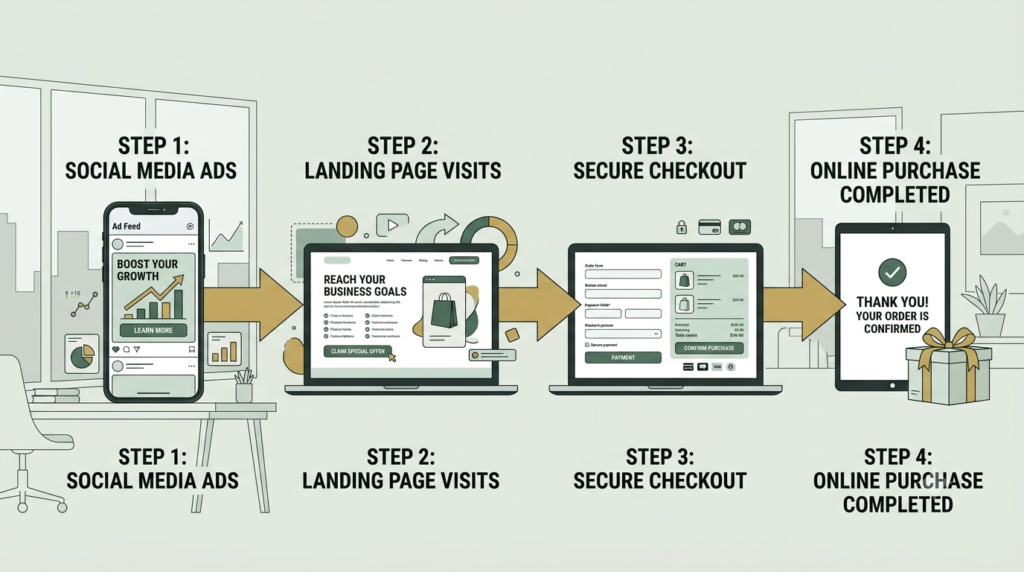
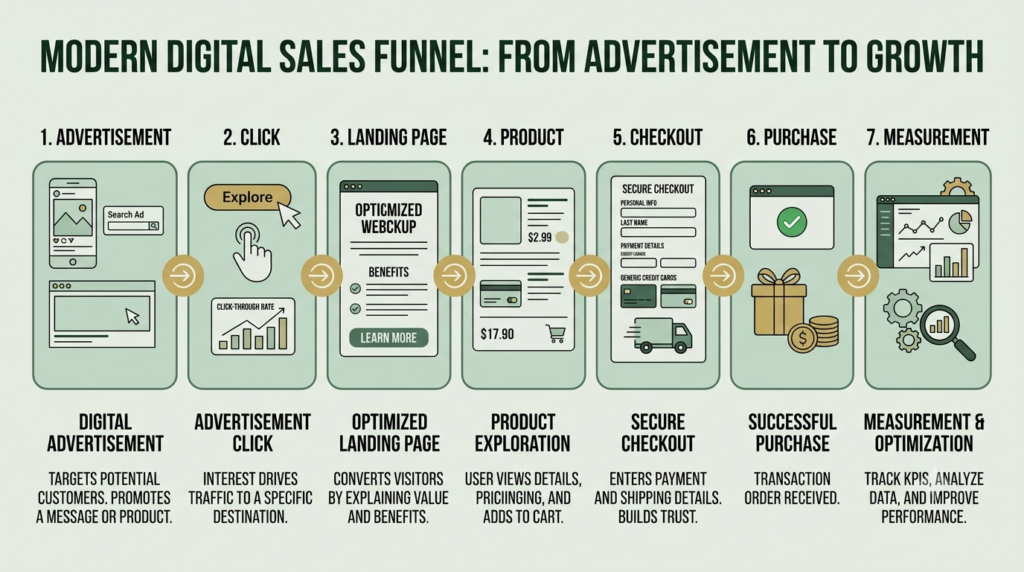
The Sales Campaign Funnel
A simple funnel looks like this:
Ad → Click → Landing Page → Product/Offer → Checkout → Purchase → Measurement → Optimization
If one part is weak, the campaign can struggle even when the advertisement itself looks attractive.
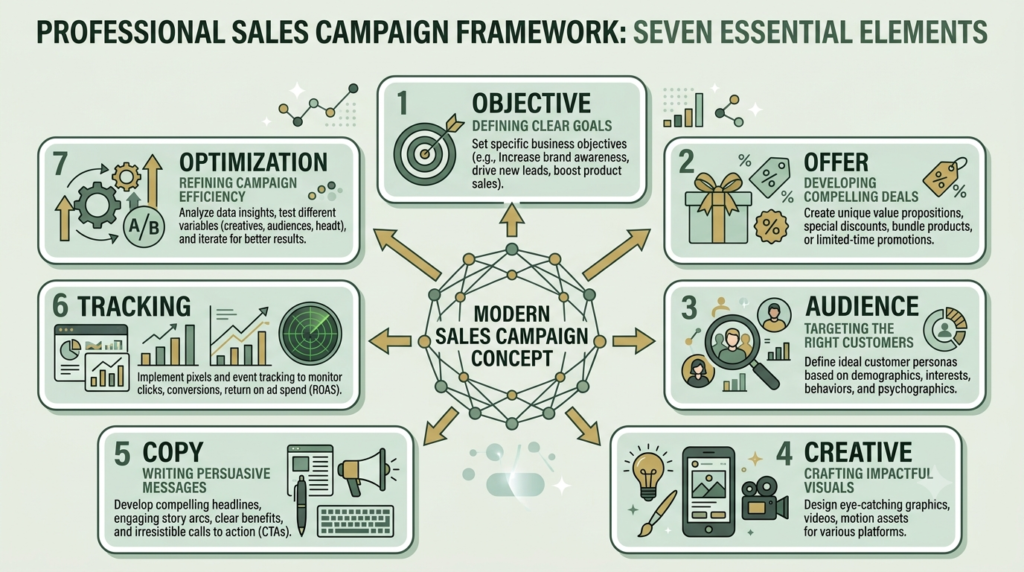
The 7 Essential Elements of a Meta Ads Sales Campaign
| Element | Purpose | Beginner Focus |
|---|---|---|
| Objective | Defines the campaign goal | Choose Sales when the goal is conversion |
| Offer | Gives people a reason to buy | Make value and price clear |
| Audience | Determines who may see the ad | Start with a relevant customer profile |
| Creative | Gets attention | Use clear, mobile-friendly visuals |
| Copy | Explains the benefit | Focus on problem, solution and action |
| Tracking | Measures results | Configure the relevant conversion events |
| Optimization | Improves performance | Test, measure and make controlled changes |
These elements work together rather than independently.
1. Choose the Right Sales Objective
The first step is deciding what you actually want the campaign to achieve.
If your primary goal is selling a product or service online, a sales-focused campaign structure can align the advertising system with that commercial outcome.
Before launching, answer:
- What am I selling?
- What is the price?
- Where does the customer complete the purchase?
- What conversion event should I measure?
- What makes this offer different?
- What happens after someone clicks?
Beginner mistake
Do not choose an objective simply because it sounds popular.
For example, a traffic campaign may generate visitors, but traffic itself is not the same as a completed purchase.
Your campaign objective should match the business result you are trying to measure.
2. Build a Strong Offer
Your advertisement cannot compensate indefinitely for a confusing offer.
A strong offer should quickly communicate:
What is it? → Who is it for? → What problem does it solve? → What does it include? → Why should someone act now?
For a digital product, for example: “A simple 30-day savings challenge for beginners who want to build a consistent money-saving habit.
This is easier to understand than: “Our amazing financial product for everyone.”
Include these offer elements
- Clear product name
- Specific benefit
- Short explanation
- Price
- What’s included
- Trust elements where available
- Clear call to action
- Simple checkout process
Your sales page should continue the same message introduced by the advertisement.
3. Define the Right Audience
Audience selection is another important part of a Meta Ads sales campaign.
Start by creating a basic customer profile.
Consider:
- Age range
- Location
- Interests
- Problems
- Buying motivation
- Awareness level
- Previous interaction with your business
For example, someone who has already visited your product page is different from someone who has never heard of your brand.
This is why campaigns can use different audience approaches, such as:
Cold Audience
People who have not previously interacted with your business.
Warm Audience
People who have engaged with your content, profile, website or other brand touchpoints.
Retargeting Audience
People who previously interacted with a product, page or other measurable conversion journey but did not complete the desired action.
Your audience should be based on the actual customer journey rather than assumptions.
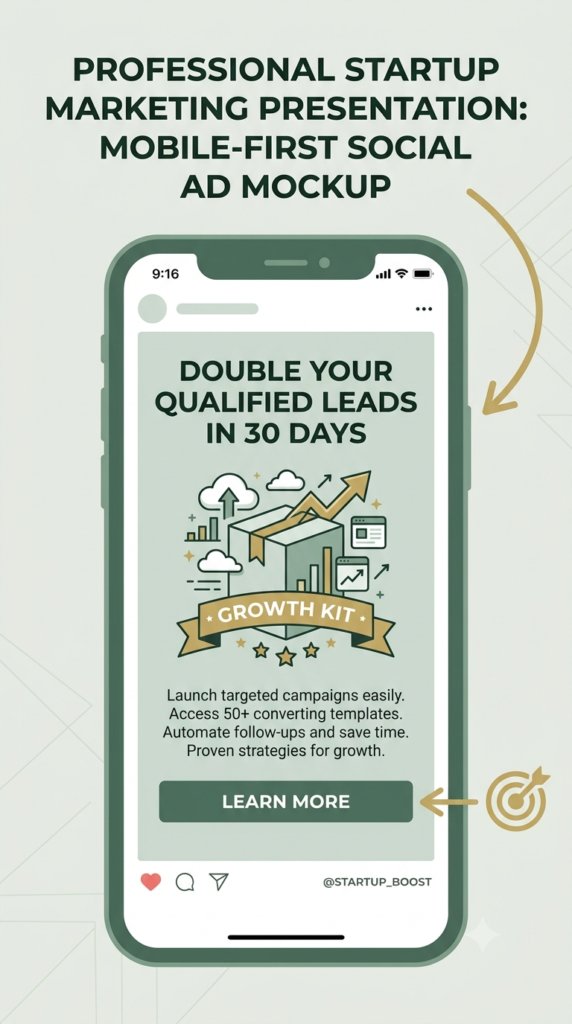
4. Create Conversion-Focused Ad Creative
Your creative is often the first thing people notice.
For mobile-first advertising, keep the main message visually clear.
Meta’s guidance for Reels emphasizes vertical 9:16 creative, keeping important messages inside the safe zone, and testing creative variations.
Useful creative formats
- Single image
- Short video
- Reels
- Carousel
- Product demonstration
- Before-and-after explanation where appropriate
- Educational creative
- Problem/solution creative
A simple creative formula
Problem → Benefit → Product → CTA
Example:
Problem:
“Struggling to save money every month?”
Benefit:
“Turn saving into a simple 30-day habit.”
Product:
“Use the ₹500 Savings Challenge.”
CTA:
“Start the challenge.”
Avoid putting too many messages into one graphic.
5. Write Human Sales Copy
Good advertising copy does not need to sound aggressive.
Write as though you are explaining the product to one real person.
Simple copy structure
Hook: Identify the problem.
Value: Explain the solution.
Details: Tell people what they receive.
Trust: Add useful proof or reassurance where available.
CTA: Tell them exactly what to do next.
For example: Saving money sounds easy until unexpected expenses appear. The ₹500 Savings Challenge gives beginners a simple 30-day structure to make saving feel more manageable. Start today and build the habit one step at a time.
Then use a clear CTA such as:
Get Started
or
Buy Now
6. Set Up Tracking Before Launch
Tracking is one of the most important technical parts of a sales campaign.
Without reliable measurement, you may see clicks but not understand whether those clicks generated meaningful business results.
Depending on your website setup, relevant measurement can involve Meta’s business tools and conversion tracking infrastructure.
Before spending money, check:
- Website URL
- Landing page
- Purchase/checkout flow
- Conversion event
- Tracking setup
- Mobile experience
- Thank-you page
- Payment process
- Confirmation or delivery process
Test the customer journey yourself
Complete the process as if you were a customer:
Advertisement → Website → Product → Checkout → Payment → Thank You → Delivery
If any step breaks, fix it before increasing advertising spend.
7. Optimize the Sales Campaign
Launching the advertisement is not the end.
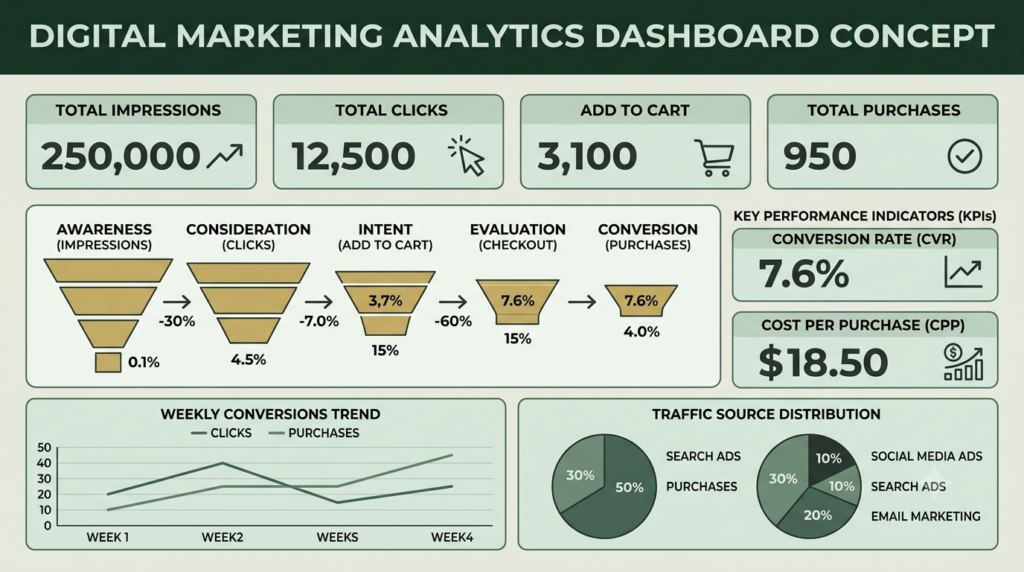
Optimization means studying the available data and identifying where the customer journey is losing people.
Watch metrics such as:
- Impressions
- Reach
- CPM
- Link clicks
- CTR
- Landing-page views
- Add-to-cart events
- Checkout events
- Purchases
- Cost per purchase
- Conversion rate
- Return on ad spend, where meaningful data is available
Do not change everything at once.
If you change the audience, creative, budget and landing page simultaneously, it becomes difficult to understand what actually affected performance.
A controlled testing approach is more useful.
Meta’s published guidance on A/B testing emphasizes isolating variables so that the effect of a change can be measured more clearly.
How to Create a Sales Campaign in Meta Ads: Beginner Steps
Step 1: Prepare the offer
Have your product, price, landing page and checkout ready.
Step 2: Open Meta Ads Manager
Create a new campaign and select the sales-oriented objective available in your current Ads Manager interface.
Step 3: Configure the campaign
Set:
- Campaign name
- Budget approach
- Conversion goal
- Relevant buying/conversion location
Step 4: Configure the audience
Define the audience according to your customer and campaign strategy.
Step 5: Review placements
Meta offers automated placement options, including Advantage+ placements, while manual placement controls may also be available depending on the campaign.
For beginners, avoid unnecessarily restricting placements without a clear reason.
Step 6: Upload creative
Prepare suitable image, video, Reel or carousel assets.
Step 7: Write the copy
Make the hook, benefit and CTA easy to understand.
Step 8: Check tracking
Verify that your intended conversion event is being recorded correctly.
Step 9: Review everything
Check:
- Spelling
- Links
- Product price
- Mobile display
- CTA
- Tracking
- Payment process
- Policy compliance
Step 10: Publish and monitor
After launch, allow enough data to accumulate before making major conclusions.
Sales Campaign Strategy: What Should You Test?
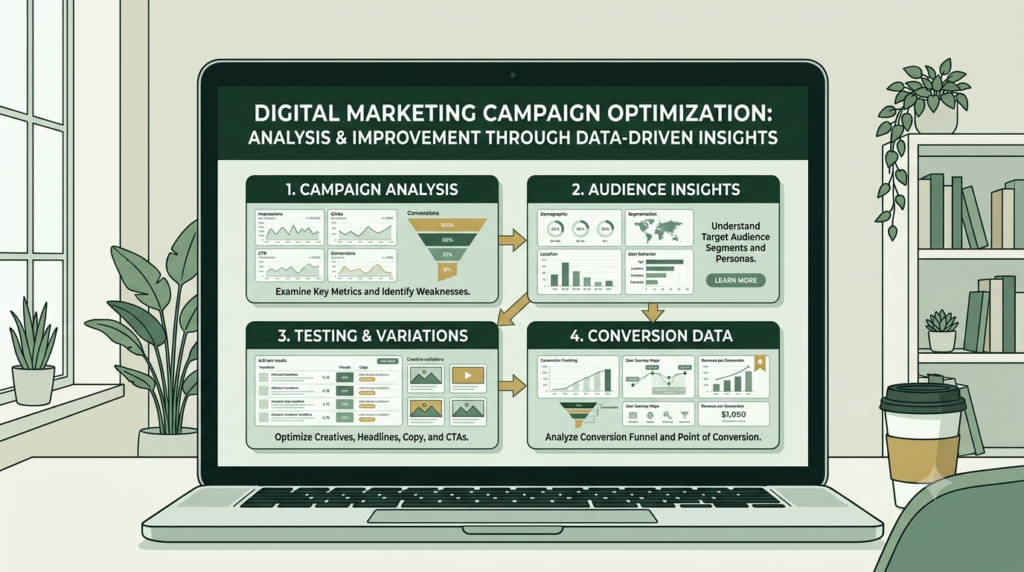
Do not test everything simultaneously.
Start with one meaningful variable.
Test 1: Creative
Version A:
Problem-focused headline
Version B:
Benefit-focused headline
Test 2: Offer presentation
Version A:
Product-focused
Version B:
Outcome-focused
Test 3: Landing page
Version A:
Short sales page
Version B:
More detailed sales page
Test 4: Audience
Compare appropriately defined audience groups when you have sufficient data to make the comparison useful.
The purpose of testing is learning, not simply changing things repeatedly.
Common Sales Campaign Mistakes
1. Sending people to a confusing page
The advertisement promises one thing while the landing page discusses something else.
Fix: Keep the message consistent.
2. Focusing only on clicks
A high click count does not automatically mean high sales.
Fix: Follow the complete conversion journey.
3. Changing campaigns too quickly
Constant changes can make results difficult to interpret.
Fix: Make deliberate changes based on meaningful data.
4. Using weak creative
A generic graphic may fail to communicate the value quickly.
Fix: Make the problem, benefit and CTA visually obvious.
5. Ignoring mobile users
Many social advertising experiences happen on mobile devices.
Fix: Test the entire journey on a phone.
6. Making unrealistic claims
Avoid exaggerated promises or misleading statements.
Fix: Use accurate, specific and supportable claims.
How a Sales Campaign Becomes the Backbone of the Marketing Entity
A sales campaign can act as a central connection point between several marketing entities:
Brand → Audience → Content → Advertisement → Website → Product → Checkout → Customer → Data
This is important because marketing should not operate as disconnected activities.
For example:
- Social media creates awareness.
- Content educates the audience.
- Meta Ads distribute the offer.
- The landing page explains the product.
- The checkout enables purchase.
- Tracking records the conversion.
- Analytics provides information.
- Retargeting can reconnect with eligible audiences.
- Customer feedback informs future marketing.
In this sense, the sales campaign becomes a measurement and conversion layer connecting multiple parts of the marketing system.
It is not literally the technical backbone of every marketing entity, but strategically it can connect acquisition, conversion and measurement into one journey.
Frequently Asked Questions About Sales Campaigns in Meta Ads
1. What is a sales campaign in Meta Ads?
A sales campaign in Meta Ads is designed to encourage measurable actions related to purchasing or conversion. It connects advertising with a commercial outcome such as an online purchase.
2. Is a sales campaign suitable for beginners?
Yes. Beginners can start with a simple offer, clearly defined audience, basic creative, working landing page and reliable conversion tracking.
3. What should I sell through a Meta Ads sales campaign?
You can advertise products or services that can be clearly presented and purchased or converted through an appropriate customer journey. The offer should have a clear value proposition and functional checkout or conversion process.
4. What is the most important part of a sales campaign?
There is no single element that guarantees success. Objective, offer, audience, creative, landing page, tracking and optimization need to work together.
5. How much should I spend on a sales campaign?
There is no universal budget that works for every business. Start with a budget you can afford to test and evaluate, then use actual conversion data to inform future decisions.
6. Why are my Meta Ads getting clicks but no sales?
Possible causes include an unclear offer, weak landing page, slow website, unsuitable audience, poor checkout experience or tracking problems. Examine the entire conversion journey rather than assuming the advertisement is the only issue.
7. How often should I optimize my sales campaign?
Optimization should be based on meaningful data rather than constant daily changes. Make controlled adjustments and monitor the resulting metrics.
8. Should beginners use automatic placements?
Meta provides automated placement options such as Advantage+ placements. Beginners should understand the available settings and avoid restricting placements without a specific reason supported by their campaign requirements or data.
9. What is the difference between a sales campaign and a traffic campaign?
A sales campaign is structured around conversion or commercial outcomes, while a traffic campaign is primarily designed to generate visits. The appropriate choice depends on the business goal and available measurement setup.
10. What should I check before launching?
Check the advertisement, audience, landing page, product information, price, CTA, website speed, mobile experience, payment process and conversion tracking before publishing.
Final Takeaway
A successful sales campaign is more than a social media advertisement.
It is a connected system:
Right offer + relevant audience + useful creative + clear message + functional landing page + reliable tracking + controlled optimization.
Start simple. Make the customer journey easy to understand. Measure the actual conversion rather than focusing only on clicks or impressions. Then improve one meaningful element at a time.
Ready to turn your digital marketing into a measurable growth system? Explore Aahraa’s digital marketing services for startups and build your next campaign around a clear customer journey