
11 Powerful campaign precautions for Campaigns in 2026: Complete Beginner’s Guide
Campaign Precautions for Campaigns in 2026 is more important than creating an attractive advertisement and pressing Publish. Whether you are running a lead generation campaign, engagement campaign, traffic campaign, sales campaign, awareness campaign, app campaign, or remarketing campaign, every decision affects your budget, audience, data, and results.
For beginners, small mistakes such as choosing the wrong objective, targeting an unsuitable audience, sending visitors to the wrong landing page, or forgetting conversion tracking can make a campaign difficult to evaluate.
This guide explains the most important Campaign Precautions for Campaigns in 2026, how each campaign works, what to check before launching, and how to optimize your campaign systematically.

What Is a Marketing Campaign?
A marketing campaign is a coordinated set of promotional activities designed to achieve a specific business objective.
A campaign may aim to:
- Build brand awareness
- Increase website traffic
- Generate leads
- Increase engagement
- Promote a product
- Generate sales
- Encourage app installations
- Retarget previous visitors or customers
The most important principle is simple:
One campaign should have one clearly defined primary objective.
Google Ads similarly recommends building campaigns around objectives and using conversion tracking to understand valuable customer actions.
1. Campaign Precautions for Campaigns in 2026
Before creating an advertisement, check these basic elements.
Define the objective
Write one sentence:
“I want this campaign to generate ______.”
For example:
- Lead campaign → qualified enquiries
- Sales campaign → purchases
- Traffic campaign → website visits
- Engagement campaign → meaningful interactions
- Awareness campaign → reach and brand recognition
Define your audience
Know:
- Who they are
- What problem they have
- What they want
- What platform they use
- What action you want them to take
Do not assume that everyone is your customer.
Check your offer
Your advertisement cannot compensate for a confusing offer.
Clearly communicate:
Problem → Solution → Benefit → Action
Check the destination
If an advertisement promises a free guide, the landing page should immediately show the free guide or the relevant sign-up form.
Avoid sending every campaign to your homepage.
2. Lead Generation Campaign Precautions
A lead generation campaign is designed to collect potential customer information, such as a name, email address, phone number, or enquiry.
Important elements
- Audience
- Lead form or landing page
- Offer
- Lead qualification
- Follow-up process
- Conversion tracking
Common mistakes
Avoid:
- Asking for unnecessary information
- Using a vague offer
- Targeting an audience that is too broad
- Forgetting to test the form
- Collecting leads without a follow-up plan
How to optimize
Start with a simple form.
For example:
Name + Email + One useful qualifying question
Test the entire journey yourself before launching.
Precaution: A campaign generating many leads is not automatically successful if those leads are irrelevant.

3. Engagement Campaign Precautions
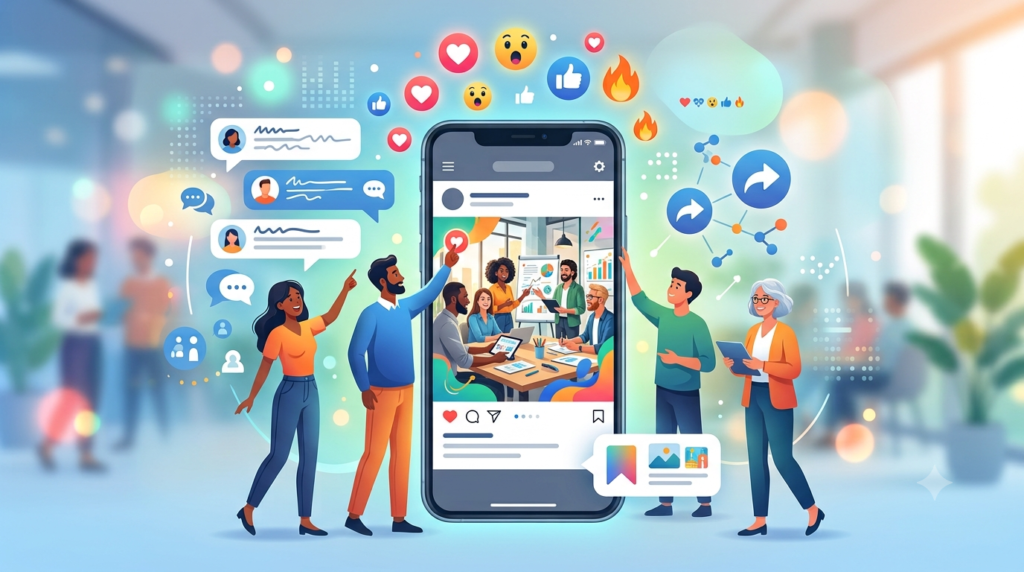
An engagement campaign focuses on actions such as reactions, comments, shares, saves, or other meaningful interactions, depending on the platform.
Important elements
- Strong creative
- Relevant message
- Clear hook
- Audience
- Call to action
- Engagement measurement
Precautions
Do not create content solely because it looks attractive.
Ask:
“Why would someone stop, read, react, save, or share this?”
Avoid misleading hooks or engagement bait.
How to correct poor performance
If impressions are high but engagement is low:
- Review the opening message.
- Improve the creative.
- Make the benefit clearer.
- Test another audience.
- Compare different creative formats.
4. Traffic Campaign Precautions
A traffic campaign attempts to send people to a website, landing page, article, product page, or another destination.
Important elements
- Campaign objective
- Destination URL
- Ad creative
- Audience
- Tracking parameters
- Landing-page experience
Biggest precaution
Do not optimize only for clicks.
A large number of clicks does not necessarily mean that visitors are interested or converting.
Check:
- Landing-page views
- Engagement
- Time spent where available
- Sign-ups
- Purchases
- Other meaningful actions
Use consistent UTM parameters so analytics can identify where campaign traffic came from. Google recommends consistent source, medium, and campaign naming because inconsistent UTM values can fragment reporting.
5. Sales or Conversion Campaign Precautions
A sales campaign is designed to encourage a valuable action such as purchasing a product or completing another conversion.
Important elements
- Product or service
- Offer
- Audience
- Creative
- Landing page
- Checkout
- Conversion tracking
- Budget
Before launching
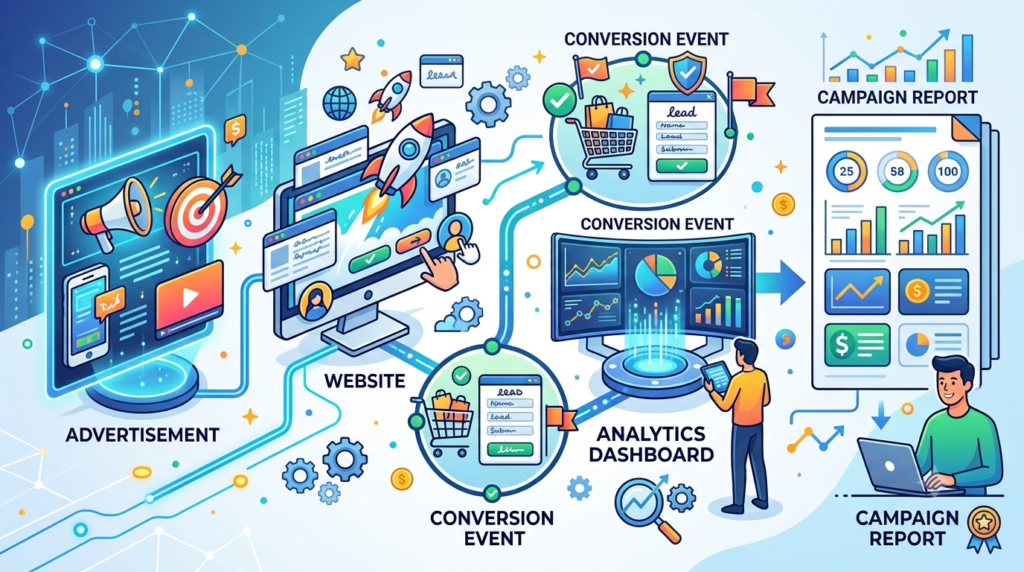
Test the complete customer journey:
Advertisement → Landing Page → Product → Checkout → Payment → Confirmation
Check every button and link.
Common mistake
Do not change five things simultaneously when results are poor.
If you change the audience, creative, landing page, offer, and budget at the same time, you may not know what caused the improvement or decline.
Test systematically.
6. Awareness Campaign Precautions
An awareness campaign focuses on introducing a brand, product, service, idea, or offer to an audience.
Important elements
- Brand message
- Visual identity
- Audience
- Reach
- Frequency
- Creative consistency
Precautions
Do not overload the advertisement with information.
A beginner-friendly awareness ad can communicate:
Who you are + what you offer + why it matters.
Do not expect an awareness campaign to behave exactly like a direct-sales campaign.
The objective determines what you should measure.
7. Remarketing Campaign Precautions
Remarketing reaches people who have previously interacted with your business, where the platform and applicable privacy rules allow such targeting.
Possible audiences may include people who:
- Visited a website
- Viewed a product
- Engaged with content
- Started a process but did not complete it
Precautions
Avoid showing the same advertisement repeatedly.
Monitor frequency and audience overlap where the platform provides those metrics.
Also make sure exclusions are correctly configured.
Google Ads provides audience exclusions and audience reporting tools for campaign management.
8. Search Campaign Precautions
Search campaigns can connect advertisements with people actively searching for relevant products, services, or information.
Important elements
- Search intent
- Keywords or search themes
- Ad copy
- Landing page
- Negative keywords where applicable
- Conversion tracking
Precautions
Do not select keywords simply because they have high search volume.
Consider the user’s intent.
For example:
“What is SEO?”
and
“SEO agency for startup”
represent different search intentions.
Your advertisement and landing page should match the intent behind the search.
9. Social Media Campaign Precautions
Social Media campaigns can be used for awareness, engagement, traffic, leads, sales, and other objectives depending on the platform.
Check before publishing
- Correct account
- Correct campaign objective
- Correct audience
- Correct creative size
- Mobile readability
- Correct destination URL
- Working CTA
- Tracking
- Budget and schedule
Creative precaution
Never assume that one creative will work for every audience.
Test different:
- Headlines
- Images
- Videos
- Hooks
- CTAs
- Formats
Keep the message human.
People respond to clear communication, not just polished graphics.
10. App Campaign Precautions
For an app campaign, the destination and conversion action are different from a standard website campaign.
Check:
- Correct app
- Correct store listing
- Installation tracking
- Important in-app events
- App-store page
- Creative assets
Do not optimize only for installations if your real business goal is a valuable in-app action.
11. The Measurement Precaution: Track Before You Spend
This is one of the most important rules in campaign management.
Do not launch first and think about tracking later.
Before spending money, decide what success means.
Examples:
- Lead submitted
- Purchase completed
- Registration completed
- Product added to cart
- Appointment booked
- Newsletter signup
Google Ads states that conversion tracking helps advertisers understand actions taken after users interact with ads and supports conversion-based optimization.
For website campaigns, also check whether UTM parameters remain intact through redirects and the complete customer journey. Incorrect tracking parameters can cause campaign traffic to appear as direct or otherwise reduce attribution accuracy.
How to Correct a Campaign That Is Not Performing
Do not immediately assume that the campaign itself is the problem.
Use this simple diagnostic sequence.
Step 1: Check the objective
Is the campaign optimizing for the action you actually want?
Step 2: Check the audience
Is the audience relevant?
Step 3: Check the creative
Does the advertisement clearly communicate the benefit?
Step 4: Check the offer
Is there a clear reason for someone to act?
Step 5: Check the landing page
Does the landing page match the advertisement?
Step 6: Check tracking
Are clicks, leads, purchases, or other conversions being recorded correctly?
Step 7: Check the data
Look at the available performance metrics rather than judging the campaign from one metric.
Step 8: Make one meaningful change
Change one major variable at a time whenever practical.
This creates a cleaner learning process.
The Campaign Optimization Checklist
Before pressing Publish, we have set campaign setup checklist:
| Campaign element | Precaution |
|---|---|
| Objective | Match it with the real business goal |
| Audience | Keep it relevant |
| Offer | Make the value clear |
| Creative | Make it easy to understand |
| Headline | Communicate the main benefit |
| CTA | Tell users what to do |
| Landing page | Match the advertisement |
| URL | Test it manually |
| Tracking | Confirm conversions work |
| UTM | Use consistent naming |
| Budget | Set a controlled amount |
| Schedule | Check start/end dates |
| Mobile | Test the experience |
| Compliance | Follow platform policies |
| Analytics | Confirm data is being received |
Google’s campaign guidance specifically highlights objectives, targeting, conversion tracking, relevant ads, and campaign structure as important setup considerations.
Why Campaign Precautions Are the Backbone of Every Marketing Entity
Campaign precautions are not an isolated advertising task.
They connect the entire marketing ecosystem:
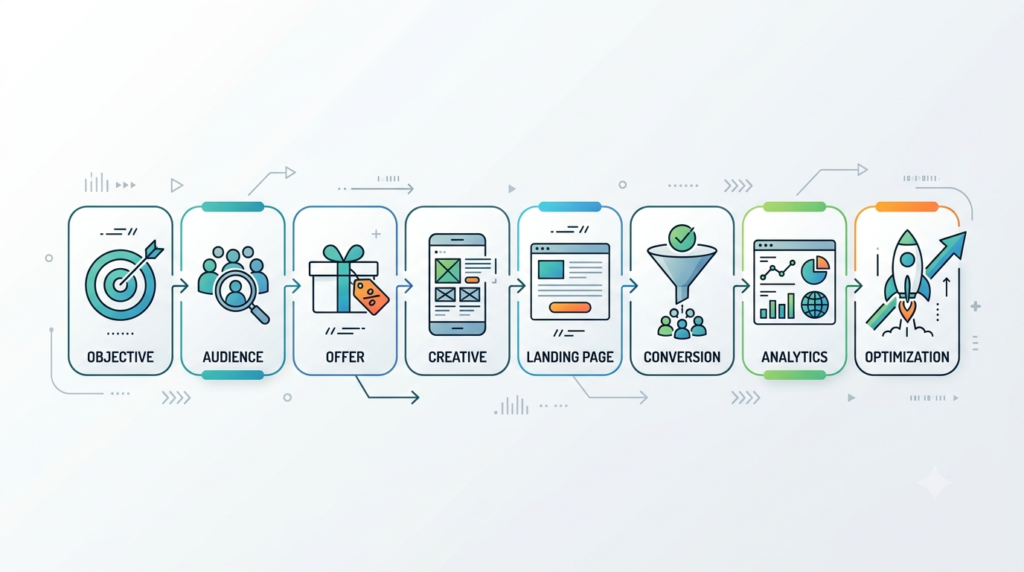
Audience → Brand → Content → Campaign → Website → Landing Page → Conversion → Analytics → Optimization
This is why campaign planning acts as a backbone for marketing entities.
A beautiful website without traffic has limited reach.
Traffic without relevant visitors has limited value.
Leads without follow-up can be wasted.
Sales without tracking cannot be properly evaluated.
Analytics without consistent campaign naming can become difficult to interpret.
A properly structured campaign connects these elements into one measurable system.
A Simple 100-Point Campaign Optimization Framework
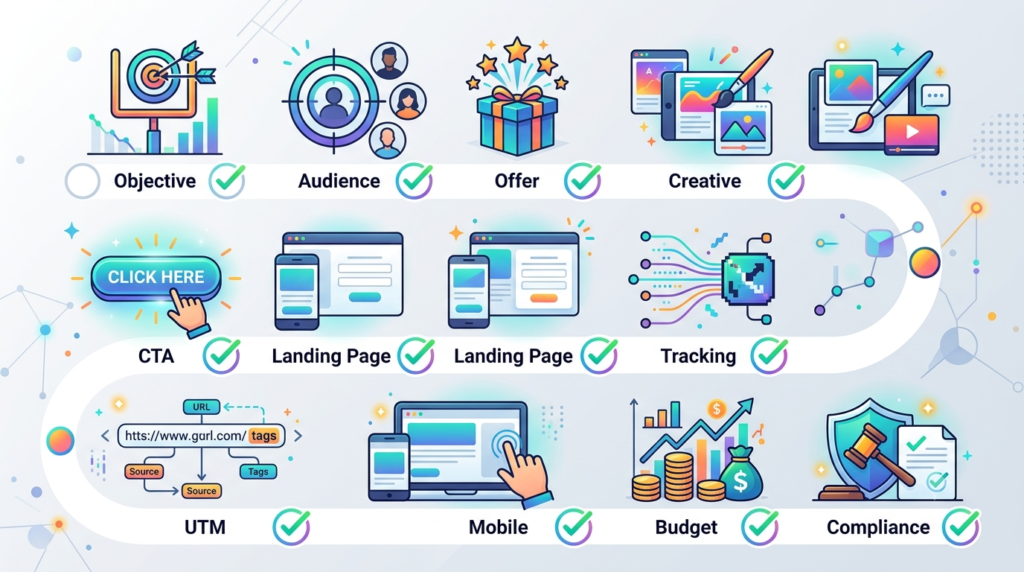
Use this checklist before launch:
- 10 points: Clear campaign objective
- 10 points: Defined target audience
- 10 points: Strong and relevant offer
- 10 points: Appropriate creative
- 10 points: Clear CTA
- 10 points: Relevant landing page
- 10 points: Conversion tracking
- 10 points: UTM/campaign naming
- 5 points: Mobile testing
- 5 points: Budget and schedule
- 5 points: Compliance check
- 5 points: Final link and form testing
Total = 100 points
A 99/100 or 100/100 checklist score does not guarantee campaign success. It means the campaign has been checked against the setup criteria. Actual performance still depends on the audience, offer, market, creative, platform, competition, budget, and user behavior.
Frequently Asked Questions
1. What is the most important precaution when running a campaign?
The most important starting point is defining a clear objective. Your audience, creative, bidding or optimization approach, landing page, and measurement should support that objective.
2. What should I check before launching a campaign?
Check the objective, audience, offer, creative, CTA, landing page, links, tracking, budget, schedule, mobile experience, and platform requirements.
3. Why is conversion tracking important?
Conversion tracking helps you understand whether users completed valuable actions after interacting with your campaign. Without reliable measurement, campaign optimization becomes much harder.
4. What is the difference between a traffic campaign and a sales campaign?
A traffic campaign is generally designed to bring visitors to a destination, while a sales or conversion campaign focuses on a valuable action such as a purchase. The exact objectives and options depend on the advertising platform.
5. Should beginners change a campaign every day?
Not necessarily. Making frequent major changes can make it difficult to understand what caused performance changes. Use the platform’s available data and make controlled adjustments.
6. What are UTM parameters?
UTM parameters are campaign-tracking values added to URLs so analytics tools can identify information such as the source, medium, campaign, term, or content.
7. Why can a campaign get clicks but no sales?
Possible reasons include poor audience fit, weak offer, unclear landing page, pricing or checkout friction, incorrect tracking, or a mismatch between the advertisement and the destination.
8. How often should I optimize a campaign?
There is no universal schedule. Review performance according to the campaign type, available data, budget, conversion volume, and platform learning requirements rather than making changes simply because a certain number of days has passed.
9. What is the biggest beginner mistake?
Launching without a clear objective and reliable tracking. If you do not know what action you are trying to generate or cannot measure it, optimization becomes guesswork.
10. Can one campaign use multiple goals?
It depends on the platform and campaign type, but as a planning principle, keeping the primary objective clear makes campaign structure and measurement easier. Google specifically recommends structuring campaigns around objectives.
Final Thoughts
The biggest campaign mistake beginners make is trying to optimize everything at once.
Instead, build a simple system:
Set the objective → Understand the audience → Create the offer → Build the campaign → Check tracking → Launch → Measure → Improve.
The goal is not simply to get more clicks, impressions, or followers.
The goal is to create a campaign where every important element has a purpose and can be measured.
When you treat precautions as part of campaign strategy rather than as a final checklist, you reduce avoidable mistakes and create a stronger foundation for continuous optimization.