
7 Powerful YouTube Content Formats for Fast Growth in 2026
Creating a YouTube channel is easier when you understand YouTube content formats. A content format is the structure or style you use to present information, entertainment, education, or a story in a video. Choosing the right format can make your channel more consistent, useful, and easier for viewers to understand.
For beginners, the biggest challenge is often not recording a video. It is deciding what type of video to create. Should you make a tutorial, review, interview, list video, Short, or case study?
Understanding different YouTube video formats, YouTube content types, and YouTube video ideas gives you a practical foundation for building a sustainable YouTube content strategy.
What Are YouTube Content Formats?
YouTube content formats are repeatable ways of structuring videos around a particular purpose, topic, or viewing experience.
For example, a creator teaching SEO could publish:
- Step-by-step tutorials
- Screen-recording demonstrations
- List videos
- Case studies
- Q&A videos
- YouTube Shorts
- Beginner guides
The subject may remain similar, but the format changes how the information is delivered.
A good format should make your content easier to plan, produce, understand, and repeat.
Why Are YouTube Content Formats Important?
Your content format is more than a creative choice. It can become the backbone of your entire YouTube content strategy.
A well-defined format helps connect several important elements:
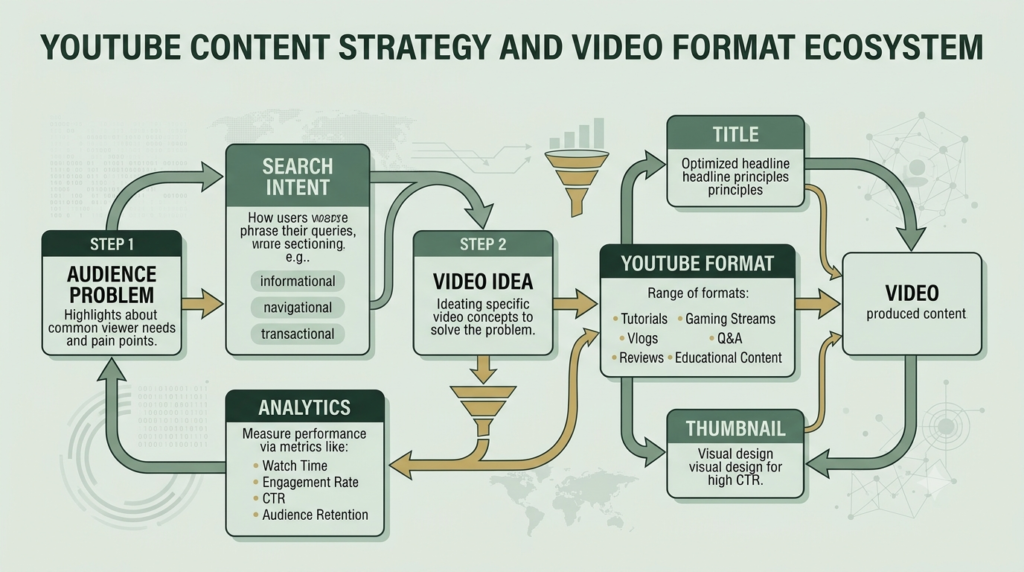
Topic → Search intent → Video idea → Title → Thumbnail → Script → Video structure → Viewer experience → Analytics → Future content
This is why content formats can act as a backbone for your broader YouTube entity and topic structure. Once Google and YouTube can consistently associate your channel with a clear subject area and connected content, your videos have a stronger opportunity to build topical relevance.
However, a format alone does not guarantee rankings or views. Quality, relevance, viewer satisfaction, packaging, and consistency still matter.
7 Main YouTube Content Formats
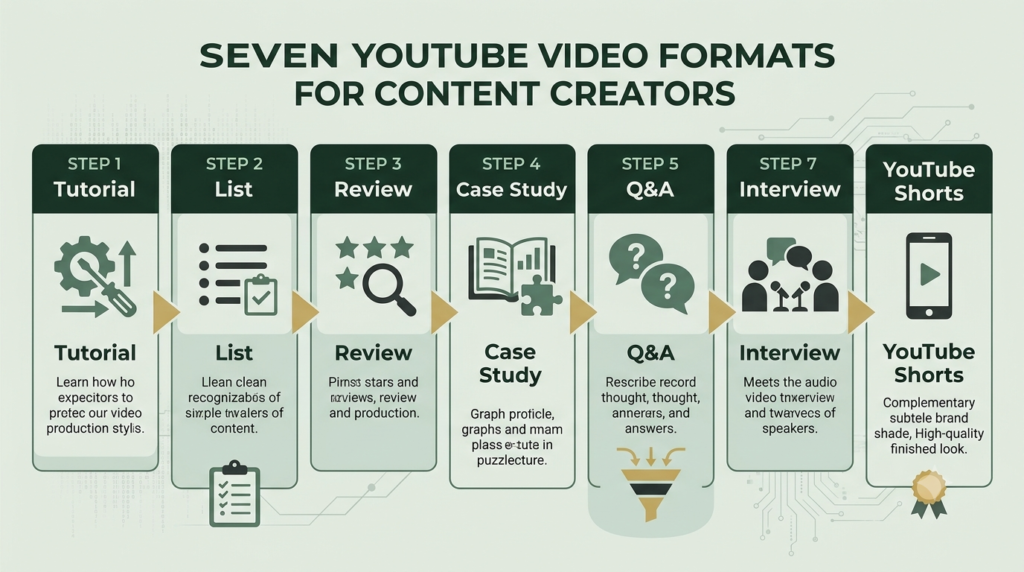
Here is a simple overview before we examine each format.
| Format | Best For | Example |
|---|---|---|
| Tutorial | Teaching a process | How to do YouTube keyword research |
| List video | Quick information | 7 YouTube SEO mistakes |
| Review | Evaluating products/tools | Best SEO tools for beginners |
| Case study | Showing real results | How a channel gained traffic |
| Q&A | Answering questions | YouTube SEO questions answered |
| Interview | Expert insights | Interview with an SEO expert |
| Shorts | Quick discovery content | 30-second SEO tip |
1. Tutorial Videos
Tutorials explain how to accomplish something step by step.
They are particularly useful for educational channels because viewers usually arrive with a specific problem.
Examples include:
- How to create a YouTube channel
- How to research YouTube keywords
- How to optimize a YouTube title
- How to design a thumbnail
A strong tutorial should have a clear beginning, logical steps, examples, and a useful conclusion.
Best practice: Tell viewers what they will learn early in the video and remove unnecessary steps.
2. List Videos
List videos organize information around a specific number.
Examples:
- 7 YouTube SEO tips for beginners
- 10 YouTube mistakes to avoid
- 5 free tools for YouTube research
This format works well because the structure is immediately understandable.
The number in your title should match the actual content. Avoid adding points simply to make a list longer.
3. Review Videos
Review videos help viewers evaluate a product, service, software tool, book, course, or other resource.
A useful review should include both strengths and limitations.
For example, instead of saying:
“This is the best SEO tool.”
Explain:
- What the tool does
- Who it is for
- Main features
- Advantages
- Limitations
- Pricing considerations
- Your conclusion
Honest reviews can be more useful than promotional content because they help viewers make informed decisions.
4. Case Study Videos
A case study tells the story of a specific result, experiment, project, or transformation.
For example:
“How I Improved a New YouTube Channel’s SEO: A Beginner Case Study”
A strong case study normally includes:
- Starting point
- Problem
- Strategy
- Actions taken
- Results
- Lessons learned
Use actual evidence whenever possible. Do not manufacture statistics or results.
5. Q&A Videos
Q&A videos answer questions from your audience.
You can find questions from:
- YouTube comments
- Search suggestions
- Community discussions
- Your own customer questions
- Frequently searched topics
Q&A content can also help you discover future YouTube video ideas.
If several people repeatedly ask the same question, it may deserve a dedicated video.
6. Interview Videos
Interviews bring another person’s experience, knowledge, or perspective into your channel.
An interview can include:
- Industry experts
- Entrepreneurs
- Creators
- Customers
- Researchers
- Specialists
Prepare questions before recording. Good interviews are not simply conversations; they should provide useful information to the viewer.
7. YouTube Shorts
Short-form videos are designed for quick consumption and discovery.
A Short can be:
- One useful tip
- A quick answer
- A short demonstration
- A surprising fact
- A common mistake
- A brief tutorial
Do not assume that every long video needs to become a Short. Instead, identify the strongest single idea and make it useful on its own.
How to Choose the Right YouTube Content Format
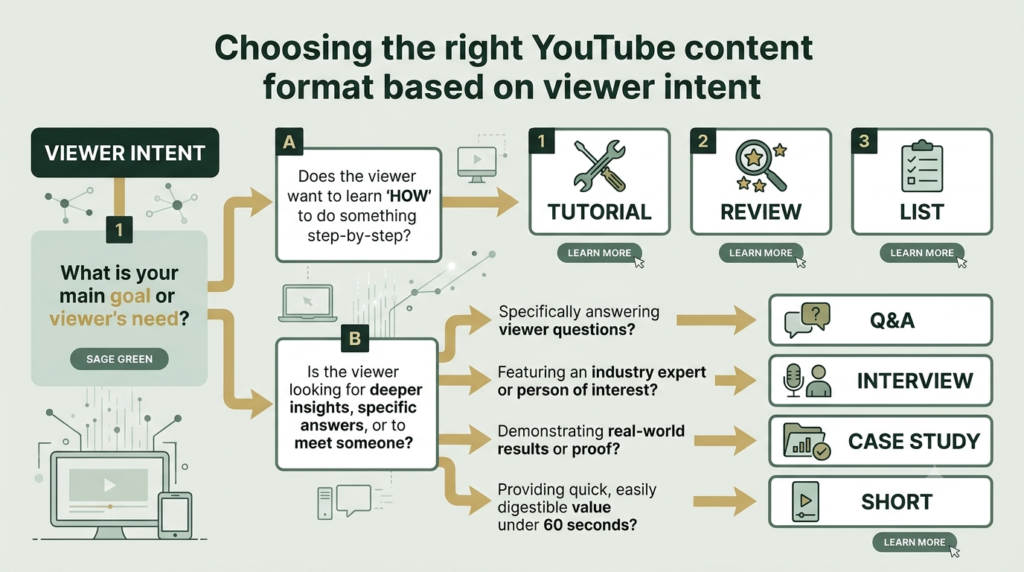
Start with your audience’s problem rather than the format.
Ask:
What does my viewer want to accomplish?
Then choose the format that delivers the answer most effectively.
For example:
- “How do I do this?” → Tutorial
- “Which option should I choose?” → Review
- “What are the best options?” → List
- “Did this strategy work?” → Case study
- “What does this mean?” → Q&A or explainer
- “I want expert advice.” → Interview
- “Give me one quick tip.” → Short
This approach prevents you from choosing formats simply because they are currently popular.
How to Create YouTube Content Formats Step by Step
Step 1: Define Your Main Topic
Choose a clear subject for your channel.
For example:
YouTube SEO for beginners
Step 2: Identify Viewer Intent
Determine whether your audience wants to learn, compare, solve, discover, or be entertained.
Step 3: Select a Format
Match the viewer’s intent with the appropriate format.
Step 4: Create the Video Structure
Prepare:
- Hook
- Introduction
- Main points
- Examples
- Practical takeaway
- CTA
Step 5: Optimize the Packaging
Create a relevant:
- Title
- Thumbnail
- Description
- Chapters where appropriate
Your title and thumbnail should accurately represent the video rather than promise something the video does not deliver.
Step 6: Publish and Study Performance
After publishing, review available YouTube Analytics data.
Look at metrics such as:
- Impressions
- Click-through rate
- Watch time
- Audience retention
- Traffic sources
- Returning viewers
Use these insights to improve your next videos.
How Content Formats Support Your YouTube Content Strategy
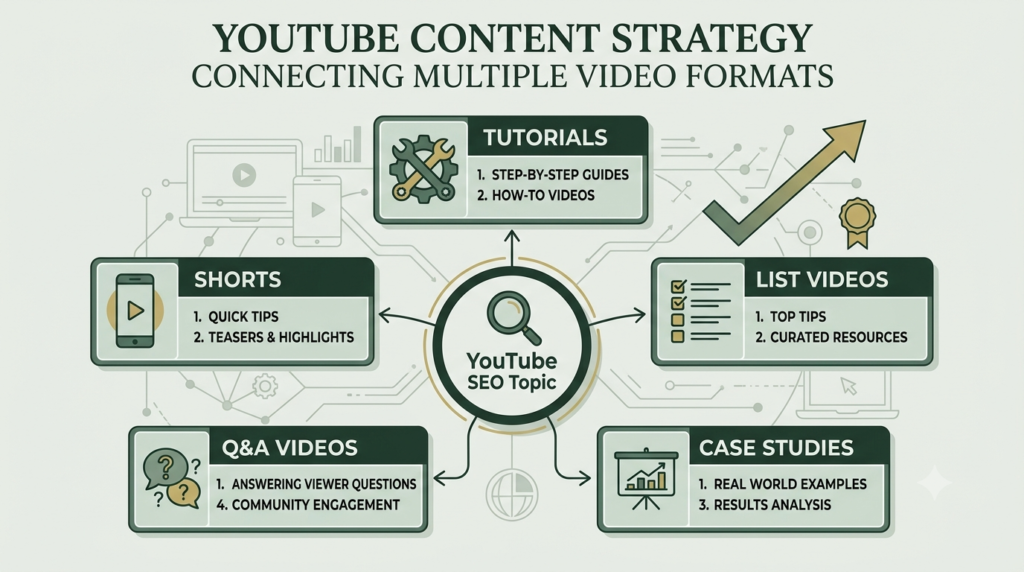
A channel becomes easier to manage when formats are organized into repeatable content systems.
For example:
Pillar: YouTube SEO
Format 1: Tutorials
Format 2: List videos
Format 3: Case studies
Format 4: Q&A
Format 5: Shorts
You can then connect related videos.
A tutorial about keyword research could lead viewers to a video about YouTube titles. That video could lead to a thumbnail optimization video.
This creates a connected content ecosystem instead of a collection of unrelated uploads
.
Common Mistakes to Avoid
Avoid these common problems:
- Using every format without a clear purpose
- Copying another creator’s style too closely
- Creating videos only because a format is trending
- Making titles that do not match the video
- Repeating the same information unnecessarily
- Ignoring audience questions
- Changing your topic constantly
- Focusing only on keywords instead of viewers
Your goal is not to use the maximum number of formats. Your goal is to find the formats that consistently help your specific audience.
Simple YouTube Content Format Formula
Use this formula when planning your next video:
Audience problem + Search intent + Suitable format + Strong topic + Useful delivery = Better content
For example:
Beginner wants to learn keyword research + informational intent + tutorial format + YouTube keyword research = useful educational video
This simple framework can make planning much easier.
Final Takeaway
YouTube content formats give creators a practical framework for turning ideas into repeatable videos.
You do not need to use all seven formats immediately. Start with two or three that match your audience and expertise. Then study the response, improve your packaging, and gradually build a content library.
The strongest YouTube channels are not necessarily those producing the most complicated videos. They are often the channels that consistently solve relevant problems in a format their audience understands.
If you are building a channel from scratch, start simple: choose one audience, one core topic, two or three useful formats, and create consistently.
Ready to plan your next video? Choose one viewer problem today and turn it into a tutorial, list, case study, Q&A, review, interview, or Short.
Frequently Asked Questions
What are YouTube content formats?
YouTube content formats are repeatable structures used to present videos, such as tutorials, reviews, list videos, case studies, interviews, Q&A videos, and Shorts.
Which YouTube content format is best for beginners?
Tutorials are often a practical starting point for beginners because they allow you to solve a specific problem step by step. However, the best format depends on your audience and topic.
How many YouTube content formats should I use?
Start with two or three formats. Once you understand which formats your audience responds to, you can expand your content mix.
Are YouTube Shorts a content format?
Yes. Shorts are a short-form video format designed for quick, vertical viewing and discovery on YouTube.
Do content formats improve YouTube SEO?
A consistent format can make content planning and topical organization easier, but it does not automatically improve rankings. YouTube SEO also depends on relevance, viewer satisfaction, engagement, and other signals.
Should every YouTube channel use the same formats?
No. A format should match the audience, topic, creator’s strengths, and purpose of the channel. What works for an educational channel may not work for an entertainment channel.