
7 Powerful Steps to Build an Engagement Campaign in 2026: Complete Beginner’s Guide
What Is an Engagement Campaign?
An engagement campaign is a marketing campaign designed to encourage people to interact with your brand, content, website, product, or community.
Instead of focusing only on immediate sales, an engagement campaign strategy
aims to create meaningful actions such as:
- Likes and reactions
- Comments
- Shares
- Saves
- Clicks
- Video views
- Poll responses
- Messages
- Website interactions
- Content downloads
- Sign-ups
- Repeat visits
For a beginner, the easiest way to understand an engagement campaign is this:
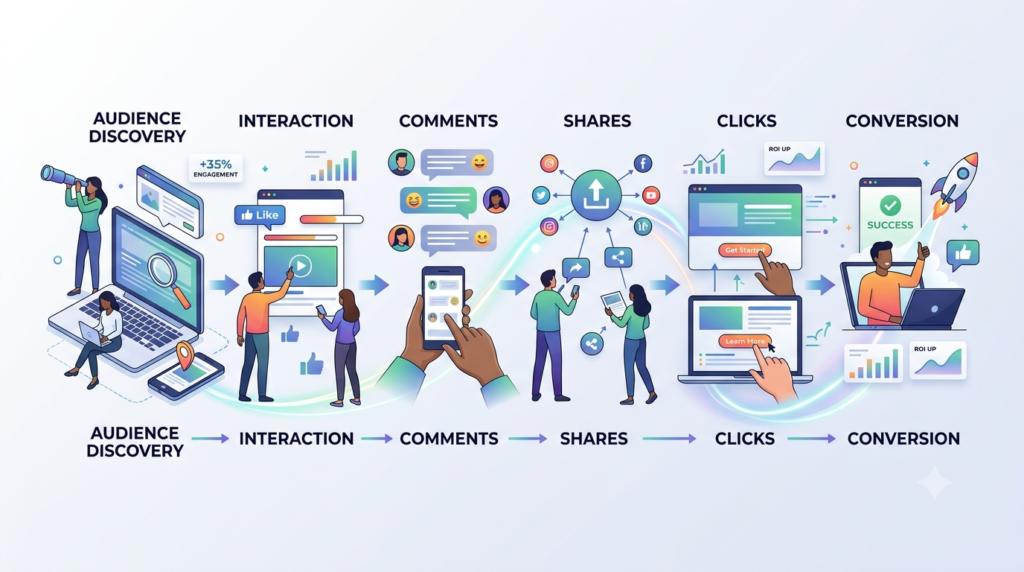
Reach gets attention. Engagement creates interaction. Conversion turns that interaction into business results.
This is why engagement can become the backbone connecting different parts of digital marketing. Your social media, content marketing, SEO, email marketing, website, advertising, and digital products can all benefit from understanding how people interact with your brand.
Google Analytics, for example, measures engagement through metrics such as engaged sessions, engagement rate, events, and average engagement time. An engaged session is generally one that lasts longer than 10 seconds, contains a key event, or includes at least two page or screen views.
Why Is an Engagement Campaign Important in 2026?
People are exposed to enormous amounts of online content every day. Simply publishing content is not enough.
An effective engagement campaign gives people a reason to stop, think, respond, save, share, click, or return.
Engagement can help you understand:
- What content your audience likes
- Which topics generate conversations
- Which products attract attention
- Which platforms produce meaningful interaction
- What questions your audience has
- Where people leave your website
- Which messages encourage action
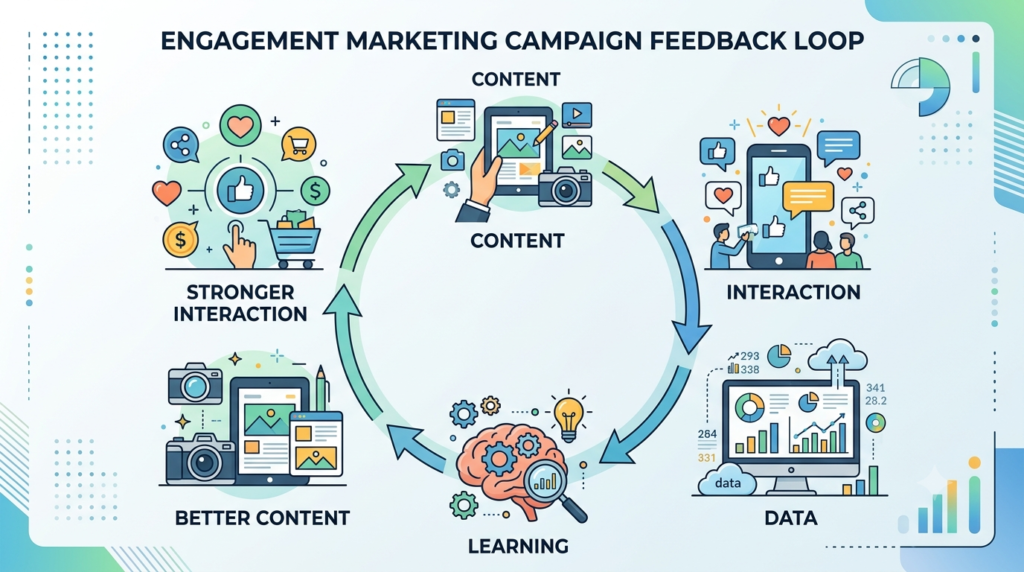
Think of engagement as a feedback loop.
Content → Interaction → Data → Learning → Better Content → Stronger Interaction
This makes engagement valuable even when the immediate goal is not a purchase.
7 Essential Elements of an Engagement Campaign
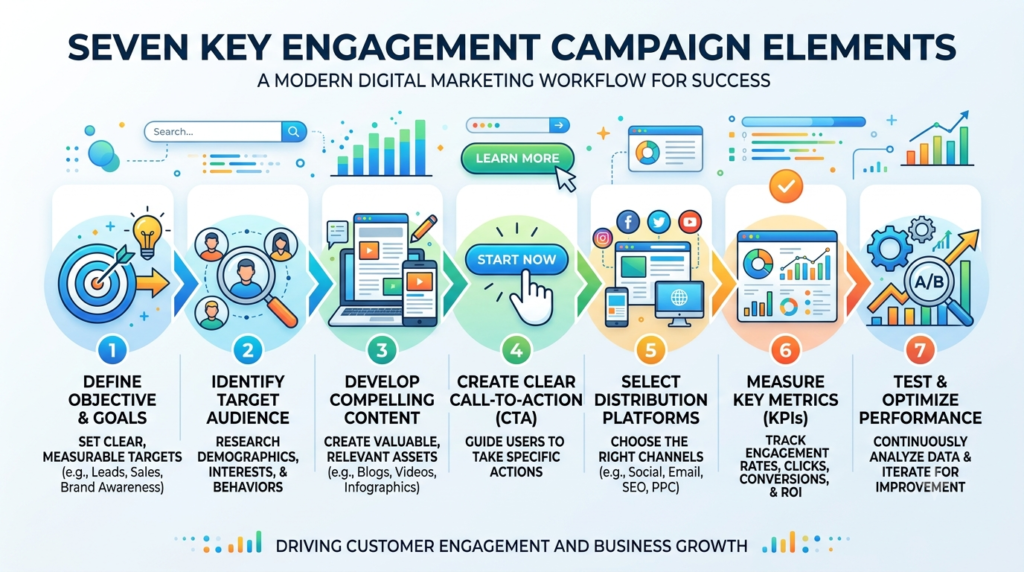
1. Clear Campaign Objective
Every engagement campaign needs one primary objective.
For example:
Goal: Increase meaningful interaction with a new digital product.
Instead of saying, “I want more engagement,” make the goal measurable:
“Increase saves, comments, shares, and product-page visits over the next 30 days.”
Your objective determines the content, audience, call to action, and metrics you should monitor.
How to correct it
If your campaign has several unrelated goals, simplify it.
Choose one main objective and two or three supporting metrics.
2. Defined Target Audience
Your content should be created for a specific audience rather than “everyone.”
Define:
- Age group
- Location
- Interests
- Problems
- Goals
- Buying behaviour
- Preferred platform
- Common questions
For example, a startup marketing campaign could target founders who need affordable digital marketing support.
A digital-product campaign could target people interested in budgeting, productivity, personal development, or online income.
How to correct it
If your posts receive views but very little interaction, check whether the message actually matches the audience’s needs.
3. Valuable and Interactive Content
Content is the heart of an engagement campaign Strategy.
Use different formats such as:
- Educational carousels
- Short-form videos
- Infographics
- Questions
- Polls
- Checklists
- Before-and-after examples
- Mini tutorials
- Case studies
- Quizzes
- Stories
Do not make every post promotional.
A simple content balance can be:
Teach → Help → Ask → Entertain → Promote
This makes your engagement marketing campaign feel more human instead of turning every interaction into a sales pitch.
4. Strong Call to Action
A call to action tells people what to do next.
Examples include:
- “Save this checklist.”
- “Which strategy would you try first?”
- “Comment with your biggest challenge.”
- “Share this with a startup founder.”
- “Visit the guide to learn more.”
- “Download the free checklist.”
A good CTA should match the purpose of the content.
Weak CTA
“Let us know your thoughts.”
Stronger CTA
“What is the biggest challenge you face when creating content? Comment below.”
The second CTA gives people a specific reason to respond.
5. Right Platform and Distribution
The same content does not necessarily perform equally well everywhere.
Your Social media engagement campaign can use:
- YouTube
- Website content
Choose platforms based on where your audience actually spends time.
For example, Pinterest may work well for searchable visual content, while Instagram can support interactive posts, Stories, and community conversations.
The important principle is not to publish everywhere simply because you can.
Choose the platform → adapt the content → measure the response.
6. Tracking and Campaign Engagement Metrics
You cannot improve an engagement marketing campaign if you do not measure it.
Useful campaign engagement metrics include:
| Metric | What It Tells You |
|---|---|
| Reach | How many people saw the content |
| Impressions | How often content was displayed |
| Likes/Reactions | Basic response |
| Comments | Conversation level |
| Shares | Content usefulness or relevance |
| Saves | Long-term content value |
| Clicks | Interest in the next step |
| Engagement Rate | Interaction relative to audience/exposure |
| Average Engagement Time | How long users actively engage |
| Key Events | Important actions completed |
Google Analytics defines engagement rate as the percentage of sessions that were engaged sessions. It also provides metrics such as engaged sessions, event count, average engagement time, and key events.
How to correct poor metrics
If reach is high but engagement is low:
Improve the message and CTA.
If engagement is high but clicks are low:
Improve the offer, CTA, or landing-page connection.
If clicks are high but conversions are low:
Check the landing page, offer, pricing, trust signals, and checkout experience.

7. Continuous Testing and Optimization
A successful engagement campaign metrics should not be created once and forgotten.
Test different:
- Headlines
- Images
- Hooks
- CTAs
- Content formats
- Posting times
- Topics
- Offers
- Audience segments
For example:
Post A: “5 SEO mistakes beginners make”
Post B: “Are these 5 SEO mistakes hurting your website?”
Both address a similar topic but use different hooks.
Measure which version creates better interaction.
Then use what you learn to improve the next campaign.
How to Create an Engagement Campaign Step by Step
Follow this simple beginner workflow:
Step 1: Choose your objective
Decide exactly what you want people to do.
Step 2: Define your audience
Identify their problem, desire, interest, and preferred platform.
Step 3: Choose one campaign theme
Keep the message focused.
Step 4: Create 5–10 pieces of content
Mix educational, interactive, inspirational, and promotional content.
Step 5: Add a specific CTA
Ask for one meaningful action.
Step 6: Publish consistently
Give your audience enough content to interact with.
Step 7: Track campaign engagement metrics
Review reach, interactions, clicks, engagement rate, and important actions.
Step 8: Improve what is weak
Do not immediately abandon the campaign. Identify the weak element first.
Step 9: Repeat what works
Create new variations around successful topics and formats.
How to Optimize Your Engagement Campaign to 99/100 SEO
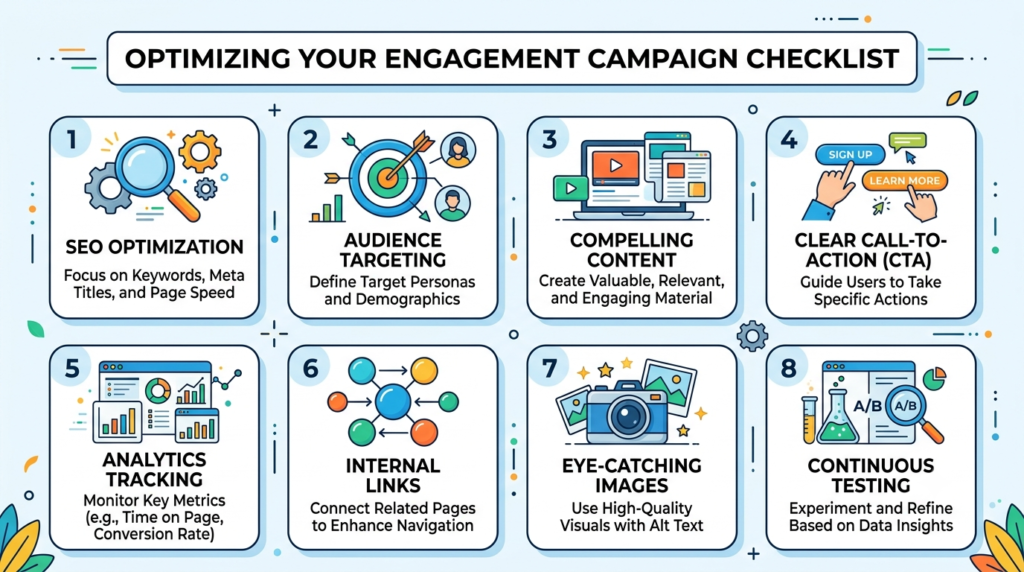
If you are publishing an engagement campaign guide on your website, use this SEO checklist.
On-Page SEO
- Put the primary keyword in the SEO title.
- Include it naturally in the introduction.
- Use it in at least one heading where appropriate.
- Include the keyword in the slug.
- Write a compelling meta description.
- Use short paragraphs.
- Use H2 and H3 headings.
- Add relevant internal links.
- Add authoritative external links.
- Optimize image filenames.
- Add descriptive image alt text.
- Add FAQ content.
- Add structured data where appropriate.
- Use natural keyword variations.
- Avoid keyword stuffing.
Google explains that structured data can help Google understand page content and can support eligible rich search features.
Content Quality
For a strong 99/100-style optimization target, make sure the article:
Answers the search intent → explains the topic → provides actionable steps → includes examples → answers common questions → gives the reader a next step.
Do not sacrifice readability simply to increase a plugin score.
Why Engagement Is the Backbone of the Digital Marketing Entity
Engagement connects many digital marketing activities.
Consider this journey:
SEO → Website Visit → Content Engagement → Social Interaction → Lead → Conversion → Customer → Repeat Engagement
A person may first discover your business through Google.
They may then read your blog, visit your service page, follow your social media account, save your content, join your email list, and eventually purchase.
Every interaction provides information about the relationship between the audience and your brand.
That is why engagement should not be treated as a vanity metric.
It is a signal of audience behaviour.
However, engagement alone does not guarantee sales. High engagement can exist without conversions, so engagement should always be connected to the wider business objective.
Simple Example of an Engagement Marketing Campaign
Imagine you sell a ₹500 digital savings challenge.
Your campaign could look like this:
Day 1: Educational post — “Why small savings matter.”
Day 2: Poll — “Can you save ₹500 this month?”
Day 3: Carousel — “5 simple ways to save ₹100.”
Day 4: Question — “What usually stops you from saving?”
Day 5: Practical tip — “Try the 24-hour spending rule.”
Day 6: Customer/problem-focused post — “Make your savings visible.”
Day 7: Product post — Introduce the ₹500 Savings Challenge.
The campaign builds interaction before making the offer.
That is the practical purpose of an engagement campaign: create relevance first, then encourage the next meaningful action.
Final Engagement Campaign Checklist
Before publishing, ask:
☐ Is the objective clear?
☐ Is the target audience specific?
☐ Does the content solve a real problem?
☐ Is the campaign message consistent?
☐ Does every post have a useful CTA?
☐ Am I using the right platform?
☐ Am I tracking meaningful metrics?
☐ Have I added internal links?
☐ Have I added authoritative external references?
☐ Are images optimized?
☐ Is the primary keyword used naturally?
☐ Are secondary keywords distributed naturally?
☐ Is the introduction strong?
☐ Are headings easy to scan?
☐ Is the FAQ section useful?
☐ Is structured data implemented correctly?
If you can answer “yes” to these questions, your campaign has a strong foundation for both users and search engines.
Frequently Asked Questions
What is an engagement campaign?
An engagement campaign is a marketing campaign designed to encourage meaningful interactions between an audience and a brand, such as comments, shares, saves, clicks, views, messages, or other actions.
What is the main goal of an engagement campaign?
The main goal is to increase meaningful audience interaction. The exact objective can vary from increasing conversations and content engagement to encouraging website visits or other actions.
What is an engagement campaign strategy?
An engagement campaign strategy is the plan used to define the audience, objective, content, platform, CTA, measurement system, and optimization process for an engagement-focused campaign.
What are important campaign engagement metrics?
Important metrics can include reach, impressions, engagement rate, comments, shares, saves, clicks, engaged sessions, average engagement time, events, and key events.
Is engagement more important than sales?
They serve different purposes. Engagement measures interaction, while sales measure a business outcome. A strong marketing system connects engagement with the actions that support the business objective.
How long should an engagement campaign run?
There is no universal duration. A campaign should run long enough to collect meaningful data, while allowing you to test and improve its content, audience, and messaging.
How can I increase engagement?
Create useful content, understand your audience, ask specific questions, use clear CTAs, test different formats, respond to people, and use performance data to improve future content.
Can an engagement campaign help SEO?
Indirectly, engagement can support a stronger marketing ecosystem by helping you understand audience interests, content performance, and user behaviour. However, social engagement itself should not be treated as a guaranteed direct Google ranking factor.
Conclusion
An engagement campaign is more than collecting likes and comments. It is a structured way to understand how people respond to your brand and content.
Start with one clear objective, understand your audience, create useful content, encourage meaningful interaction, track the right metrics, and continuously improve.
Remember:
Reach gets attention. Engagement builds connection. Conversion creates business results.
The strongest campaign is not necessarily the one with the most activity. It is the one where the activity helps you understand your audience and move them toward a meaningful next step.